Pinyin: Shexiang
Aliases
Yixiang, Qixiang, Dangmenzi, Shengxiang, Sheqixiang.
Source
Cervidae animal Moschus berezovskiiMoschus berezovskiiFlerov, Moschus chrysogasterMoschussifanicusPrzewalski or Moschus moschiferusMoschusmoschiferusLinnaeus mature male body scent gland dry secretion.
Distribution
Mainly distributed in the Northwest, Northeast, North China, Central China, and Southwest regions. Mainly produced in the northwestern and northeastern areas.
Harvesting and Processing
Wild musk deer are mostly hunted from winter to the following spring. After capture, the musk sac is cut off and dried in the shade, commonly known as "crude musk sac." The musk sac is then opened, and the outer sac is removed, yielding what is commonly called "musk kernel." For domesticated musk deer, the musk kernel is directly extracted from the musk sac, dried in the shade, or sealed and dried in a drying apparatus.
Medicinal Properties
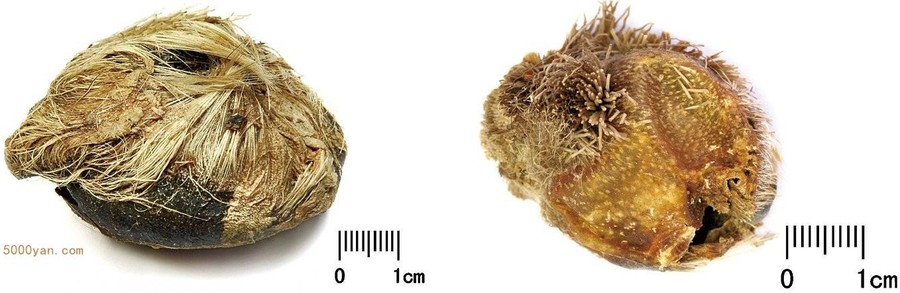
1. Moschus in shell: It is a flat-round or sub-oval sac-like body, 3-7 cm in diameter and 2-4 cm in thickness. The opening surface is leathery, brown, slightly flat, densely covered with short white or grayish-brown hairs arranged around the center from both sides, with a small sac opening in the middle. The other side is a brownish-purple skin membrane, slightly wrinkled, occasionally showing muscle fibers, with slight elasticity. When cut open, the middle layer membrane is brown or grayish-brown, semi-transparent, and the inner layer membrane is brown, containing granular and powdery Moschus kernels, a small amount of fine hairs, and detached inner layer membrane (commonly known as "silver skin").
2. Moschus (Shexiang): Wild material is soft, greasy, and loose; the irregularly round or granular pieces are commonly referred to as "Dangmenzi", with a surface that is mostly purplish-black, greasy and glossy, with slight pitting, and a cross-section that is dark brown or yellowish-brown; the powdered form is mostly brownish-brown or yellowish-brown, with a small amount of shed inner membrane and fine hairs. Cultivated material appears as granules, short strips, or irregular masses; the surface is uneven, purplish-black or dark brown, oily, slightly glossy, with a small amount of hairs and shed inner membrane. The odor is strong, rich, and distinctive, and the taste is slightly pungent, slightly bitter, and salty.
Chemical Constituents
This product contains muscone, normuscone, musk alcohol, musk pyran, musk pyridine, hydroxy musk pyridine-A, hydroxy musk pyridine-B, and others. It also contains cholest-4-en-3-one, cholesterol and its esters, testosterone, estradiol, and 5α- Androstane-3,17-dione and 11 other androstane derivatives. Also contains proteins and amino acids.
Pharmacology
It has strong anti-inflammatory effects, and when used in combination with Niuhuang (Calculus Bovis), it exhibits a synergistic anti-inflammatory action; it exerts a dual effect on the central nervous system, with excitation at low doses and inhibition at high doses, enhances tolerance to hypoxia, increases hepatic drug-metabolizing enzyme activity, and for the cardiovascular system, it increases myocardial contractility, accelerates heart rate, lowers blood pressure, reduces myocardial oxygen consumption, and protects ischemic myocardium; it has anticoagulant effects; it stimulates the uterus and exhibits androgenic-like effects; it possesses anti-tumor activity and enhances immune function; it also has antibacterial and anti-ulcer effects.
Properties and Channel Entry
Acrid, warm. Enters the Heart and Spleen channels.
Functions and Indications
Opens the orifices, awakens the Spirit, activates Blood circulation, unblocks the channels, reduces swelling, and alleviates pain. Used for: febrile disease with clouded Spirit, Wind-stroke with Phlegm syncope, Qi depression with sudden collapse, miasmic coma, amenorrhea, abdominal masses, difficult labor with stillbirth, chest Bi with Heart pain, sudden epigastric and abdominal pain, traumatic pain from falls, Bi pain with numbness, abscesses, scrofula, and sore throat.
Dosage and Administration
Internal use: prepared into pills or powders, 0
Precautions and Contraindications
Contraindicated in cases of collapse syndrome; this product, whether taken internally or applied externally, can induce abortion, so it is contraindicated during pregnancy.
Prescriptions
1. For wind-strike with unconsciousness: Shexiang 6 g, grind into powder, add into 60 g of clear oil, mix well and administer orally. (Jisheng Fang) 2. For phlegm confusing the heart orifice: Shexiang 0.3 g, Yuezhu, Yazao, Mingfan, Xiongjing each 3 g. Grind the above together evenly, store tightly, take 1.5 g per dose. (Yangke Yibian) 3. For chest impediment (chest Bi): Shexiang (ground) 30 g, Niuhuang (ground) 15 g, Xijiao (shaved) 0.3 g. Grind the three ingredients into a powder. Take 6 g per dose, adjusted with warm wine, taken on an empty stomach, once at noon and once before bed. (Shengji Zonglu, Shexiang San) 4. For traumatic injury with Qi closure: Yazao, Beixixin, Bingpian, Shexiang equal parts. Grind into powder, blow into the nose. (Yichao Leibian, Chuiyao Fang) 5. For flank pain from Qi injury: Shexiang 6 g, Xiongjing 1.5 g. Grind together into a fine powder and place in a medicine bottle. Whenever someone suffers from Qi injury, apply the powder into the eye socket. (Shangke Buyao, Shanqi San) 6. For toothache: Shexiang the size of a soybean, Badou 1 kernel, Xixin powder 15 g. Grind the above together finely, mix with date pulp to form pills the size of millet grains. Wrap one pill in new silk, bite down on it at the painful area; if saliva forms, spit it out; if there is a cavity, insert one pill into it. (Shenghui Fang, Shexiang Wan)