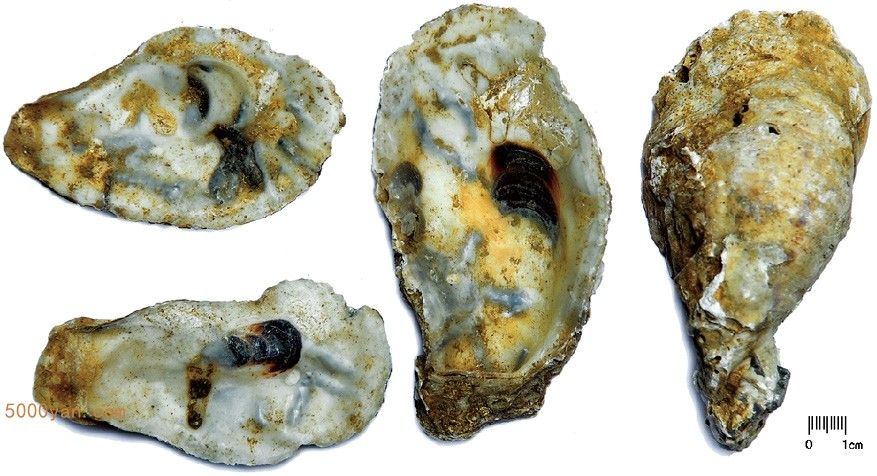
Pinyin: Muli
Aliases
Lìgé, Mǔgé, Hǎilìzǐké, Hǎilìzǐpí
Source
Oyster family animal, Pacific oysterOstrea gigas1. Thunberg: Oyster (Muli) from Dalian Bay.Ostrea talienwhanensisCrosse or Ostrea rivularis (freshwater oyster).Ostrea rivularisGould's shell.
Distribution
It inhabits areas near the low tide line to depths of about 7 m in the vicinity of river estuaries
Harvesting and Processing
Can be caught throughout the year, remove the meat, wash clean, and dry in the sun.
Chemical Constituents
Contains calcium carbonate, calcium phosphate, and calcium sulfate, as well as magnesium, aluminum, silicon, and iron oxide.
Pharmacology
It has sedative and local anesthetic effects, and can inhibit neuromuscular excitation, resist experimental gastric ulcer injury, and enhance immune function.
Properties and Channel Entry
Salty, slightly cold. Enters the Liver, Gallbladder, and Kidney channels.
Functions and Indications
Sedates and calms the Spirit, subdues Yang and tonifies Yin, softens hardness and dissipates masses. Used for palpitations and insomnia, dizziness and tinnitus, scrofula and phlegm nodules, and abdominal masses. Calcined Oyster Shell (Duan Muli) astringes and consolidates, controls acid and alleviates pain; used for spontaneous sweating and night sweats, nocturnal emissions and spermatorrhea, uterine bleeding and leukorrhea, and stomach pain with acid reflux.
Dosage and Administration
Oral: Decoct 15-30 g, decoct first; or take in pill or powder form. External: Apply appropriate amount, grind into powder and sprinkle or mix for topical application. Unless calcined for astringent and consolidating effects, use raw in all other cases.
Precautions and Contraindications
Taking this product in large doses or for prolonged periods may easily cause constipation and indigestion.
Prescriptions
1. For wind deficiency with spontaneous sweating and shortness of breath: *Muli* (calcined oyster shell) 30 g, *Baizhu* (Atractylodes macrocephala) 30 g, *Fangfeng* (Saposhnikovia divaricata, root removed) 30 g. Grind the above ingredients into a fine powder. Take 6 g with warm water at any time, regardless of meals. For aversion to wind, increase *Fangfeng*; for shortness of breath, add *Baizhu*; for profuse sweating and facial edema, increase *Muli*. (From *Shenghui Fang*: *Muli San*). 2. For leukorrhea (white vaginal discharge): *Muli* powder, *Aiye* (Artemisia argyi), and *Huixiang* (Foeniculum vulgare) 30 g each, plus half a *he* of *Nuomi* (glutinous rice, stir-fried until cooked). Grind into a powder, form into pills with water, each pill the size of *Wutong* seeds. Take 50 pills on an empty stomach with warm rice water. (From *Danliao Fang*). 3. For severe loose stools following warm disease treatment, with a still rapid pulse: Raw *Muli* 60 g. Grind finely, decoct in eight cups of water, reduce to three cups, and take warm in three divided doses. (From *Wenbing Tiaobian*: *Yijia Jian*). 4. For epistaxis (nosebleed) after recovery from a serious illness: *Muli* 3 g, *Shigao* (gypsum) 1.5 g. Grind into powder, take one *fangcunbi* (approximately 2-3 g) with wine, 3-4 times daily. Alternatively, form into pills the size of *Wutong* seeds with honey and take. (From *Zhouhou Fang*). 5. For heart pain due to excess: Use single-ingredient *Muli*, calcined into powder, take 6 g with wine. (From *Danxi Xinfa*). 6. For hyperacidity: *Muli* and *Haipiaoxiao* (cuttlefish bone) 15 g each, *Zhebeimu* (Fritillaria thunbergii) 12 g. Grind together into a fine powder. Take 9 g each time, 3 times daily. (From *Shandong Zhongcaoyao Shouce*). 7. For purpura (purple spots on skin): *Muli* and *Danfan* (chalcanthite) 15 g each. Use both raw ingredients, grind into a powder. Mix with vinegar and apply topically to the affected area. (From *Shengji Zonglu*: *Muli San*).