Pinyin: Biejia
Aliases
Shangjia, Bieke, Jiayu Ke, Tuanyuke, Biegai Zi.
Source
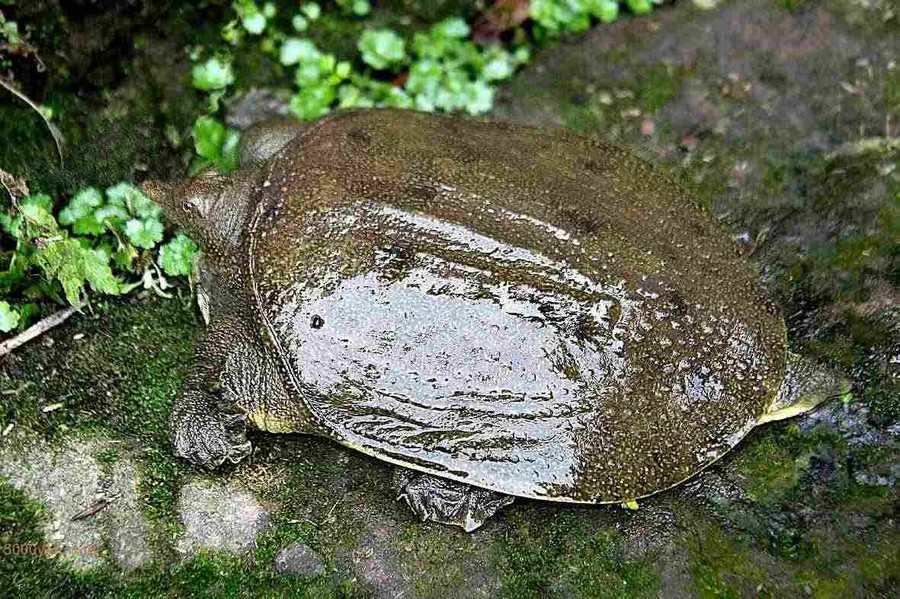
Animal of the Trionychidae family (softshell turtle)Trionyx sinensisWiegmann's carapace.
Distribution
Lives in lakes, rivers, ponds, and reservoirs. It is widely distributed throughout China except in Xinjiang, Ningxia, Qinghai, and Tibet where it has not been reported.
Harvesting and Processing
It can be captured year-round, with autumn and winter being the most common seasons. After capture, kill the animal, place it in boiling water until the hard skin on the carapace can be peeled off, then remove, peel off the carapace, remove any remaining flesh, and dry in the sun.
Medicinal Properties
This specimen is oval or ovate in shape, with a raised dorsal surface, measuring 10-15 cm in length and 9-14 cm in width. The outer surface is dark brown or blackish-green, slightly lustrous, with fine reticulate wrinkles and grayish-yellow or grayish-white spots. There is one longitudinal ridge in the center, with 8 symmetrical transverse concave lines on each side. After the outer skin is shed, a serrated interlocking seam can be seen. The inner surface is off-white, with a prominent vertebral column in the middle, the neck bones curved inward, and 8 ribs on each side protruding beyond the edge. The texture is hard. Odor: slightly fishy; Taste: bland.
Chemical Constituents
This product contains bone collagen, calcium carbonate, calcium phosphate, iodine, etc. It also contains various amino acids and inorganic elements.
Pharmacology
Has the effects of enriching the Blood and exhibiting anti-tumor activity.
Properties and Channel Entry
Salty, slightly cold. Enters the Liver and Kidney channels.
Functions and Indications
Nourishes Yin and subdues Yang, reduces fever and eliminates steaming bone disorder, softens hardness and dissipates masses. Used for Yin-deficiency fever, bone-steaming consumptive fever, Yin-deficiency with Yang hyperactivity, dizziness and vertigo, internal stirring of deficiency Wind, amenorrhea, and abdominal masses.
Use
Internal use: decoct 3-10 g.
Oral: decoct 10-30 g, decoct first; prepare as concentrated decoction; or prepare pills or powder. External use: appropriate amount, calcined preserving property, grind into powder for application or mix for topical application. For nourishing Yin and subduing Yang, use raw; for softening hardness and dissipating masses, use vinegar-fried.
Precautions and Contraindications
Contraindicated in cases of Spleen and Stomach deficiency-cold with reduced appetite and loose stools, as well as during pregnancy.
Prescriptions
1. For chronic cough with lung deficiency leading to consumptive disease, hematemesis, and hemoptysis: Biejia (vinegar-fried) and Ejiao (stir-fried) 30 g each, Lujiaoshuang 10 g, Gancao 15 g. Grind into powder. Take 9 g each time, decoct with one cup of water and one 3-cun-long leek stalk until 80% of the liquid remains, take after meals. (From Gujin Yitong) 2. For chronic malaria and miasmic disorders: Biejia 90 g, fry with suet until yellow, grind into powder. At the onset of the attack, take 6 g with warm wine. (From Shenghui Fang) 3. For abdominal masses: Biejia, Helelipi, and Ganjiang in equal parts. Grind into powder and form into pills. Take 30 pills on an empty stomach, followed by a second dose. (From Yaoxing Lun) 4. For pediatric epilepsy: Roast Biejia until yellow, pound into powder. Take 3 g, administer with milk. Alternatively, make into pills the size of small beans with honey. (From Zimu Milu) 5. For chronic hepatitis, hepatosplenomegaly, and elevated transaminases: Biejia 30 g, Danshen and Chuipencao 15 g each. Decoct Biejia first for 60 minutes, then add the other herbs, decoct in water. Take 1 dose daily, each dose decocted twice, once in the morning and once in the afternoon. (From Buyiyao Zhibing Yu Jianshen)