Pinyin: Xiongdan
Source
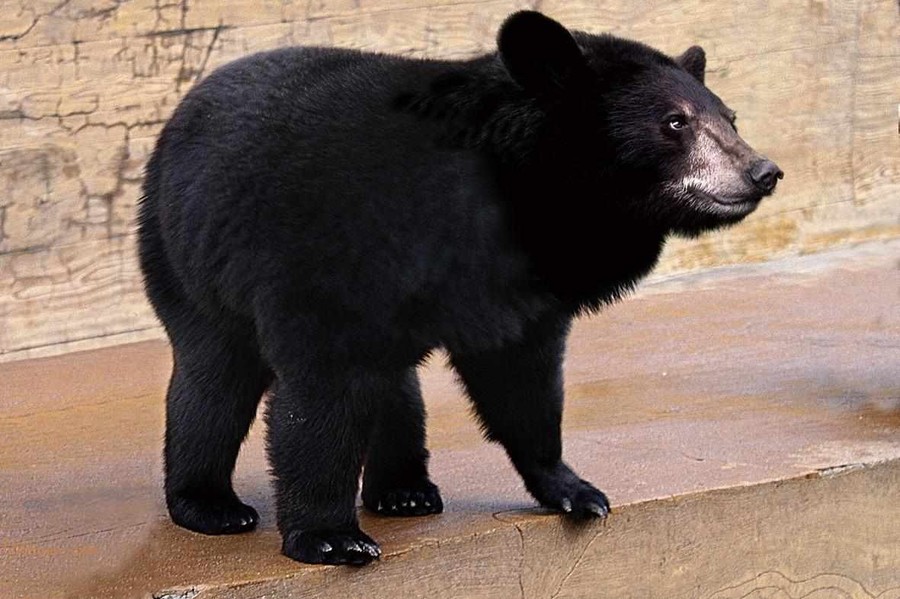
Bear family animal black bearSelenarctos thibetanusG. Cuvier and brown bearUrsus arctosThe dried gallbladder of Linnaeus.
Distribution
Distribution is extremely widespread, found in Northeast, North, Southwest, South China, as well as Shaanxi, Gansu, Qinghai, Anhui, Zhejiang, Jiangxi, Fujian, Taiwan, Tibet, and other regions.
Harvesting and Processing
After the gallbladder is removed, tie the cystic duct tightly, peel off the fat attached to the outside of the gallbladder, press it flat between wooden boards, and dry it in a ventilated place in the shade or in a lime container. China has developed the ability to artificially extract bear bile from live bears by surgically creating a gallbladder fistula to collect bile at regular intervals, which is then processed into bear bile powder for medicinal use.
Medicinal Properties
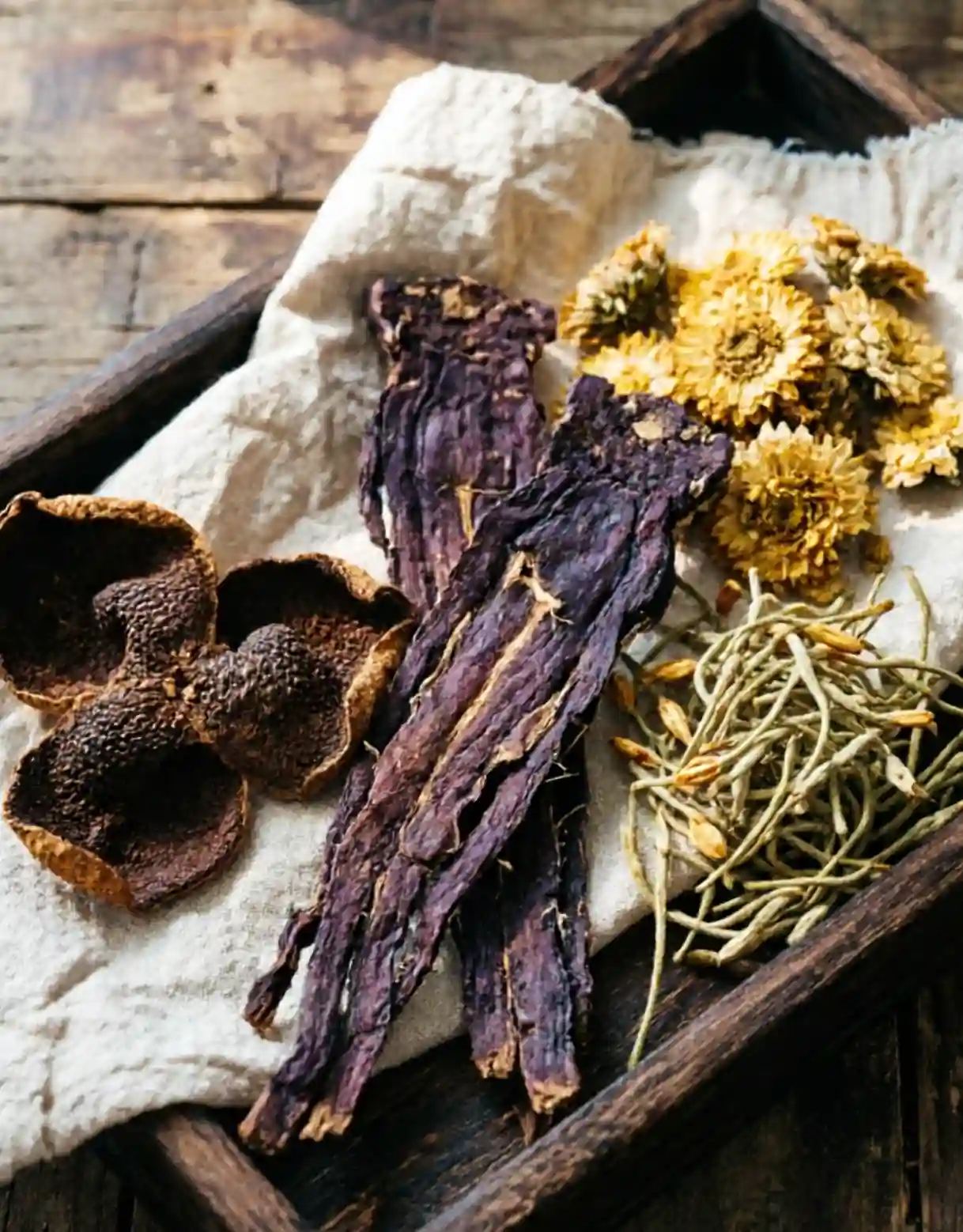
This product is oblong-ovoid in shape, narrow at the upper part and enlarged into a sac-like form at the lower part, measuring 10-20 cm in length and 5-10 cm in width. The surface is black, blackish-brown, or yellowish-brown, glossy, with slight wrinkles. Inside the sac, there is dried bile, commonly known as "Danren" (bile concentrate), which appears in block, granular, or powder form. The golden-yellow, transparent, amber-like, glossy, and brittle type is commonly called "Jindan" (golden bile) or "Tongdan" (copper bile); the black, hard and brittle or thick paste-like type is called "Modan" (ink bile) or "Tiedan" (iron bile); the yellowish-green, less glossy, and brittle type is called "Caihua Dan" (cauliflower bile). It has a faint, fragrant odor and an extremely bitter taste with a sticky sensation on the tongue.
Chemical Constituents
Contains alkali metal salts of bile acids, as well as cholesterol, bile pigments, tauroursodeoxycholic acid, a small amount of chenodeoxycholic acid, and cholic acid.
Properties and Channel Entry
Bitter, cold. Enters the Liver, Gallbladder, Heart, and Stomach channels.
Functions and Indications
Clears Heat and resolves toxicity, calms the Liver and improves vision, kills parasites and stops bleeding. Mainly indicated for Damp-Heat jaundice, Summer-Dampness diarrhea and dysentery, febrile disease with convulsions, red eyes with corneal opacity, throat obstruction, nasal erosion, furuncle, hemorrhoids and fistulae, infantile malnutrition, roundworm, and various types of bleeding.
Dosage and Administration
Internal use: prepared into pills or powder, 0.2-0.5 g. External use: appropriate amount, grind into powder for topical application or eye drops.
Precautions and Contraindications
Contraindicated in deficiency patterns. Incompatible with Fangji and Dihuang.
Prescriptions
1. For traumatic coma: Bear bile 1.5-3 g. Take with wine. (Guangxi Medicinal Animals) 2. For roundworm heart pain: Bear bile the size of a soybean. Take with water. (Waitai) 3. For infantile chancre sores: Bear bile 0.15 g. Dissolve in warm water and apply into the nose. (Shenghui Fang) 4. For nervous gastralgia: Grind bear bile into powder, take 3 times daily, 0.9 g each time, with boiled water. (Guangxi Medicinal Animals) 5. For hemorrhoids: Bear bile and borneol (ground fine) equal parts. Mix with water, apply to hemorrhoids with a cotton swab. (Guangxi Medicinal Animals) 6. For wind-dam toothache: Bear bile 9 g, borneol 1.2 g. Grind into powder, mix with pig bile and apply to affected area. (Shesheng Zhongmiao Fang) 7. For cholangitis, cholelithiasis, jaundice: Bear bile 0.5 g, turmeric 10 g, artemisia capillaris 15 g. Decoct in water, take 2 times daily. (Zhongguo Dongwu Yao) 8. For red eyes and nebula: Bear bile 0.3 g, coptis 3 g, borneol 0.9 g. Add 12 g cold water, mix well, store in a bottle for use. Apply frequently to affected area. Use with caution in pregnancy. (Guangxi Medicinal Animals)