Pinyin: Shuizhi
Aliases
Mazhi, Mahuangqi, Rouzuanzi, Mahuang.
Source
Leech family animal *Whitmania pigra* WhitmanWhitmania pigraWhitman, ShuizhiHirudo nipponicaThe dried whole body of Whitman.
Distribution
Distributed in lakes, ponds, and paddy fields in most regions of the country.
Medicinal Properties
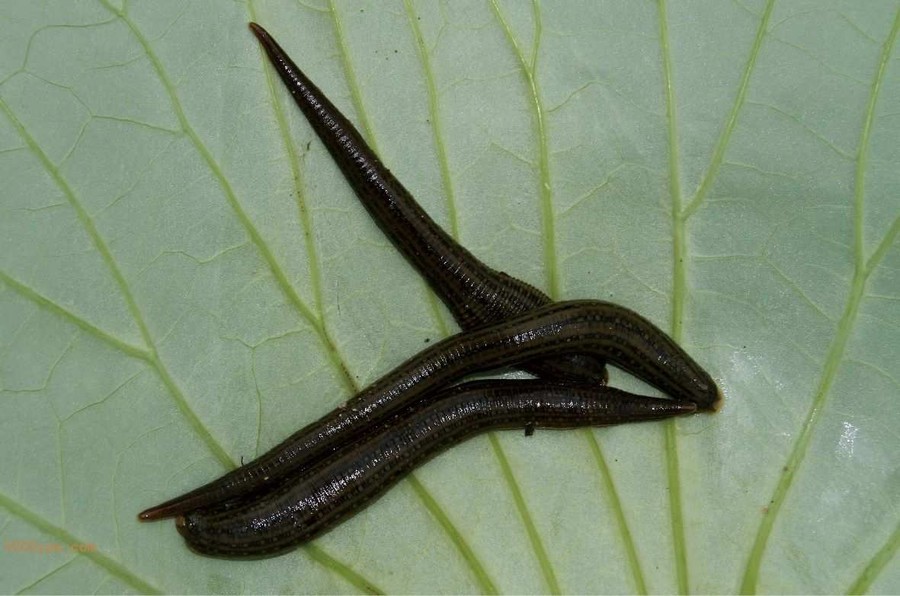
1. Shuizhi: Flat fusiform shape with numerous segments, 4-10 cm long and 0.5-2 cm wide. Dorsal surface dark brown or blackish brown, slightly raised; after soaking in water, 5 longitudinal rows of black spots become visible. Ventral surface flat, brownish yellow. Both sides brownish yellow, anterior end slightly pointed, posterior end bluntly rounded, with one sucker at each end. The anterior sucker is inconspicuous, the posterior sucker larger. Texture brittle, easily broken; fracture surface gelatinous. Odor: slightly fishy.
2. Shuizhi (Leech): flat, elongated, and cylindrical in shape, the body is often curved and twisted, 2-5 cm long, 0.2-0.3 cm wide.
Harvesting and Processing
Captured in summer and autumn, killed by scalding in boiling water, then sun-dried or dried at low temperature.
Chemical Constituents
It primarily contains protein. It also contains multiple trace elements such as iron, manganese, and zinc. The saliva of fresh leeches contains an anticoagulant substance called hirudin.
Pharmacology
It has the effects of preventing thrombosis and dissolving thrombus; reducing platelet activity, inhibiting platelet release, aggregation, and adhesion, thereby exerting anticoagulant and antiplatelet effects; influencing hemorheology, lowering blood lipids, inhibiting fibroblast proliferation, protecting endothelial cells, and improving cardiovascular function; promoting the absorption of cerebral and subcutaneous hematomas, alleviating surrounding inflammation and edema, relieving intracranial hypertension, and improving local blood circulation; preventing acute tubular necrosis and improving renal function; and exhibiting anti-early pregnancy effects, terminating late-stage pregnancy, and contracting the isolated uterus.
Properties and Channel Entry
Salty, bitter, neutral; slightly toxic. Enters the Liver channel.
Functions and Indications
Breaks Blood, unblocks the menses, expels stasis, and reduces concretions
Dosage and Administration
For oral administration: decoct in water, 3-9 g; or in pill or powder form, 0.5-1.5 g per dose, up to 3 g per dose for large doses.
Precautions and Contraindications
For individuals with weak constitution and blood deficiency, pregnant women, women during menstruation, and those with a tendency to bleed, use is contraindicated.
Prescriptions
1. For incessant bloody discharge: Process Shuizhi (Hirudo) into fine powder, take 3 g with wine twice daily; blood stasis resolves and condition heals. (From Qianjin Yaofang) 2. For fractures: Dry Shuizhi on a new tile, grind into fine powder, take 3 g with hot wine. After a meal, pain may lessen; take another dose to stop pain. Then apply fracture-setting medicine and secure with splints. (From Jingyan Fang) 3. For fracture pain: Shuizhi (fried with glutinous rice until yellow, remove rice), Bai Mian (burned to ash), Mo Yao (Frankincense, ground separately), Ru Xiang (Myrrh, ground separately), equal parts. Xue Yu (child's hair) 15 tufts (burned to ash). Grind into powder. For those over 50: take 3 g; under 20: take 1.5 g; children: half a character (approximately 0.15 g), taken with warm wine. (From Puji Fang, Jiegu Rushen San) 4. For migratory pain and numbness in men and women: Shuizhi (fried with glutinous rice until cooked) 15 g, She Xiang (Musk, ground separately) 7.5 g. Grind into fine powder. Take 3 g per dose with warm wine, without regard to meals, twice daily. (From Zhengzhi Zhunsheng) 5. For back abscess with initial redness and swelling: Apply live Shuizhi to the lesion to let it suck blood. After feeding, the leech becomes distended and falls off; keep it alive in fresh water. (From Baiyi Xuanfang) 6. For amenorrhea or postpartum lochiostasis with umbilical abdominal pain: Shu Di Huang (Rehmanniae Radix Praeparata) 90 g, Meng Chong (Tabanus, remove head, legs, wings, fry) 50 pieces, Shuizhi (fried with glutinous rice until yellow, remove glutinous rice) 50 pieces, Tao Ren (Persicae Semen, processed) 50 pieces. Grind into fine powder, form into pills with honey, size of wutong seeds. Take 5 pills on an empty stomach with warm wine. If ineffective, increase to 7 pills. (From Furen Liangfang, Dihuang Tongjing Wan) 7. For menstrual obstruction in women, also for urinary bladder fullness and urgency with blood stasis in men: Shuizhi (roasted) 30 pieces, Meng Chong (remove wings, legs, roasted) 30 pieces, Tao Ren (remove skin and tip) 20 pieces, Da Huang (Rheum, wine-soaked) 90 g. Grind the four ingredients into powder, boil with 5 sheng of water to obtain 3 sheng, strain, and take 1 sheng warm. (From Jingui Yaolue, Didang Tang)