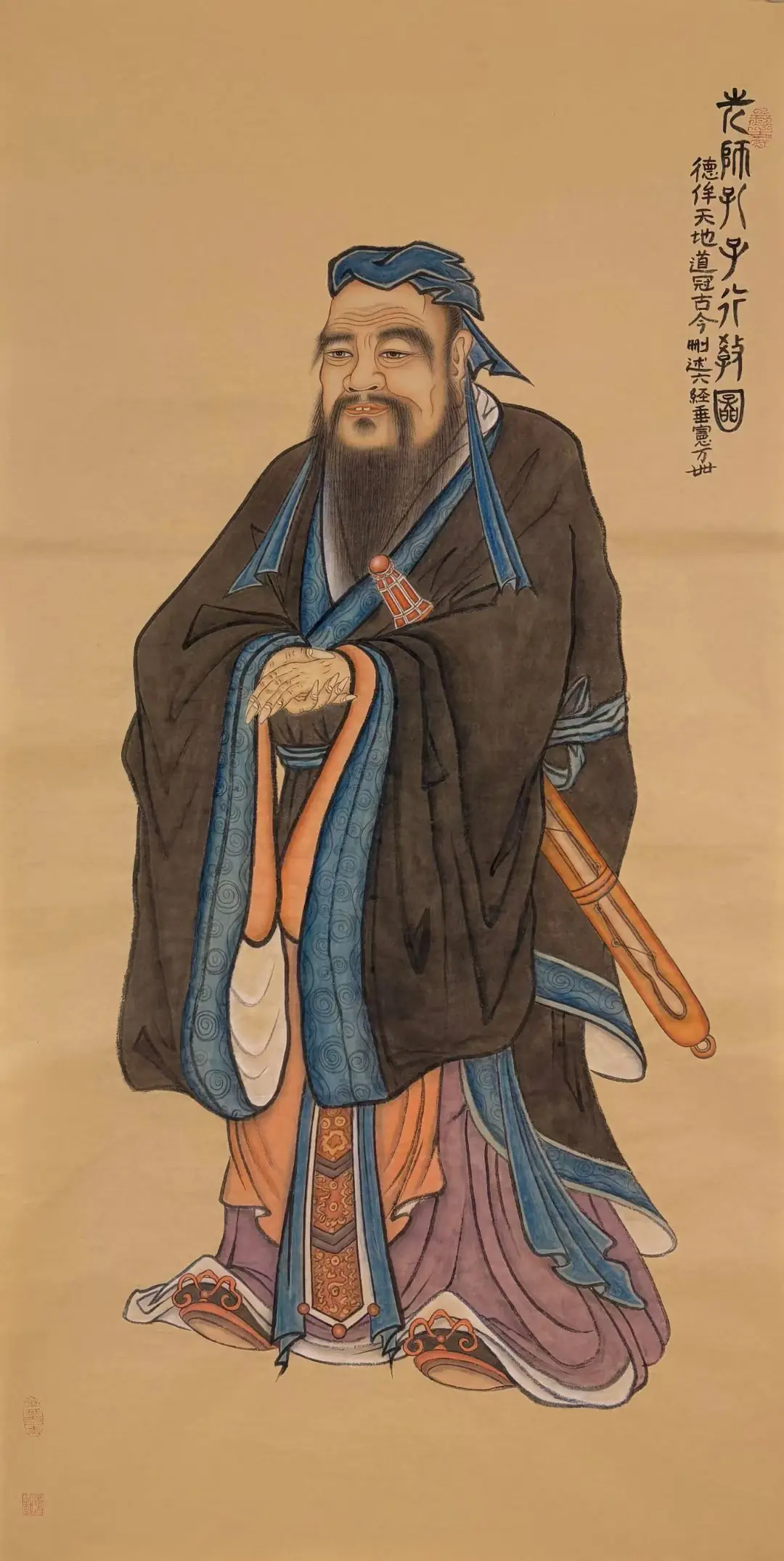
Due to the breadth and depth of his learning and virtue, Confucius gradually gained recognition from society. At age thirty, he "took his stand" and began teaching students. Before and during Confucius's time, the ancient Chinese feudal nobility monopolized the rights to cultural education. It was said that "learning was in the government," meaning schools were established only for the children of nobles, while commoners had no qualifications or rights to education. To popularize education among the people, Confucius obtained permission from Grand Master Zhongsun and Duke Zhao of Lu, and with their financial support, built a teaching platform and began accepting students. Because there were apricot trees beside the platform, it was named the Apricot Altar (Xingtan). In the private school founded by Confucius, anyone who brought a token "bundle of dried meat" (a customary gift for teachers) was accepted as a student. From then on, the number of disciples gathering at his door grew daily, reportedly reaching over three thousand at its peak, with seventy-two who were proficient in the "Six Arts." Most of these students came from humble backgrounds, including early disciples such as Yan Lu, Zeng Dian, Zi Lu, Bo Niu, Ran You, and Yan Yuan. Even the two sons of the nobleman Meng Xizi of Lu, Meng Yizi and Nangong Jingshu, as well as Sima Niu of the Song State, came to study Li (Propriety), showing that Confucius's school had become widely renowned.
The establishment of private schools broke the tradition of "education in the hands of officials," further promoting the downward spread of academic culture. Confucius spent forty to fifty years of persistent effort in "learning tirelessly and teaching without fatigue," taking on disciples and giving lectures, cultivating a large number of talented individuals. The content of Confucius's teaching mainly included subjects such as the Classic of Poetry (Shijing), the Book of Documents (Shangshu), Li (Propriety), music, and the I Ching (Book of Changes). His teaching locations and methods were very flexible; sometimes he lectured to students at the Apricot Altar, and other times he sat waiting for students to come and ask questions. Confucius was skilled at teaching according to students' aptitudes, using inspiration and guidance. He sometimes also took students outside the city, combining outings to enjoy natural scenery and cultivate their character with lecturing or guiding students in discussions. Among his students, some later entered politics (serving as officials), while others became educators (teachers), and many became individuals with political achievements and renown.