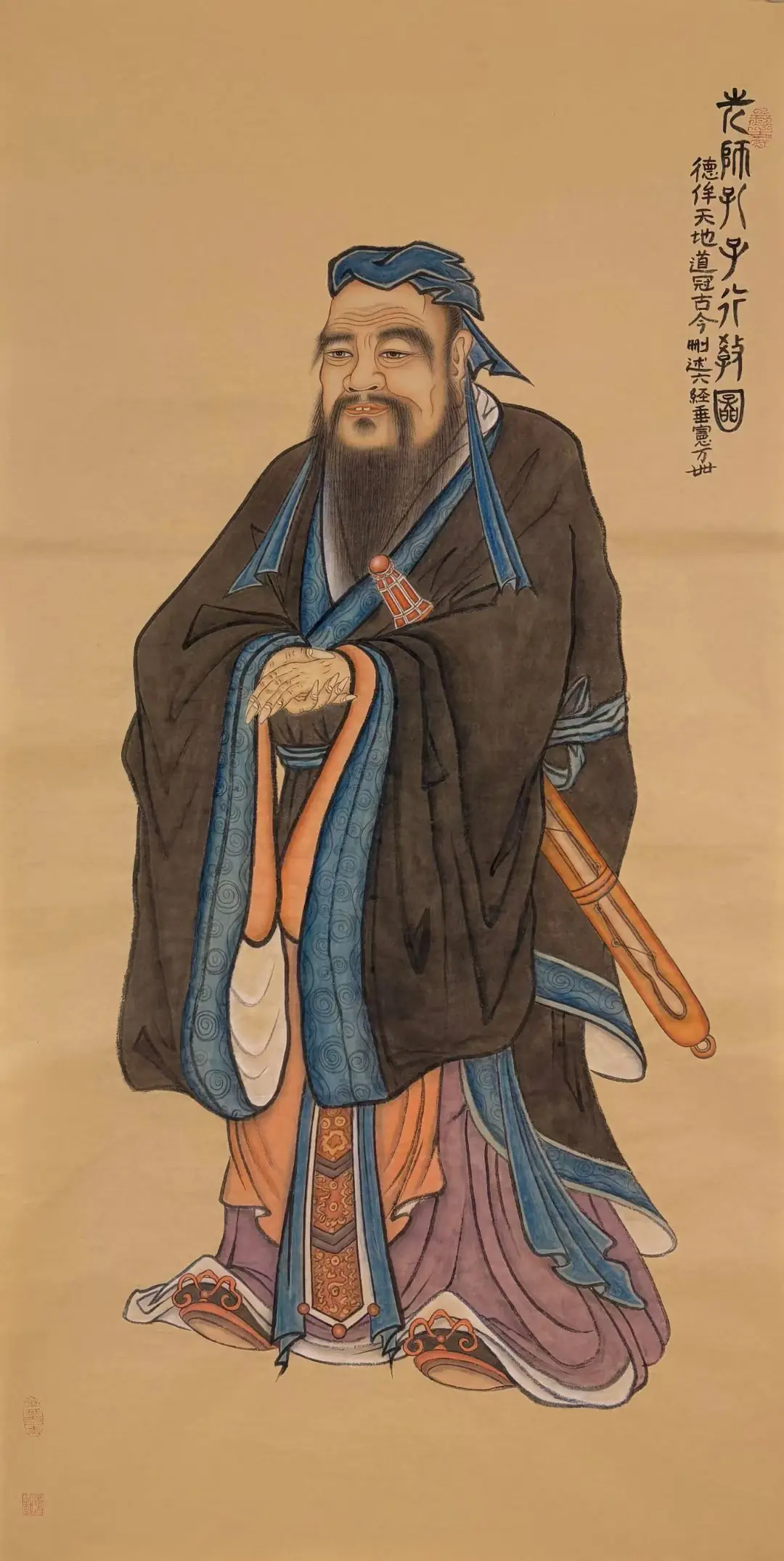
After Confucius was disappointed in the State of Chu, many of his disciples sought official positions in the State of Wei and urged him to return there. Confucius then led his disciples away from Fuhan, passing through the State of Chen, and arrived at Wei. By this time, Confucius was sixty-three years old. Before his arrival, Duke Ling of Wei had already died, and his grandson Zhe was ruling the state. Zhe's father, Kuaikui, had resented Duke Ling's wife, Nanzi, for her adultery and attempted to assassinate her but failed. He fled to the State of Song and later to the State of Jin. After Duke Ling's death, Nanzi installed Zhe as ruler, making him Duke Chu of Wei. Kuaikui argued that as the father, the throne should pass to him, leading to a father-son conflict over the state. At that time, the various feudal lords tended to side with Kuaikui, and public opinion condemned Zhe, who faced pressure from other states. This matter was widely discussed throughout Wei.
Zi Lu (a bold and straightforward disciple of Confucius) thought that the Duke of Wei, Kuai Zhe, was likely seeking Confucius's support. So he asked his teacher, "If the ruler of Wei were to ask you to take charge of governance, what would you do first?"
Confucius said, "The first thing to be done is to rectify the improper use of names and titles with regard to Li (Propriety)!"
Zi Lu (a bold and straightforward disciple of Confucius), observing that the father and son in the State of Wei were then contending for the throne, felt Confucius was out of touch with the times. He disapprovingly said, "Is this really necessary? Master, you are too pedantic! Why expend effort on rectifying such empty names?"
Confucius, believing that the rectification of names (Zhengming) was the foundation of governance, rebuked Zi Lu (his disciple) by saying: "You, how boorish you are! A Junzi (Exemplary Person) should adopt an attitude of reserve regarding matters he does not understand. If names are not rectified, then speech will not be smooth; if speech is not smooth, then affairs cannot be accomplished; if affairs cannot be accomplished, then Li (ritual propriety) and music will not flourish; if Li and music do not flourish, then punishments will not be just; if punishments are not just, then the common people will not know where to place their hands and feet. Therefore, when a Junzi determines a name, it must be speakable, and once spoken, it must be practicable. A Junzi must never be careless or arbitrary with any word he utters."
Ran You (a disciple of Confucius) asked Zi Gong (a wealthy and eloquent disciple): "Do you think our Master would assist the Duke of Wei, Kuai Zhe?" Zi Gong replied: "That is exactly what I was planning to ask the Master."
After Zi Gong (a wealthy merchant and eloquent disciple of Confucius) met with Confucius, he skillfully asked, "What kind of people were Bo Yi and Shu Qi (two sons of the Lord of Guzhu)?" Confucius replied, "They were virtuous people of ancient times!" Zi Gong then asked, "They yielded the throne to each other and fled, eventually starving to death on Shouyang Mountain. Did they harbor any resentment?" Confucius said, "They wholeheartedly sought Ren (Benevolence) and attained it. What resentment could they have?"
Zi Gong (a disciple of Confucius) thus understood that his teacher advocated yielding through Li (Propriety) and would not support the Duke of Wei contending with his father for the throne. Upon coming out, he said to Ran You (another disciple), "The Master will not assist him."
Indeed, although Duke Chu of Wei (Kuaizhe) imitated his grandfather Duke Ling of Wei's practice of welcoming the sage Confucius in the suburbs with proper Li (ritual propriety), he had no intention of employing Confucius. Seeing that Duke Chu used state power rashly, overworked the people, imposed harsh punishments, and was stubbornly self-opinionated, Confucius believed that speaking too little would be ineffective while speaking too much would incur resentment. Thus, he had no intention of interfering in Wei's state affairs, holding that "if it cannot be done, stop; do not bring disgrace upon yourself," and had no plan to stay long in Wei. However, despite his disappointments, Confucius was not disheartened or dejected. On the contrary, having experienced many vicissitudes, his mind broadened with his horizons, and his will grew stronger. He once told his disciples: "If the Dao (Way) cannot be practiced, I will take a raft and float out to sea," wishing to realize his ideal of benevolent governance abroad. Later, he also "wanted to dwell among the Nine Yi (Eastern barbarian tribes)" to practice the Dao. When disciples dissuaded him, saying those places were remote and backward, he replied: "If a Junzi (Exemplary Person) dwells there, what rudeness could there be?" meaning that if they lived there and helped the people learn culture and build civilization, how could it remain "rude" forever? In the end, this plan did not materialize because Duke Ai of Lu and Ji Kangzi sent envoys with generous gifts to summon Confucius back to Lu, so he changed his mind and returned to Lu with his disciples.