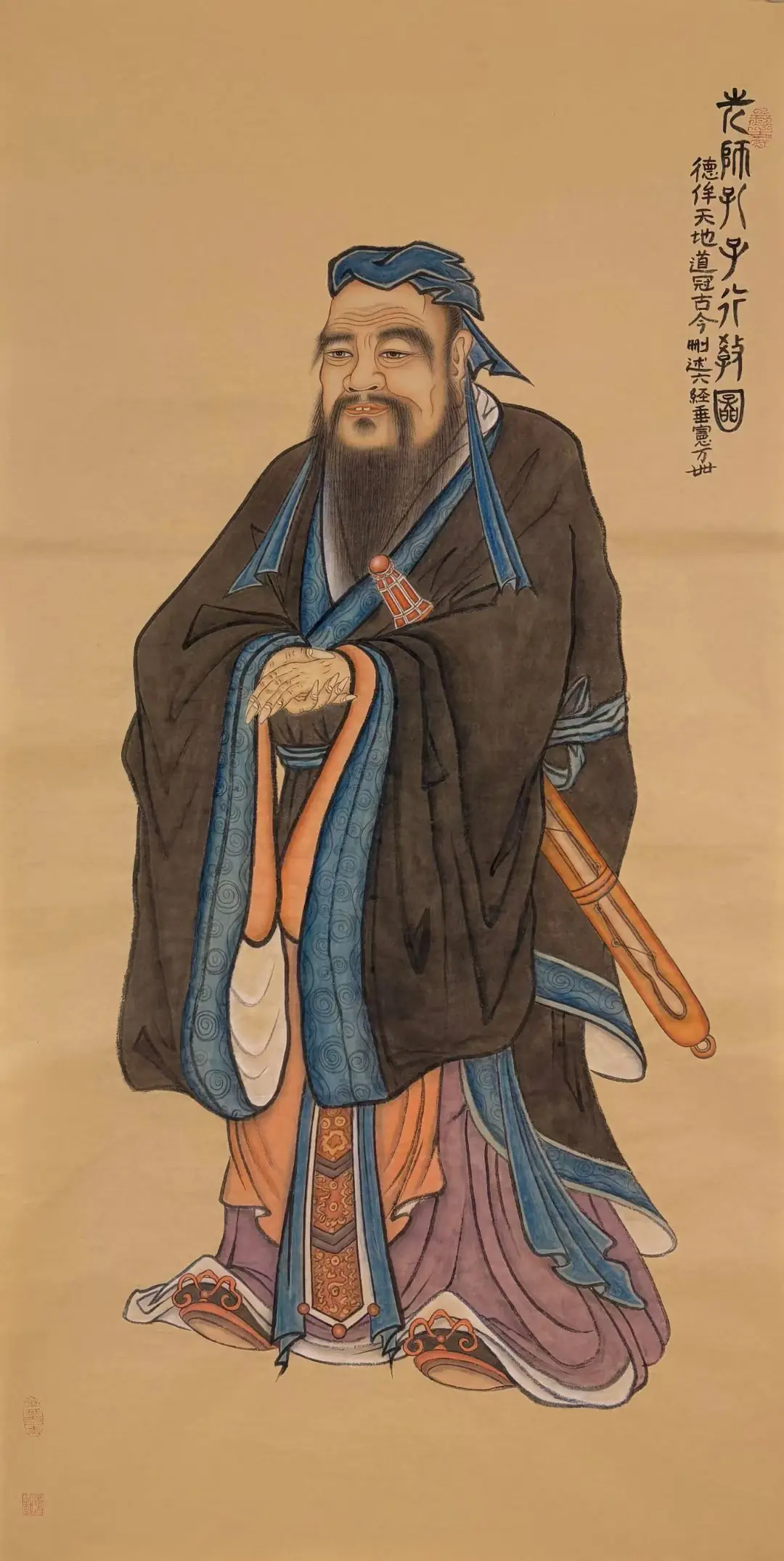
The first state Confucius chose to visit during his travels through the various states was Wey. Because of his outstanding political achievements in the State of Lu, his reputation was renowned throughout the states. Thus, when he and his disciples reached a place called Yi on the border of Wey, they were welcomed by the local border official, known as a Fengren (border warden). This official requested an audience with Confucius, saying to his disciples, "Whenever a Junzi (Exemplary Person) of such virtue and talent arrives here, I have never failed to meet with him." The disciples then led him to see Confucius. After personally hearing Confucius's words and witnessing his amiable, courteous demeanor and manner, the Fengren was immediately sincerely convinced. When he took his leave, he exclaimed to Confucius's disciples, "Why should you worry about not holding office? The world has been without the Dao (The Way) for a long time. Heaven will use Master Kong as a guide to command the world and reform its governance." Thus, Confucius already enjoyed extremely high prestige at that time, especially in matters of Li (Propriety), with many believers; this Yi Fengren was one of them. Having merely met Confucius once and conversed with him, he recognized Confucius as a sage sent by Heaven to command the world, holding him in great admiration.
After Confucius and his disciples left the town of Yi, they proceeded toward the capital of the State of Wei. Along the way, they observed local customs and discussed how to govern the people and bring peace to the state. People-centered governance was a fundamental principle of Confucius's political philosophy, so he took note of Wei's large population and praised it. Ran Qiu (Confucius's disciple who was driving the chariot) then asked him: "Since the population is so large, how should it be governed?"
Confucius's reply was concise and to the point: "Enrich them." This meant finding ways to make the people prosperous. Ran Qiu (a disciple of Confucius) pressed further: "Once the people are prosperous, what should be done next?" Confucius answered with two words: "Educate them." This meant broadly promoting education, allowing the people to learn culture, shed ignorance, act according to Li (Propriety), develop a sense of shame, and advance with dignity on the path of civilization. Confucius's "educate them" targeted the masses, undoubtedly representing universal education for all people, as well as a concrete and widespread application of his policy of "teaching without discrimination" (you jiao wu lei). At that time, education was monopolized by the government (xue zai guan fu), and there were no private schools among the people. This educational philosophy of Confucius broke through traditional views, expanded the social foundation and talent pool of education, actively promoted the improvement of the quality of all social members, and marked an epoch-making significance in the history of educational development.
After Confucius and his disciples arrived at Diqiu (present-day Huaxian County, Henan Province), the capital of the State of Wei, they lodged in the home of Yan Zhuozou, a relative of Zi Lu (a disciple known for his courage and straightforwardness). Mi Zixia, the husband of Zi Lu's wife's sister and a favored minister of Duke Ling of Wei, heard of this and said to Zi Lu with considerable pride: "If Confucius had stayed at my house, he would have become a high-ranking minister of Wei long ago."
Zi Lu naturally relayed this to Confucius, who merely said calmly, "Let us follow the decree of fate." Confucius detested Mi Zixia (a sycophantic courtier of Wei) as a petty man skilled in opportunism and disdained associating with him. At that time, there was a high official named Wangsun Jia (a favored minister of Duke Ling of Wei) in the State of Wei, who asked Confucius, "What is meant by 'It is better to pay homage to the stove than to the southwest corner'?" The "southwest corner" (Ao) originally referred to the honored position in a house, where the Ao spirit was worshipped as superior to the stove god (Zaoshen, the kitchen god). Although the stove god held a lowly status, he oversaw people's daily actions, acting as their direct supervisor. As the saying goes, "The county magistrate is less effective than the current manager," so the stove god became the primary object of worship. Wangsun Jia's words ostensibly sought advice on whom to worship but actually hinted that Confucius should attach himself to him. In response, Confucius retorted, "Not so. If one offends Heaven, there is nowhere to pray." Heaven helps those who help themselves; if one's words and deeds contradict the principles of Heaven, worshiping any deity will be of no avail.
Confucius, finding himself unable to put his political talents to use in the State of Wei, felt inevitably frustrated and took up playing the sounding stone (qing) as a pastime.
Once, a man carrying a straw basket happened to pass by Confucius's door; he might have been a hermit, and from the sound of the stone chime, he vaguely discerned Confucius's inner thoughts, commenting, "From the sound of the chime, this person seems to have something on his mind."
But then he criticized further: "This sound of striking the stone chime is truly too crude, as if saying, 'No one understands me, my talents go unrecognized!' Since no one recognizes your abilities, you might as well focus solely on self-cultivation. It's like when we cross a river—when the water is deep, we carefully step on stones; when it's shallow, we lift our robes and roll up our trousers to wade straight through." The implication is that since the current society is so dark and corrupt, if you still see a glimmer of hope, do what you can to improve the situation; if you feel it's beyond redemption, simply close your eyes, pretend not to see it, and muddle through life carelessly. Either way is fine—why make yourself so depressed?
After hearing this outside the gate, the disciples relayed these words to Confucius. He sighed and said, "If one could truly live like this, then I would have nothing left to be troubled by." He understood this person's intent and attitude toward life, and also knew that his resolve was firm, making it impossible for Confucius to persuade him. In truth, although Confucius was in an awkward position in the State of Wei and was not given important roles, he always maintained a passion for saving the world and adhered firmly to his own principles. His inner suffering could not be understood by these reclusive philosophers, yet what makes Confucius who he is lies precisely in this spirit of "knowing it cannot be done and still doing it" — a commitment to aiding the world.
Through the recommendations of Yan Chuzou and Qu Boyu (two officials of the State of Wei), Duke Ling of Wei received Confucius. Upon their first meeting, the Duke asked Confucius, "What was your official salary in the State of Lu?" Confucius replied, "My salary was sixty thousand small measures of grain." The State of Wei then granted him the same amount of sixty thousand small measures of grain. Consequently, Confucius and his disciples moved out from Yan Chuzou's residence and established their own lodgings. Duke Ling of Wei was fond of warfare and eager to expand his territory, so he asked Confucius about the methods of deploying troops and arranging battle formations. Confucius answered, "Regarding matters of temple sacrifices and ritual ceremonies, I have heard something about them; but concerning military affairs, I have never studied them." Because Duke Ling of Wei had been constantly engaged in military adventures, improving the state of Wei would require fundamentally shifting the focus of policy from war to the practice of Ren (Benevolence). The Records of the Grand Historian, "The Hereditary House of Confucius," records another anecdote: the next day, while speaking with Confucius, Duke Ling of Wei saw a wild goose flying overhead and immediately stared up at the sky, his expression clearly distracted. Maintaining eye contact with a speaker is the most basic courtesy; the Duke's attitude plainly showed disrespect toward Confucius, completely disregarding him. This left Confucius deeply disappointed.
Confucius stayed in the State of Wey for ten months. Someone spoke to Duke Ling of Wey, saying, "If they have come to plot against Wey for the benefit of Lu, what then?" Duke Ling of Wey then sent Gongsun Yujia to secretly monitor Confucius and his disciples. Fearing harm, Confucius hastily left Wey and prepared to go to the State of Chen.
As Confucius was leaving the capital of Wei, he shared his observation on Wei’s politics with his disciples: “The governments of Lu and Wei are like brothers.” This statement actually implied two meanings: First, Lu was the fief of the Duke of Zhou, while Wei was the fief of Kang Shu. Since the Duke of Zhou and Kang Shu were brothers, the political situations of the two states were somewhat similar. Second, in Confucius’s time, both states had declined significantly from their founding days. In Lu, rulers failed to act as rulers and ministers failed to act as ministers. In Wei, beyond that, fathers failed to act as fathers and sons failed to act as sons. The similarity of their current conditions was striking.