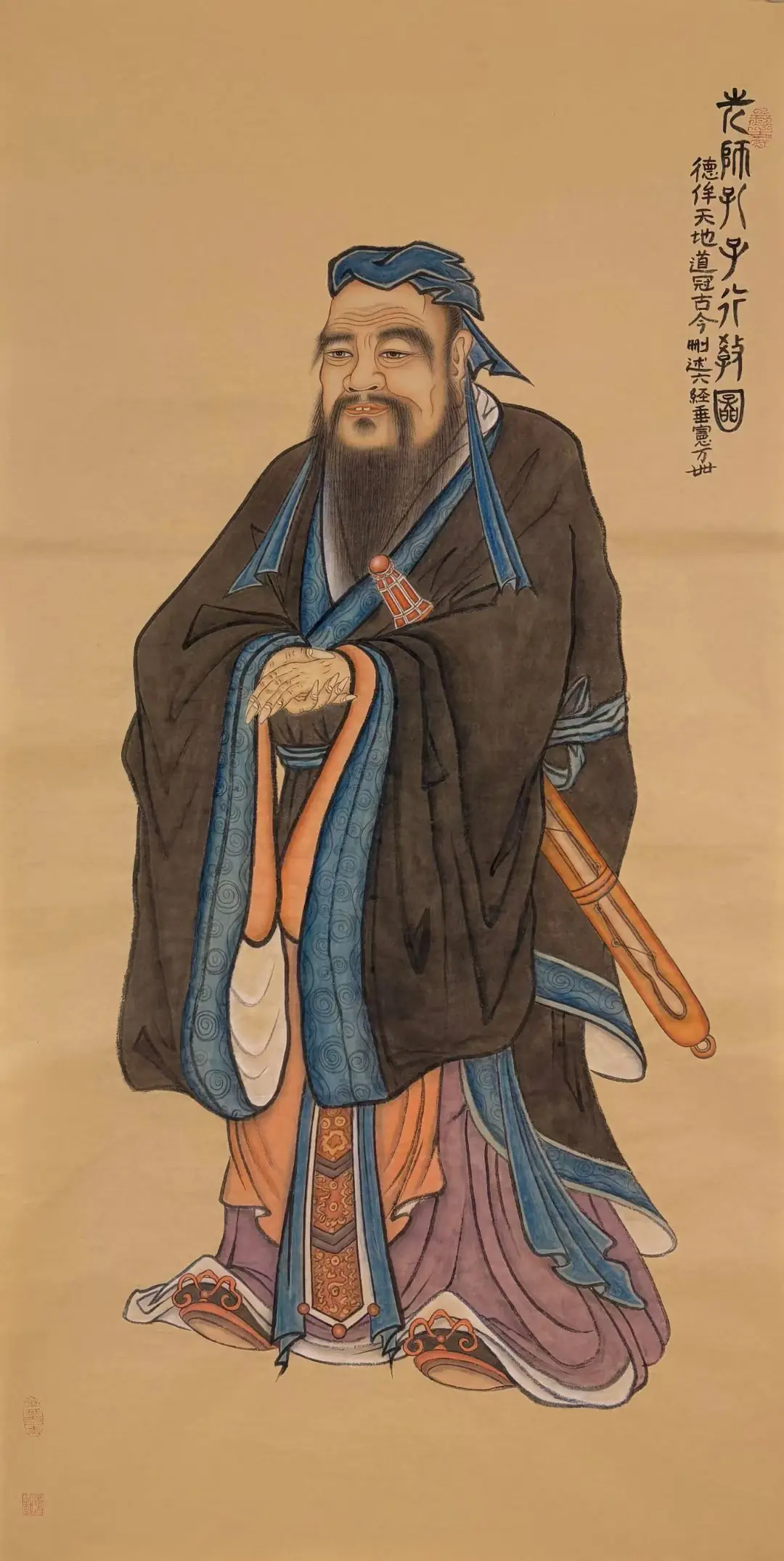
Confucius had extremely high expectations for himself. Because he was born into a declining noble family, grew up in poverty, and depended solely on his widowed mother, he developed a strong drive for achievement. As a child, the way he played and amused himself differed from other children; he would often arrange sacrificial vessels such as zu and dou (ritual vessels) in proper order and then imitate the ceremonial gestures of adults performing sacrifices. When he grew up, he became renowned throughout the world for his knowledge of Li (Propriety).
Confucius described his own journey of learning and reflection: "At fifteen, I set my heart on learning; at thirty, I was established... at seventy, I could follow my heart's desire without overstepping the bounds." That a fifteen-year-old could set his mind on learning shows how high his standards were for himself. He later said, "I was not born with innate knowledge; I am one who loves antiquity and diligently seeks it." At fifteen, his studies were extensive—he was interested in learning anything he could access, had no fixed teacher, and often sought guidance from others. He not only mastered practical skills such as accounting (as a "granary keeper") and animal husbandry (as a "field overseer"), but also deeply studied and mastered the Six Arts (rites, music, archery, charioteering, calligraphy, and mathematics), the Classic of Poetry (Shijing) and Book of Documents (Shangshu), as well as the cultural relics of the Three Dynasties (Xia, Shang, and Zhou).
Due to his extensive learning and versatile abilities, he was able to respond calmly and appropriately when facing rulers, powerful ministers, recluses, and disciples of varying personalities. At thirty, he "established himself" (establishing life goals), setting a life goal that he pursued throughout his life: the Dao (The Way) of Ren (Benevolence) and Yi (Righteousness).
Confucius valued versatility in people, teaching that "the Junzi (Exemplary Person) is not a vessel" (the Junzi (Exemplary Person) is not a vessel), meaning the more abilities an exemplary person has, the better. He was naturally broad in interests, curious about all things in the world, and through long-term, tireless effort in learning, coupled with a spirit of "asking about everything" (asked about everything), he mastered many skills. He humbly claimed that because he was of lowly status in his youth, he learned to do many things. His contemporaries also marveled at why he possessed so many talents. Among the Six Arts (Six Arts, Liu Yi: rites, music, archery, charioteering, calligraphy, mathematics), "calligraphy" and "mathematics" were essential competencies for a "granary clerk" (a petty official), a job Confucius relied on for a livelihood in his youth.
Confucius inherited the robust and imposing physique of his father, Shu Lianghe, and possessed the strength to lift the gate barrier of the city, yet he did not wish to be known for his physical prowess. He was skilled in archery and well-versed in the lethal power of bows and arrows, often commenting on the art of archery with the tone of an insider. However, Li (Propriety), music, poetry, and historical documents were the main sources of Confucius's knowledge and wisdom. Through his creative interpretation and editing, these classics from ancient traditions established their authoritative status.
Confucius valued versatility and cultivated himself into a person of many talents. Thereafter, he took it as his mission to cultivate Junzi (exemplary persons), shifting traditional official education toward the common people and spreading it among the populace.
As a teacher, Confucius led by example, tirelessly pursuing new knowledge with unwavering dedication and zeal, while consolidating what he had already learned with a mindset of "fearing he might lose it." Despite enduring hardships, the many disciples of Confucius’s school remained sincerely devoted to him.
Liang Qichao said: "To learn without tiring and to teach without growing weary—these two phrases seem ordinary, but in reality, being untiring and unwearying is an extremely difficult thing." Because to possess this spirit requires strong perseverance, great patience, and good physical health. Perseverance comes from a strong will, patience must be cultivated through long-term practice, and good physical health sustains it. Beyond these basic conditions, one must also develop a good way of life that integrates work with one's own life, even with life itself, thereby reaching the state of being "so intent on learning as to forget food, so joyful as to forget worries, unaware that old age is approaching." He was open-minded, readily accepting good advice, and unashamed to ask his inferiors; willing to set aside his status and act as a student, he was adept at discovering and appreciating the strengths and merits of others. The more Confucius learned and the broader his knowledge became, the more he felt his own inadequacy. Thus, he acknowledged his own ignorance, which drove him to tirelessly and persistently pursue learning.
Before being placed on a pedestal, Confucius was actually a most sincere and natural person. When at leisure, he was "relaxed and cheerful, gentle and easy." "Relaxed and cheerful" describes his harmony and contentment, while "gentle and easy" means he was neither overly restrained nor unrestrained, appearing lighthearted and joyful. Moreover, he loved singing, not only alone but sometimes with others. From these aspects, one can see that Confucius was a person of reason who was not lacking in sensibility. He was honest and open, magnanimous and selfless, never putting on airs to embellish his image. He said, "My disciples, do you think I am secretive? I have no secrets from you! There is nothing I do that I do not share with you—such is Qiu." It was precisely because of this sincere and natural disposition that even when occasionally scolded by him, his disciples did not feel hurt.
Confucius also had strong likes and dislikes; he was not always gentle, kind, respectful, frugal, and yielding. Those he favored possessed qualities such as reticence, humility, a sense of shame, love of learning, and unyielding firmness. Those he detested were clever talkers with ingratiating manners, those who loved bravery but hated poverty, those who feigned compliance while opposing in secret, those whose words exceeded their deeds, and those who were arrogant and stingy. Yan Hui (Confucius’s most beloved disciple) was his most favored disciple, and Confucius never spared praise for him: “Hui, his heart does not violate Ren (Benevolence) for three months.” “There was Yan Hui who loved learning; he did not transfer his anger, nor did he repeat a mistake.” Zi Lu (a brave and outspoken disciple) was also a disciple Confucius liked, but his personality was bold and straightforward; he often spoke frankly and dared to offer different views on Confucius’s words and actions. Confucius praised him for his self-confidence, self-respect, and decisiveness, saying, “Wearing a shabby robe and standing with those wearing fox and badger furs without feeling ashamed—that would be You (Zi Lu).” “With a single phrase, one can decide a lawsuit—that would be You.” But he also directly criticized him for being bold but reckless, and for being crude and lacking Li (Propriety). “Zi Lu said, ‘If you were to command the Three Armies, whom would you take with you?’ Confucius said, ‘I would not take someone who fights a tiger barehanded or crosses a river on foot, dying without regret. I would take someone who approaches affairs with caution and is good at planning to succeed.’” “Zi Lu said, ‘If the ruler of Wei were to entrust you with governance, what would you do first?’ Confucius said, ‘Surely it would be to rectify names (Zhengming)!’ Zi Lu said, ‘Is that so? You are too impractical! Why rectify them?’ Confucius said, ‘How crude you are, You! A Junzi (Exemplary Person) remains silent about what he does not know.’” Although Zi Lu often spoke insolently, he remained loyal for over forty years following Confucius, and Confucius felt he was someone with whom he could share hardships, saying, “If the Dao (Way) is not practiced, I will take a raft and drift on the sea. The one who follows me will be You (Zi Lu)!” Confucius seemed to rebuke Ran You (a disciple of Confucius) and Zai Yu (a disciple of Confucius) very harshly. “The Ji family was wealthier than the Duke of Zhou, yet Qiu (Ran You) gathered taxes for them and increased their wealth.” Regarding this matter, Confucius angrily cursed him, saying, “He is no disciple of mine! You young men may beat the drum and attack him!” Zai Yu slept during the day, and Confucius rebuked him, saying, “Rotten wood cannot be carved, and a wall of dung cannot be plastered. What is the use of blaming Yu (Zai Yu)!”
He was not only strict with his disciples but also refused to show favoritism toward old friends and powerful ministers. Once, his old friend Yuan Rang (a childhood acquaintance of Confucius) squatted on the ground with legs spread apart, waiting for him. Seeing such rudeness, Confucius immediately criticized: "As a youth, you were not humble and respectful; as an adult, you have done nothing worthy of praise; now in old age, you refuse to die—you are a thief!" And he struck Yuan Rang's shin with his staff. Another time, speaking of the usurpation of rites by Ji Shi (a powerful minister of the State of Lu), Confucius said angrily: "Eight rows of dancers perform in his courtyard—if this can be tolerated, what cannot be tolerated?" He also bluntly called Duke Ling of Wei (the ruler of Wei State) fatuous and immoral, even though he was living in Wei at the time, enjoying an annual salary of sixty thousand shi (a unit of volume) of grain from the duke.
Although Confucius is revered by later generations as the "Sage" and "Paragon of Teachers" and was always strict with himself, he too could make mistakes. However, unlike ordinary people who gloss over their faults, Confucius could face his own errors openly. He discussed the issue of faults many times, believing they are inevitable and encountered frequently by everyone. He said that everyone makes mistakes, so committing a fault is forgivable, but persisting in error without correction is unforgivable. He confessed: "Grant me a few more years, so that I may study the I Ching at fifty, and I will be free from major faults." "Chen Si Bai (a minister of Chen State) asked: 'Did Duke Zhao (of Lu) know Li (Propriety)?' Confucius replied: 'He knew Li.' After Confucius left, (Chen Si Bai) bowed to Wu Ma Qi (a disciple of Confucius) and invited him forward, saying: 'I have heard that the Junzi (Exemplary Person) is not partisan; is the Junzi also partisan? The Duke (Zhao) took a wife from Wu, who shares his surname, and called her Wu Mengzi. If the Duke knew Li, who does not know Li?' Wu Ma Qi reported this. Confucius said: 'I am fortunate! Whenever I have a fault, people always know it.'" Duke Zhao of Lu was known at the time for knowing Li, but in marriage he violated the ancient rule of "not marrying within the same clan." This minister of Chen State asked abruptly, seemingly intending to trap Confucius, who, without careful consideration, answered rashly and easily fell into the verbal snare. Later, when Wu Ma Qi reported the facts, Confucius could have defended himself by saying that his remark about Duke Zhao knowing Li was based on general reputation. But Confucius did not say this; instead, he frankly admitted his verbal error, showing that he was a magnanimous person who recognized and corrected his mistakes.