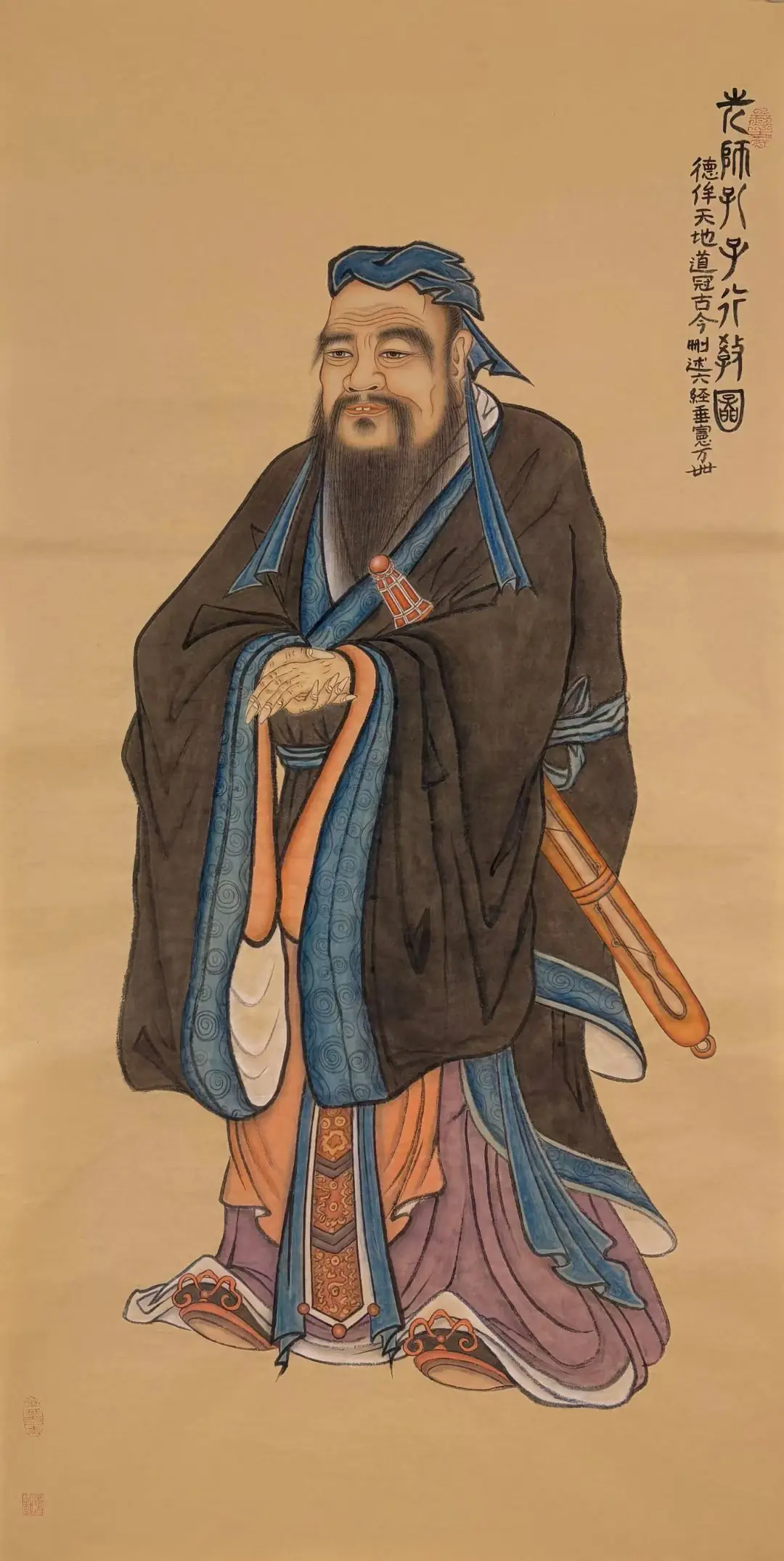
According to the Xunzi (Chapter 28, "Youzuo"), Confucius once visited the temple of Duke Huan of Lu with his disciples and saw a vessel called a "Qi Vessel" (an inclined vessel). It was used to hold wine during sacrificial rituals and had a strange shape, appearing as if it might tip over at any moment.
Confucius did not recognize the Qi Vessel (a tilting vessel used as a warning device), so he asked the temple keeper, who replied: This is a vessel placed on the right side of the ruler’s seat (ancient people often placed cherished objects on the right side), intended to admonish one’s words and deeds to be balanced and impartial, neither leaning nor deviating.
These words stirred Confucius’s memory, and he said: “I have heard of such a vessel: when empty, it tilts; when filled to the proper capacity, it stands upright; once full, it overturns.”
To let his disciples see for themselves, Confucius had them pour water into it, and sure enough, it happened exactly as he had described. He sighed and said, "Alas, in this world, is there anything that, once full, will not topple over?"
Zi Lu (Confucius's impetuous disciple) was not satisfied and further asked Confucius, "Then what method can maintain a state of fullness without overturning?" Confucius replied, "One who is intelligent and wise should guard it with foolishness; one whose merit covers the world should guard it with yielding; one whose courage moves the age should guard it with caution; one who possesses wealth within the four seas should guard it with humility." The general meaning is that only by not flaunting intelligence and wisdom, not coveting merit, not displaying courage rashly, and being frugal and modest despite wealth can one maintain an already achieved position of fullness. This dialogue reveals a truth: everything has a limit; once exceeded, it changes in nature. As the I Ching (Book of Changes), in the Qian Hexagram, says: "A dragon at the top has regret; fullness cannot last long." This means that those in high positions must never be overly arrogant, or they will regret their failure.
As the saying goes, "The moon waxes only to wane, and water overflows when full." Reaching a peak and then declining is the inevitable trend of all things, beyond human resistance. Since this is the case, we must always act with proper measure—remaining balanced, impartial, and in harmony with nature, without forcing things. Otherwise, as Confucius said, "Going beyond is as bad as falling short." Doing too much is no more appropriate than doing too little. This aligns precisely with the Zhongyong (Doctrine of the Mean) that Confucius consistently advocated.