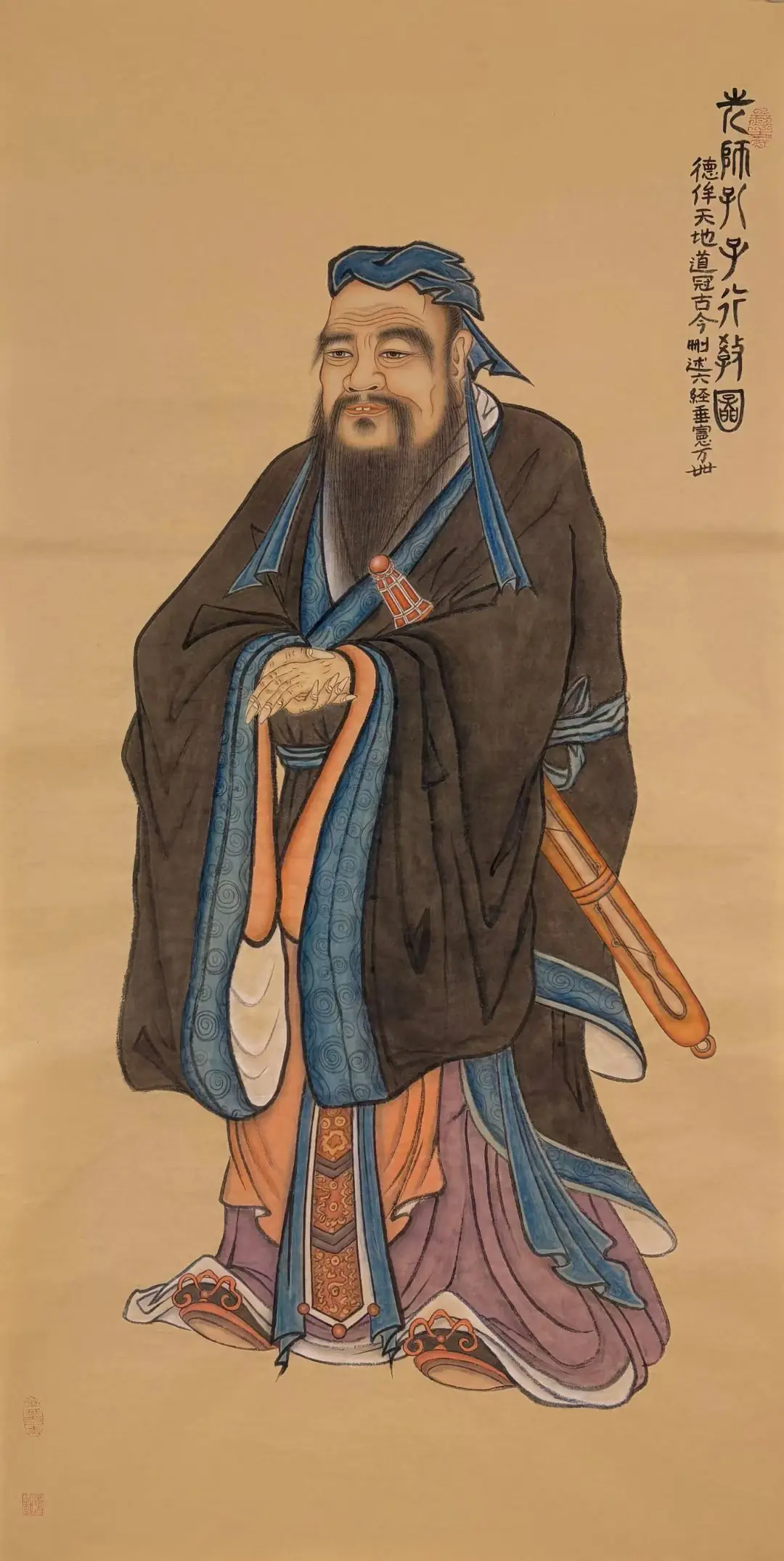
In the thirty-second year of Duke Zhao of Lu (510 BCE), the exiled Duke Zhao died of illness in Qianhou of the State of Jin. At that time, Ji Pingzi, who was governing Lu, installed Duke Zhao's younger brother as the ruler, known as Duke Ding of Lu. In the fifth year of Duke Ding of Lu (505 BCE), Ji Pingzi died, and his son Ji Sunsi succeeded him as prime minister, known as Ji Huanzi. Yang Hu was a retainer of the Ji family; he had once refused the seventeen-year-old Confucius the opportunity to attend a banquet at the Ji household. Thirty years later, the authority of the hereditary Qing official Ji family fell into the hands of Yang Hu, a situation Confucius described as "a retainer holding the reins of state" (the fate of the nation controlled by a family servant). Yang Hu imprisoned Ji Huanzi and only released him after coercing him into submission. At that time, Confucius was also unsuccessful in the State of Qi, so he returned to Lu. By then, Confucius's reputation was already very high, and he had more disciples, with many people coming from afar to study under him. Yang Hu wanted to win over Confucius to consolidate and elevate his own position, repeatedly seeking an audience with him, but Confucius deliberately avoided meeting him. Unable to do otherwise, Yang Hu devised a plan using the prevailing custom to arrange a meeting. The custom was: whenever a high official (Dafu) gave a gift to a scholar (Shi), if the scholar was not at home and could not personally receive it, that scholar had to go to the official's home to offer thanks. So Yang Hu sent a steamed piglet to Confucius when he was not home, forcing Confucius to come to his house to express gratitude. Knowing Yang Hu's intention, Confucius planned to visit when Yang Hu was absent, but unexpectedly encountered him on the way back. Yang Hu said to Confucius, "Come! I have something to tell you." Confucius did not reply. Yang Hu continued, "Can one who possesses virtue and talent yet allows the affairs of the state to remain in confusion be considered a person of Ren (Benevolence)?" Without waiting for Confucius's answer, he added, "Probably cannot be considered a person of Ren! Can one who wishes to take office but repeatedly misses the opportunity be considered a person of Zhi (Wisdom)? Probably cannot be considered wise either! Time passes day by day; the years do not wait for you!" Confucius then replied, "I do intend to take office." However, afterward, Confucius adhered to his principles and beliefs, stating, "When the Way (Dao) prevails in the state, it is shameful to be poor and lowly; when the Way does not prevail, it is also shameful to be wealthy and noble." Confucius said, "Wealth and nobility obtained through unrighteousness (Yi) are like floating clouds to me." Since Lu was then governed by rebellious ministers and unscrupulous sons, he did not readily take office during Yang Hu's rule.
Later, Zigong (a wealthy merchant and eloquent disciple) asked him: "If you had a piece of precious jade, would you hide it away in a chest, or seek out a discerning merchant to sell it?" Confucius, understanding the subtle meaning behind the words, immediately grasped Zigong's implication: Should a worthy person with talents to govern the state live in seclusion, or take office to put those abilities to use? He replied: "Sell it, sell it. I am waiting for the right buyer at a high price." This shows that Confucius always longed to fulfill his ambitions, but only on the condition of finding a truly discerning patron.