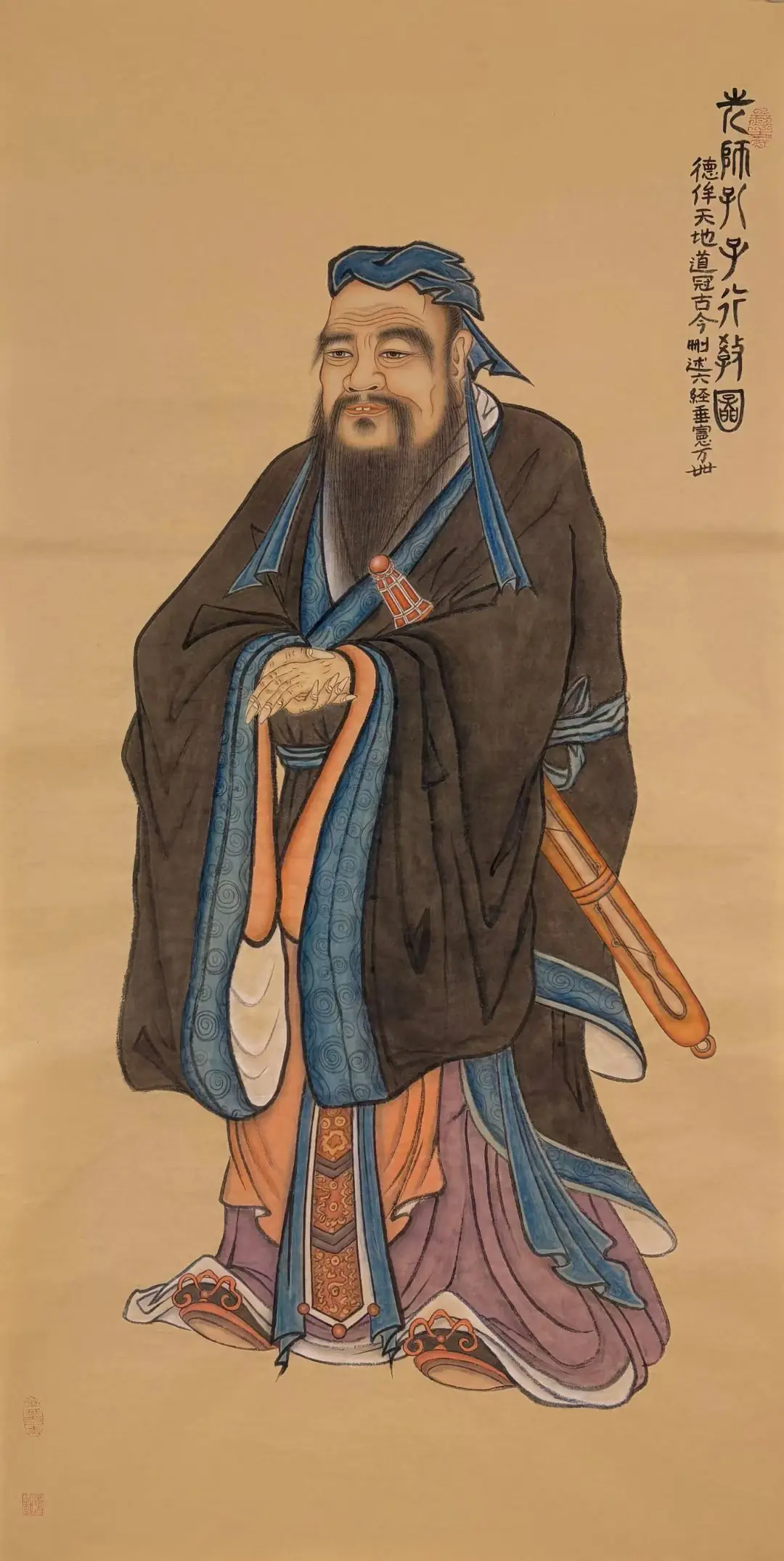
Throughout his life, Confucius focused on exploring the correct attitude toward life and reasonable principles of conduct. He systematically clarified the status and role of humans in society, proposing a moral and ethical system centered on Ren (Benevolence).
The meaning of Ren (Benevolence) mainly has two layers: first, "the benevolent person loves others," and second, "restrain oneself and return to Li (Propriety) to achieve Ren." The former is about loving others, while the latter is about self-cultivation and compliance with moral standards. "The benevolent person loves others" requires one to extend empathy to others, achieving "if you wish to establish yourself, help others establish themselves; if you wish to succeed, help others succeed." Do not impose on others what you yourself do not desire, which is the principle of "do not do to others what you do not want done to yourself." Confucius also advocated the way of Zhong (Loyalty) and Shu (Reciprocity) to eliminate conflicts and realize the political ideal of "the ruler employs his ministers with Li (Propriety), and the ministers serve the ruler with Zhong (Loyalty)."
"A person of Ren (Benevolence) loves others," and must take Ren as the standard, disregarding closeness or distance in relationships, treating all equally, broadly seeking out talent, and safeguarding the fundamental interests of the ruling house.
"The benevolent person loves others" also includes "practicing frugality while loving others, employing the people according to the seasons," which means upholding a spirit of thrift, using human resources reasonably, and advocating for policies of "loving the people," "nurturing the people," "enriching the people," and "benefiting the people" in governance. The benevolent person who loves others opposes "executing without teaching" and advocates "educating the people through Li (Propriety)."
“Ren (Benevolence)” is expressed through “Li (Propriety).” Li is the system and norms of the patriarchal society, emphasizing the order of superior and inferior, elder and younger. The ethical significance of Ren is a humanitarian thought that stresses fraternity, understanding, care, and tolerance among people, as well as the stability and improvement of the material life of the broad masses.
In terms of society and politics, Confucius advocated loyalty to the ruler and reverence for the king, implementing benevolent governance and rule by virtue. He believed that if there were only Li (Propriety) without Ren (Benevolence), it would intensify opposition and sharpen contradictions, leading to social crisis; if there were only Ren without Li, it would cause chaos and disorder in social life. Therefore, one must take Zhongyong (Doctrine of the Mean) as the principle, promoting "harmony in diversity" to achieve a society with hierarchy but not excessive opposition, with benevolence but not indiscriminate affection, where life is stable and prosperous.
Confucius's philosophy of Ren (Benevolence) embodies his sense of mission to "take Ren as one's own responsibility" and "illuminate the Dao (Way) to save the world," along with values that prioritize righteousness over private gain. It imbues traditional Chinese culture with moral education, profoundly influencing Chinese thought and behavioral patterns, and serves as the theoretical foundation of Chinese character and psychology, shining with the ideological brilliance of humanism and realism.