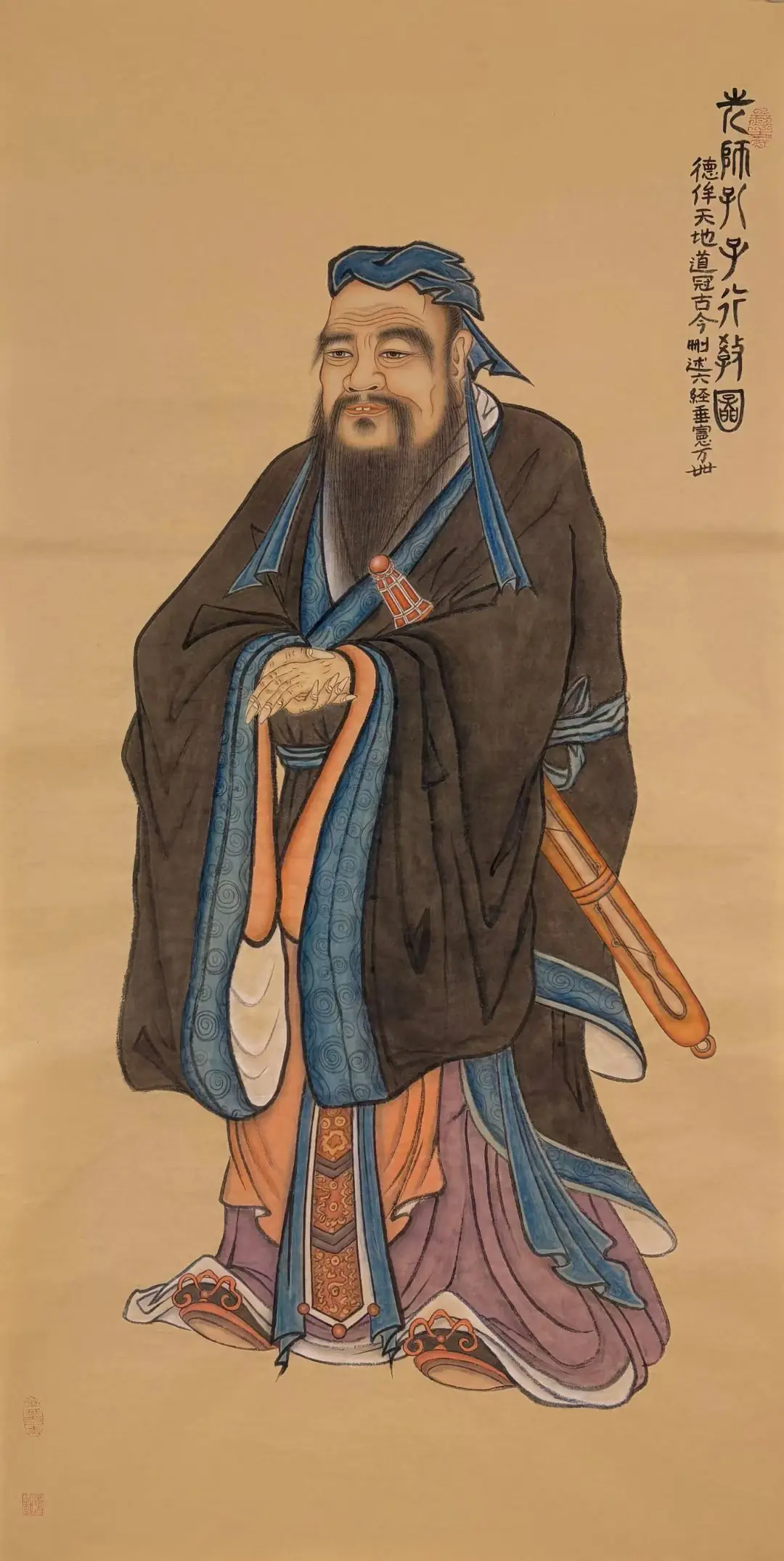
In the fourteenth year of Duke Ai of Lu (481 BCE), Confucius was seventy-one years old. In spring, the Yuren (forestry officials) were hunting in the area of present-day Juye County, west of Qufu. A groom named Shang, serving the Shusun family, captured a strange beast. Its body resembled a river deer, its tail like an ox, its forehead like a wolf, its four hooves like a horse, with five-colored markings on its body and a yellow underside. It was twelve feet (approximately 3.6 meters) tall, and no one recognized it, so they brought it back. Shusun, seeing this strange beast, considered it inauspicious, refused to keep it, and gave it to the Yuren. Confucius, upon seeing it, said: "This is a Lin (unicorn)! The Qilin is a benevolent beast, embodying Ren (Benevolence) and Yi (Righteousness). Its cry sounds like music, its movements and turns follow proper measure. Its feet do not trample insects, nor does it break living grass. It does not appear except in times of great peace. Why has it come now? Why has it come now!" After speaking, he covered his face and wept bitterly, tears soaking his lapels. Upon hearing this, Shusun decided to keep the beast. It is said that Confucius was then writing the Spring and Autumn Annals (Chunqiu). Seeing that a Qilin had been captured in the western hunt, he believed the Qilin was an auspicious "benevolent beast" that only appears during times of great peace. Since the present era was not one of peace and the beast had appeared at the wrong time only to be killed, Confucius was deeply grieved. After writing the words "a Qilin was captured in the western hunt," he laid down his brush and wrote no more.
Let us ask: does such a so-called "Benevolent Beast" (Benevolent Beast) truly exist in the world? Clearly, the Qilin (a mythical creature) is a product of fantasy, embellished and deified. There are two possible reasons why Confucian scholars throughout the ages have so vividly fabricated this Qilin. One possibility is to elevate Confucius, portraying him as a deified sage, and then deifying the Qilin as a Benevolent Beast, using the idea that the Benevolent Beast "appeared at the wrong time" and was captured to highlight the situation of Confucius as a sage who was "born at the wrong time." The other possibility is that in his later years, after repeated setbacks, deep within his heart that could "find joy in forgetting worries," Confucius's superstitious belief in "Heaven's Mandate" (Mandate of Heaven) still played a certain role. Thus, contradicting his own principle of "not discussing strange phenomena, feats of strength, disorder, or spirits," he saw a captured, unusual beast, mistook it for the legendary divine creature—the Qilin—and vented his frustrations, thereby laying down his brush and ending the writing of the Spring and Autumn Annals (《Spring and Autumn Annals》).