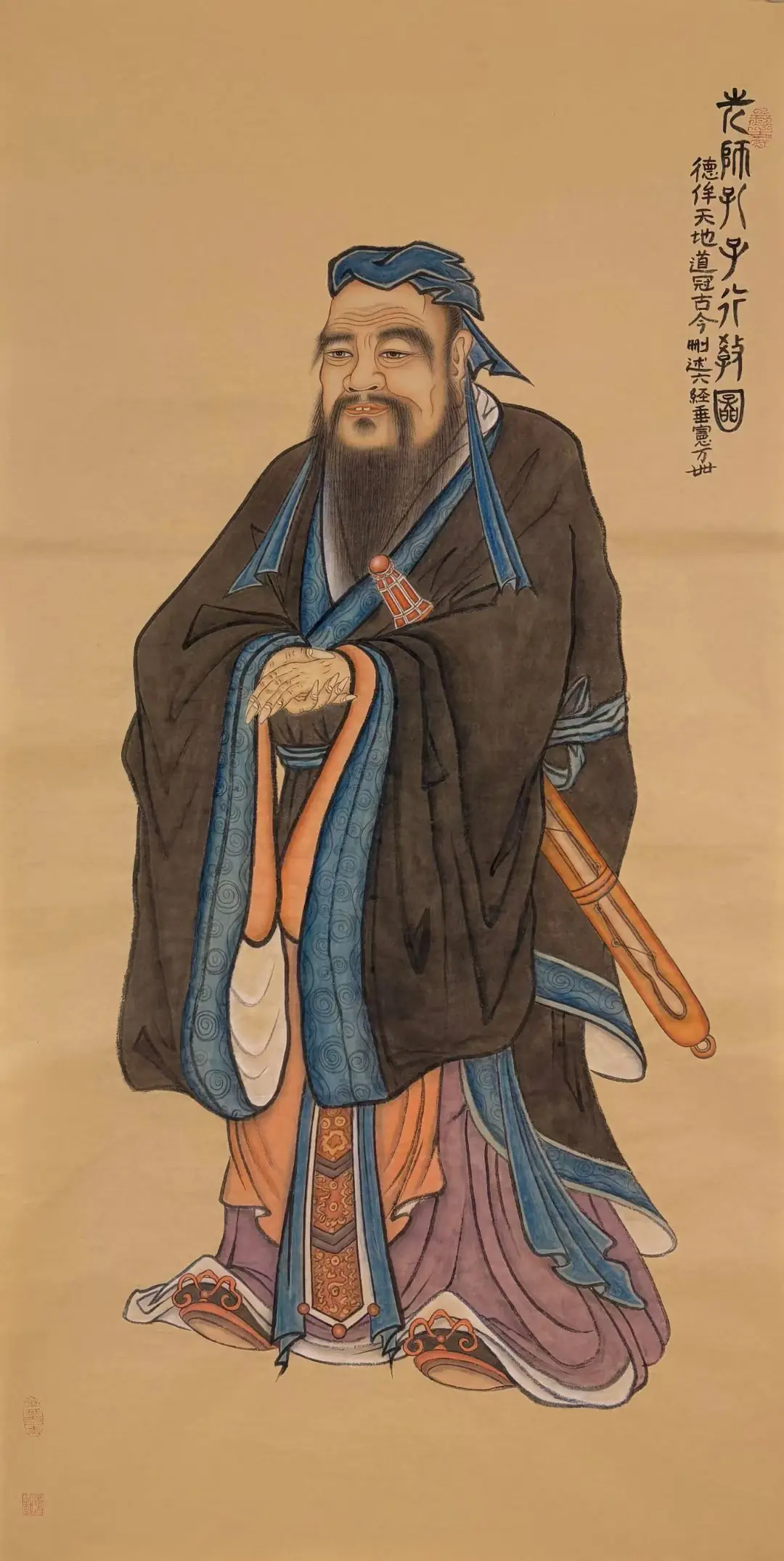
Ji Kangzi (the de facto ruler of the State of Lu), having recalled Confucius with generous gifts, naturally sought his advice on political matters.
In matters of governance, Ji Kangzi (a powerful minister of the State of Lu) asked Confucius: "What do you think of killing those who are wicked and immoral to get close to those who are virtuous and good?" Confucius replied: "Why must you use capital punishment in governing? If you desire to do good, the common people will follow suit." Opposing violent suppression of the people, he advocated guiding them toward goodness through benevolent governance and ritual education. He then used an analogy: "The moral conduct of the Junzi (Exemplary Person) is like the wind, while that of the common people is like the grass on the ground. When the wind blows, the grass is sure to bend."
Ji Kangzi (a powerful minister of the State of Lu) asked Confucius: "How should one govern to bring order to the state?" Confucius replied: "To govern is to rectify one's own thoughts and leadership style. If you are upright in conduct, who would dare to be otherwise?" This highlights that the key to governance lies in the ruler himself setting an example and behaving with integrity.
Ji Kangzi intended to levy taxes according to the acreage of farmland, but fearing that the people would rebel and revolt as a result, he sent Ran You (a disciple of Confucius serving as his steward) to seek Confucius's advice. Confucius disapproved, believing that Ji Kangzi's private lands already exceeded those of the ruler's public fields and that he was already quite wealthy, yet he still sought to increase taxes and exploit the people to live a life of extravagance and dissipation—this was utterly improper. Confucius privately admonished Ran You, saying, "When a Junzi (Exemplary Person) administers governance, he should take Li (Propriety) as his measure, first weighing right and wrong. In bestowing benefits upon the people, he should be generous; in handling affairs, he should consider impartiality; in collecting taxes from the people, he should be sparing." However, Ji Kangzi did not heed Confucius's advice, and Ran You still implemented the "tax-by-land" system according to Ji Kangzi's decision, resulting in taxes more than double the previous amount. When Confucius learned of this, he was very angry and said to his disciples, "The Ji family is wealthier than the high ministers beside the Zhou Son of Heaven, yet Ran You still plunders the people for them to amass even more property. Ran You is no longer my disciple. You should openly denounce him and may indeed attack him!"
Ji Kangzi (a powerful minister of the State of Lu) increased taxes to exploit the people, causing them to suffer from hunger and cold, unable to survive, and theft became rampant in society. Troubled by the incessant theft and feeling anxious, Ji Kangzi asked Confucius how to punish the thieves. Confucius said, "This is caused by your insatiable greed. If you did not exploit the people so greedily by increasing taxes, they would be able to live. Even if you rewarded them for stealing, they would not be willing to become thieves." This was indeed a sharp and merciless exposure of Ji Kangzi's cruel governance.
After Confucius returned to the State of Lu from his travels through various states, Ji Kangzi (a powerful minister of Lu) inevitably discussed the politics of different states with him. When the topic turned to Duke Ling of Wei, who was fond of women and lacked the Dao (Way), yet the State of Wei had not perished, Confucius commented that although Duke Ling himself was without the Dao, there were still a group of worthy and capable individuals in Wei at the time who managed important affairs such as diplomacy, internal governance, and military matters, thus preventing Wei from collapsing.
The State of Lu ultimately could not employ Confucius. He lamented, "No one understands me," realizing there was no hope of putting the Dao (The Way) into practice in his lifetime. Once, by a river, he saw water flowing swiftly and unstoppably, which reminded him of time and his own aging, and he sighed, "Time passes like this flowing water, never ceasing day or night." He also said, "I have not dreamed of the Duke of Zhou for a long time!" Thus, he decided to no longer serve in office.