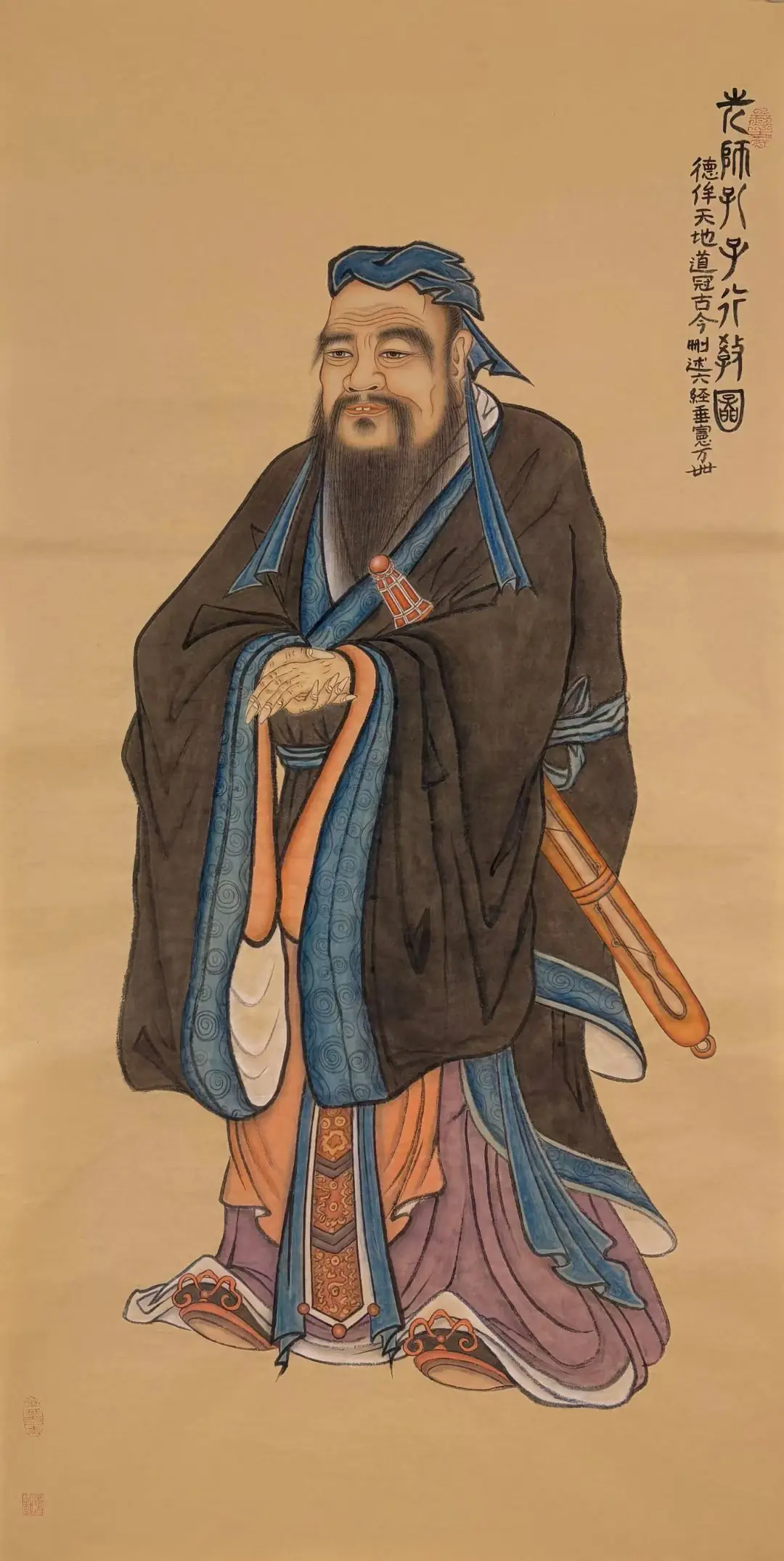
After the Yang Hu (a powerful noble of the State of Lu) incident, the government of Lu invited Confucius to take office. In the ninth year of Duke Ding of Lu (501 BCE), Confucius was appointed as the Steward of Zhongdu (a district magistrate), at which time he was already fifty-one years old.
After governing Zhongdu for one year with outstanding achievements, Confucius was promoted to Xiaosikong (Deputy Minister of Works), the deputy to the Minister of Works who oversaw the nation's highest construction projects. Soon after, he was further promoted to Dasikou (Minister of Justice), the highest judicial official in the State of Lu, ranking alongside the three ministers—Sima (Minister of War), Situ (Minister of Education), and Sikong (Minister of Works)—with a status equal to that of a high minister. During his tenure, Confucius punished the most heinous criminals according to the law, while also using Ren (Benevolence) and Li (Propriety) to educate the people, teaching them to distinguish right from wrong, and honor from disgrace. He said: "Lead the people with governmental measures and regulate them with punishments, and they will avoid wrongdoing but will have no sense of shame. Lead them with virtue and regulate them with Li (Propriety), and they will have a sense of shame and will also correct themselves."
Approaching governance from the root issue of people's hearts, Confucius pointed out the limitations of using punishment to govern. As a coercive measure, punishment can only make people try to avoid crime out of fear of penalties, but this treats symptoms rather than root causes. It cannot, like moral education, enable people to fundamentally understand the shamefulness of crime and thus consciously refrain from it. This reflects the importance of De (Virtue) and its distinction from rule of law as a policy, while also revealing Confucius's view of governing through virtue. Under his administration, lawsuits gradually decreased, and the State of Lu achieved a harmonious political environment.
Sima Qian described Confucius’s governance of the State of Lu, saying: “After Confucius participated in state affairs for three months, those selling lambs and piglets no longer arbitrarily raised prices; men and women walked on separate sides of the road; items left on the road were not picked up; visitors from all directions arriving in the city did not need to request aid from officials, as all were received and treated as if they had returned home.”
During his tenure as Minister of Justice (Sikou) in the State of Lu, Confucius had to obtain approval from Ji Huanzi (the de facto ruler of Lu and one of the three hereditary noble ministers) for any matters he wished to accomplish.
Once, Confucius went to see Ji Huanzi (a powerful noble of the State of Lu) regarding "the governance of officials," but Ji Huanzi was displeased at the time, and the matter was not settled. A few days later, Confucius went to see Ji Huanzi again to facilitate the matter, yet Ji Huanzi still treated him arrogantly. Confucius's disciples were greatly dissatisfied with this, and Zai Yu (a disciple known for his eloquence) said: "Previously, I heard you, Master, say that if a prince or duke does not come to invite you, you should not take action. Now that you have served as Minister of Crime (Sikou) for only a few days, you have already humbled yourself before the prince and duke multiple times. Can you not stop doing this?"
Confucius explained: "The unrest in the State of Lu, where the strong bully the weak and violence prevails through military force, has persisted for a long time. If those in authority fail to govern, chaos will surely follow. This situation requires my intervention—what could be more solemn and urgent than this?" His meaning was that the chaotic state of Lu was awaiting his governance, and this itself was the greatest appointment. His repeated willingness to humble himself and seek an audience with Ji Huanzi (the de facto ruler of Lu) was precisely out of consideration for the greater national interest.