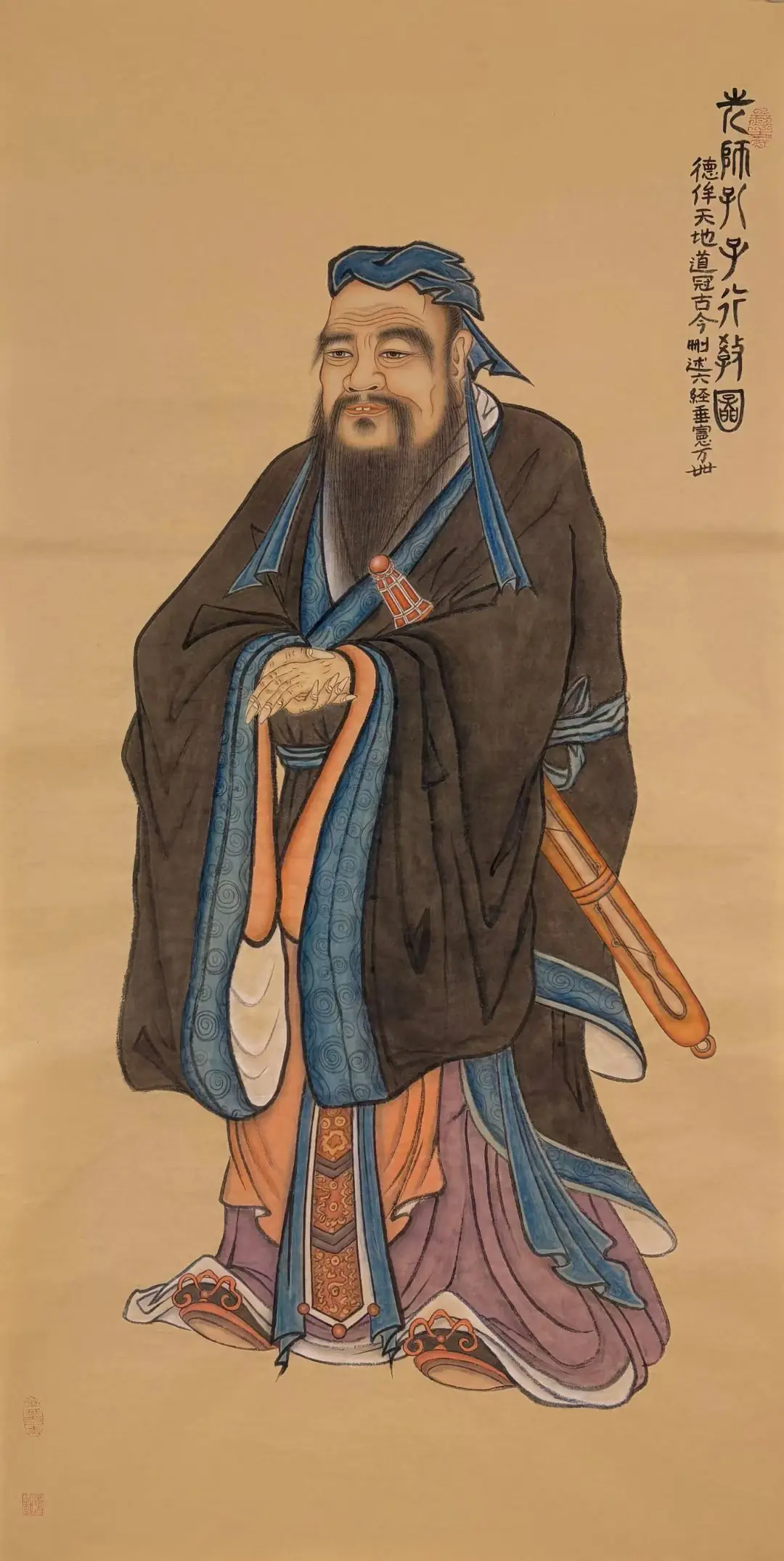
After meeting up at the eastern gate of Zheng State, Confucius and his disciples, weary and travel-worn, endured many hardships and arrived at Chen State. Chen was a small state, its ruler said to be a descendant of Shun (a legendary sage-king), with its capital at Wanqiu (present-day Huaiyang, Henan). Confucius settled in Chen, lodging at the home of Sicheng Zhenzi (a senior official in Chen).
Duke Min of Chen (ruler of the State of Chen) welcomed Confucius into the city with the highest guest rites, treating him with considerable respect and often consulting him on various questions. One day, many falcons struck by arrows fell dead in front of the Chen court; they were pierced by arrows made of Ku wood, with stone arrowheads and shafts one chi and eight cun long (approximately 60 centimeters). Duke Min of Chen, puzzled by these unusual arrows, sent for Confucius to inquire about their origin. After examining the falcons and arrows, Confucius said to the Duke and several of his high ministers: "These falcons come from the far north, and these arrows are from the Sushen people (a northern tribal group). When King Wu of Zhou overthrew the Shang dynasty, all the nine Yi and hundred Man tribes (various non-Chinese peoples) came to pay tribute, and the northern Sushen state offered such arrows. It seems that people there still use them. The former kings distributed the arrows tribute from the Sushen to their eldest daughter Tai Ji. Later, Tai Ji married Yu Hu Gong (a feudal lord), who was enfeoffed in Chen. You should be able to find such arrows in Chen's treasury of ancient artifacts." Confucius paused and said in a deep tone: "The former kings bestowed these distant tributes upon both same-surname and different-surname feudal lords to demonstrate familial bonds and remind them never to forget their allegiance to the Zhou king, but to guard his territory." Duke Min of Chen sent someone to search the treasury and indeed found such arrows, after which he held Confucius in even higher esteem.
In the State of Chen, Confucius participated in court affairs and received a salary. Thus, he stayed in Chen for three years. However, Chen was merely a small state, sandwiched between the states of Chu and Wu. At that time, as Jin and Chu were contending for hegemony, Chen was frequently affected by warfare, and Wu also took advantage of the chaos to raid Chen. Unable to realize his grand ambitions, Confucius had to turn to cultural and educational activities, studying scholarship and collecting documents.
Later, the State of Chu attacked the State of Chen. The western gate of Chen's capital was burned down, and the people of Chu forced Chen's surrendered citizens to repair the city gate. Confucius and his disciples could no longer remain in Chen and decided to go to Chu. As they left Chen's capital and passed through the western gate, Confucius did not bow from his carriage with his hands on the crossbar to salute the Chen people—that is, "Confucius passed by them without performing the Shi (carriage bow)."
Zi Lu (Confucius's impulsive disciple) thought the teacher's attitude violated Li (Propriety), so he questioned: "The rites dictate that when meeting three people, one should dismount and greet them; when meeting two, one may salute from the carriage. Now we encounter so many people from the State of Chen repairing the city wall here. Even if you are in a hurry and cannot strictly follow the rites by dismounting to greet them, why did you not even manage to salute from the carriage?"
Confucius replied seriously: "I have heard that those who do not know their country is perishing are ignorant; those who know it is perishing but do not rise up to resist are disloyal; and those who know to rise up and save the country but refuse to sacrifice themselves are without a sense of shame. Now, these people of Chen who are repairing the city gates are numerous, yet they lack all three of these qualities. Not only have they willingly accepted the fall of their state and become subjects of the enemy, but they are even building fortifications for the enemy. Therefore, I did not bow to them."