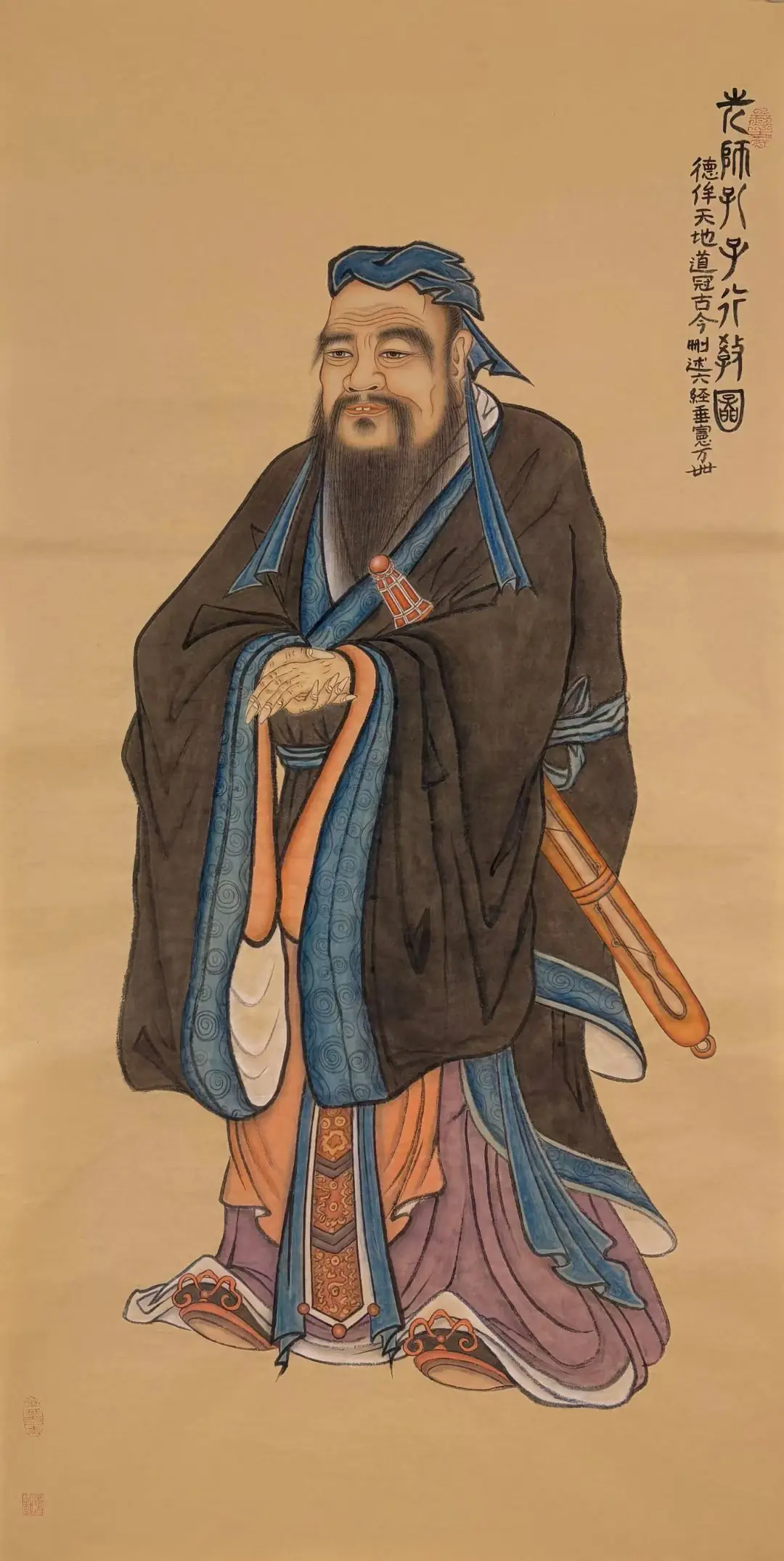
When Confucius was seventeen years old, his mother Yan Zhengzai passed away. Soon after, the nobleman Ji Sun of the State of Lu invited members of the Shi class (the lowest rank of nobility) to a banquet. Believing that as the son of the late warrior Shu Lianghe he might be eligible to attend, Confucius followed others inside. Unexpectedly, Yang Hu (a steward of the Ji family) rudely rebuked him, saying, "Lord Ji is feasting the Shi—who invited you?" Confucius had no choice but to withdraw. This incident only strengthened his resolve and determination to study diligently.
Since childhood, Confucius was diligent and inquisitive, studying hard through self-discipline. His main area of study was the Liu Yi (Six Arts): rites, music, archery, charioteering, calligraphy, and mathematics. This meant becoming familiar with and following the prevailing rites and music of his time, mastering archery skills, learning to drive a chariot, practicing writing (calligraphy), and developing basic arithmetic (mathematics) skills. The Six Arts were the essential knowledge, skills, and talents for anyone wishing to participate in aristocratic politics and gain a certain social standing during the Spring and Autumn Period. Through tireless study, Confucius thoroughly mastered and became proficient in the Six Arts, and his reputation for being "broadly learned" and "knowledgeable in Li (ritual propriety)" gradually spread.
At nineteen, Confucius married a woman from the Song state, Qiguan Shi, with Grand Master Zhongsun acting as matchmaker. In the year of his marriage, he began serving as a "Weili" (a minor official managing granaries), keeping the accounts clear and ensuring no discrepancy in goods stored or distributed. Jisun Shi, appreciating Confucius's abilities, promoted him to "Cheng Tian" (a minor official in charge of herding livestock). During the Spring and Autumn Period, cattle and sheep were primarily raised for sacrificial offerings, which were matters of utmost importance requiring fat and strong animals. Within less than a year as "Cheng Tian," Confucius's pastures were filled with thriving, robust herds. In the tenth year of Duke Zhao of Lu (532 BCE), the year after his marriage, Confucius's son was born. Hearing of Confucius's reputation for upholding, understanding, and teaching Li (Propriety), Duke Zhao sent a congratulatory gift of a carp. Considering this a great honor, Confucius named his son Li (carp), with the courtesy name Boyu. This, however, did not change the family's poverty. Confucius himself once said, "In my youth, I was lowly, so I could perform many menial tasks." He had done all sorts of labor, including sweeping, cooking, washing clothes, planting vegetables, carrying loads, pushing carts, herding sheep and cattle for others, and even serving as a musician at weddings and funerals—all of which he performed skillfully. Near Confucius's residence in Queli was Daxiang Lane, where people praised him, saying, "How remarkable! So broadly learned, yet lacking a specialty to achieve fame." Hearing this, Confucius joked to his disciples, "What am I good at? Driving a chariot? Archery? I am merely good at driving a chariot." This reflects his proficiency in charioteering (Yu). Confucius had no fixed teacher, was adept at learning from others, and was tireless in his pursuit of knowledge. He once said that among three people walking together, one could always be his teacher.
When Confucius was twenty-seven years old (525 BCE, the seventeenth year of Duke Zhao of Lu), Tanzi, the ruler of the small vassal state of Tan located southeast of Lu, came to pay homage to the Duke of Lu. During a banquet, Zhaoxi (named Shusun), a senior official of Lu, asked Tanzi about the system of naming officials after birds during the time of Shao Hao, and Tanzi provided a detailed answer. Upon hearing this news, Confucius immediately went to visit Tanzi to inquire about the official system of the Shao Hao era. When he first had the opportunity to enter the Grand Temple of Lu, where sacrifices were made to the Duke of Zhou, he earnestly asked about every matter. Some people, witnessing this, remarked, "Who said that the son of the official of Zouyi understands Li (Propriety)? When he enters the Grand Temple, he has to ask about everything." When this comment reached Confucius's ears, he said that asking about what one does not know is itself an act of Li (Propriety). Confucius was diligent and eager to learn, becoming self-taught, and he thoroughly mastered the knowledge of the Six Arts (Liu Yi: rites, music, archery, charioteering, calligraphy, and mathematics). By around the age of thirty, he had already laid a solid foundation in both learning and moral cultivation, earning considerable respect from the noble class of his time.