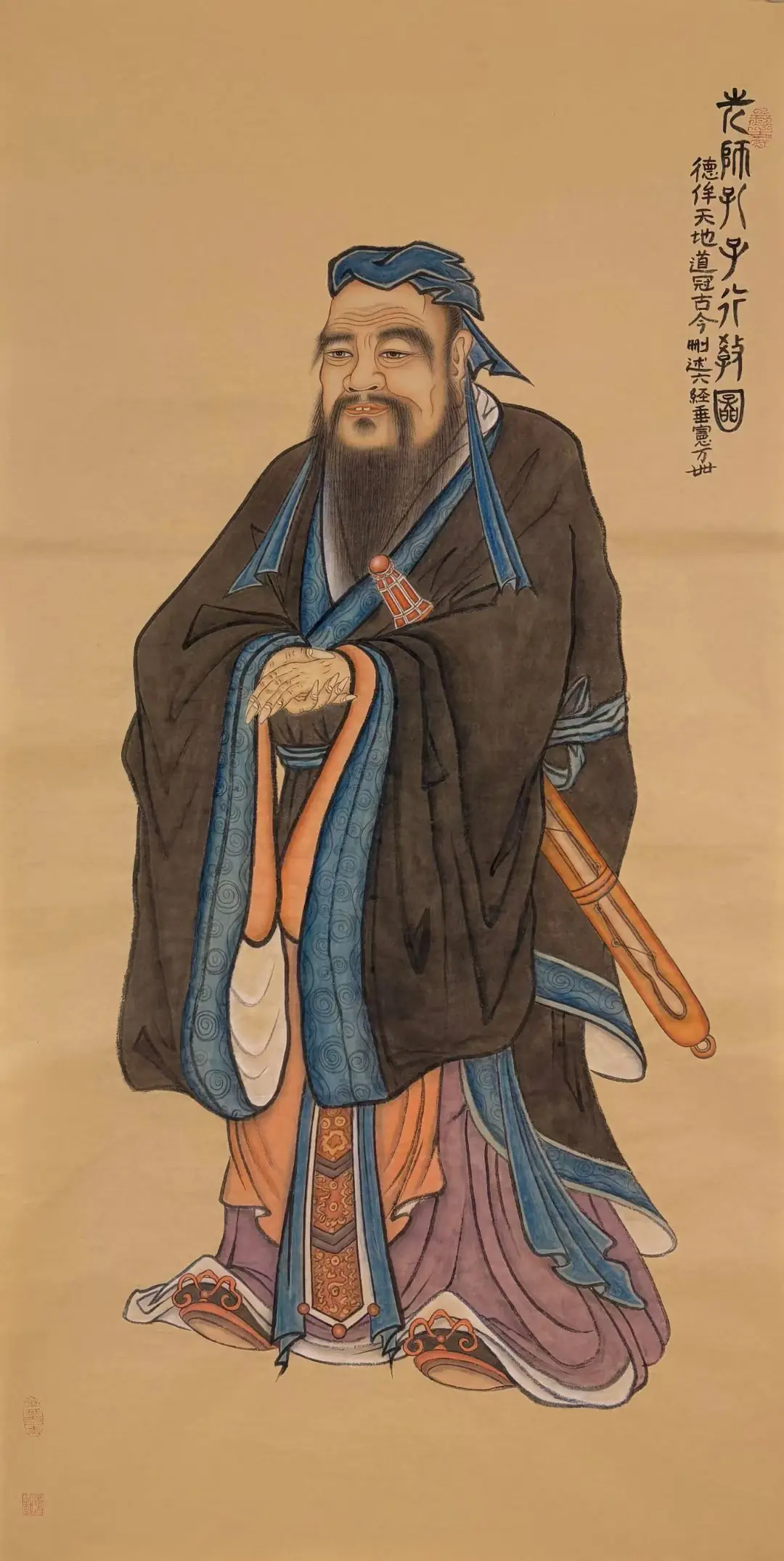
After Confucius returned to the State of Lu in his later years, the people of Lu honored him as the "Elder of the State." At first, Duke Ai of Lu and Ji Kangzi (a powerful noble of Lu) frequently consulted him on state affairs, but he was ultimately never given an important position. Confucius did not resent Heaven nor blame the rulers; instead, he devoted himself to compiling classical texts and continued to gather disciples and teach, never ceasing his educational work. According to historical records: "His disciples numbered about three thousand, and among them, seventy-two were thoroughly versed in the Six Arts (rites, music, archery, charioteering, calligraphy, and mathematics)." At their teacher's invitation, many of his outstanding students participated in or held government office both within and outside the state. For example, Yan Yuan (Confucius's most beloved disciple), Ran You (a talented administrator), Min Ziqian (a filial disciple), Zi You (a disciple known for ritual expertise), Zeng Shen (a disciple known for filial piety), Mi Buqi (a disciple who served as a district magistrate), Yuan Si (a disciple known for integrity), Gao Chai (a disciple known for honesty), Fan Xu (a disciple who asked about farming), Gongxi Chi (a disciple skilled in court ceremonies), Wuma Qi (a disciple who served as a magistrate), Kong Mie (a relative of Confucius), and Zi Jian (a disciple known for virtuous governance) all successively held office in the cities of Lu. Those who served abroad included: Zi Lu (a brave and loyal disciple) in Wei, Zeng Shen in Qi, Chu, and Jin, Zi Gong (a wealthy and eloquent disciple) in Qi, Jin, and Yue, and Bi Xi (a steward of Zhongmou) in Jin. Within their respective spheres, they largely put into practice their teacher's political teachings.
Confucius's educational policy was "teaching without discrimination" (youjiao wulei), which greatly differed from the Yin and Zhou ruling classes' policy of primarily educating the aristocratic class. Among Confucius's known disciples, aside from Meng Yizi and Nangong Jingshu (both from noble families), the vast majority came from poor and humble families, with a few from the so-called "freemen" class. Among his most beloved disciples, Yan Hui was a poor youth living in a humble alley; Zeng Shen's mother worked as a weaver, and he himself once farmed and weeded; Zi Lu was so poor he ate grass seeds as a staple and "carried rice for his parents"; Zi Zhang was originally a "rustic man of Lu"; Min Ziqian had to pull his father's cart when his father went out; Yuan Xian lived in a poor lane and wore tattered clothes; Gongye Chang was a young man wrongly imprisoned on suspicion of theft; and the relatively wealthy Zi Gong was merely a merchant belonging to the "freemen" class.
Confucius's procedure for accepting students was very simple; as long as they brought a bundle of dried meat (shu xiu) as a symbolic gesture of respect to the teacher, it was sufficient. Confucius is said to have had three thousand disciples, which refers to the total number of students he taught throughout his life, and most of these students came from humble backgrounds. The purpose of teaching these children of the poor and lowly, as his disciple Zi Xia (a student known for his emphasis on learning) explained, was "to become an official after excelling in one's studies" (xue er you ze shi), allowing these children of poor working people to learn cultural knowledge and the Six Arts (Liu Yi: rites, music, archery, charioteering, calligraphy, and mathematics), so that in the future they could serve as officials, administer government, and implement his political doctrine of Ren (Benevolence).
In his later years, Confucius also compiled and edited the cultural classics used in his previous teaching—the Classic of Poetry (Shijing), Book of Documents (Shangshu), Book of Rites (Liji), Book of Music (Yuejing), I Ching (Book of Changes), and Spring and Autumn Annals (Chunqiu)—turning them into standardized textbooks. He divided instruction into four categories: "culture" (wen), "conduct" (xing, moral cultivation), "loyalty" (Zhong, devotion to others), and "trustworthiness" (Xin, consistency between words and deeds). These four subjects were all beloved by ordinary people, thus attracting many young students from common families both within and outside the state. In this way, he transformed the "ritual arts" (RuChanges), which since the Shang and Zhou dynasties had been exclusively for the nobility, into "Confucian learning" (RuMusic (Yueji)) for governing the world and benefiting the people. Confucius himself thus became the "founding patriarch" of China's Confucian school. He was the first great educator in Chinese history to establish a large-scale private school on his own initiative.