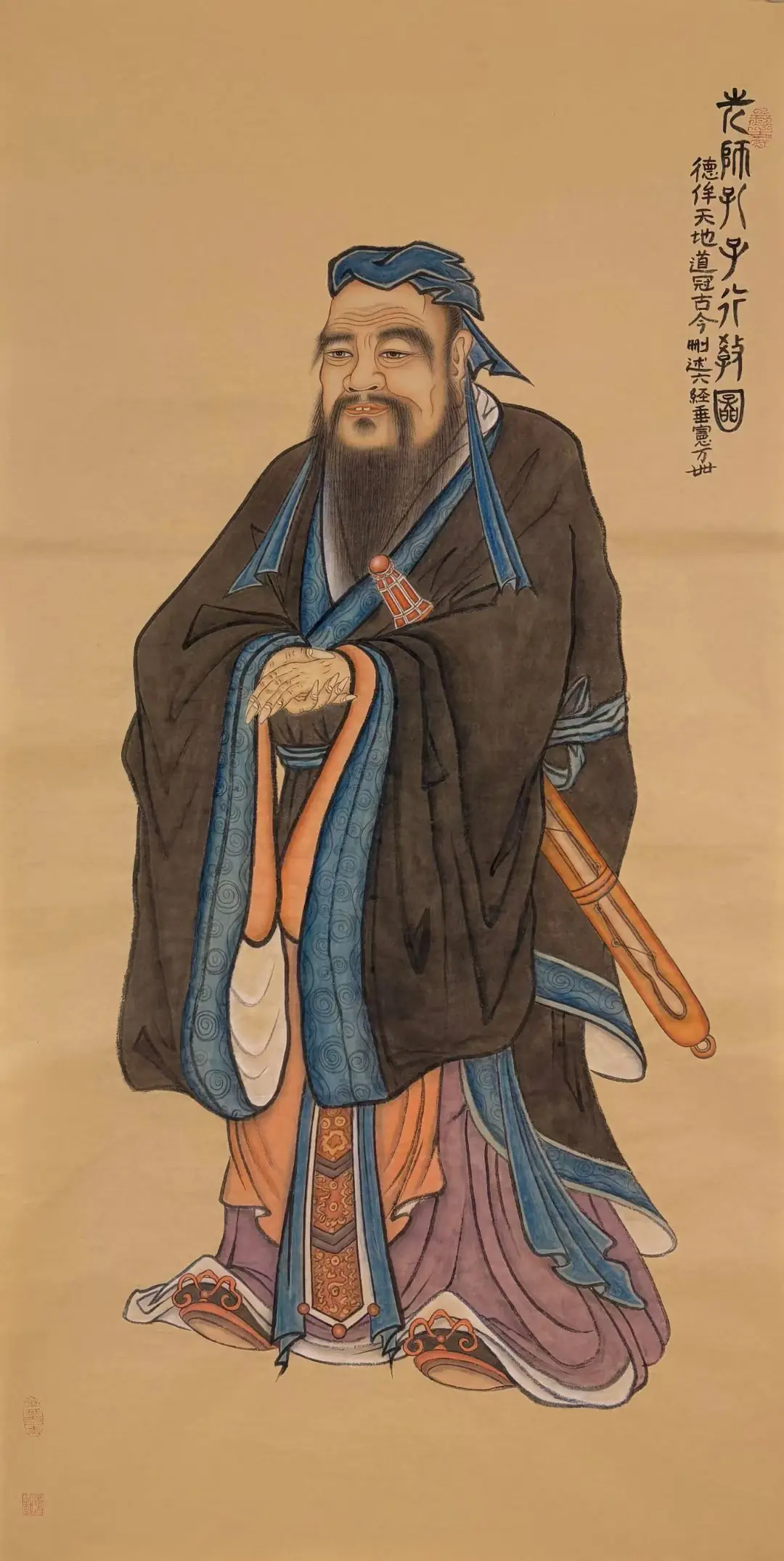
This passage comes from The Analects, Book 12, Chapter 2: "Zhonggong asked about Ren (Benevolence). The Master said, 'When going out, behave as if meeting an important guest; when employing the people, act as if conducting a great sacrifice. Do not impose on others what you yourself do not desire.'" The meaning is that the standard of conduct for Ren is: whatever I do not wish others to do to me, I should not do to them. Confucius stated that the core of his thought system is the Way of Zhong (Loyalty) and Shu (Reciprocity), and what he called Shu is precisely "Do not impose on others what you yourself do not desire" (The Analects, Book 15, Chapter 24). Zi Gong (a wealthy merchant and eloquent disciple) interpreted these eight characters as: "What I do not wish others to impose upon me, I also wish not to impose upon others," and Confucius approved of this interpretation.
From the above, it can be seen that "Do not impose on others what you yourself do not desire" is the core principle of Confucius's concept of Ren (Benevolence). It expresses a fundamental standard for interpersonal relations, requiring that in family life, social interactions, and all societal activities, people act with a mindset of respecting, considering, and understanding others. For example: "What you dislike in your superiors, do not do to your subordinates. What you dislike in your subordinates, do not do to your superiors. What you dislike in those before you, do not do to those after you. What you dislike in those after you, do not do to those before you. What you dislike on your right, do not do to your left. What you dislike on your left, do not do to your right" (The Great Learning, Chapter 10). This means understanding and empathizing with others in social interactions, extending one's own feelings to others. As Zhu Xi explained, "Just as if you do not want your superiors to treat you without Li (Propriety), then you must measure your subordinates' hearts by this standard and dare not treat them without Li. If you do not want your subordinates to be disloyal to you, then you must measure your superiors' hearts by this standard and dare not serve them with disloyalty. This applies to front and back, left and right alike. Thus, in one's own position, above and below, all four sides, long and short, broad and narrow, self and other are as one, and everything is square and proper" (same source). This is the meaning of "Do not impose on others what you yourself do not desire." Confucius believed that this standard of putting oneself in another's place is Shu (Reciprocity). If this standard is implemented in all spheres of social interaction, one can "have no resentment in the state" and "have no resentment in the family," fully manifesting the virtue of Ren in one's conduct. Therefore, in his view, "Do not impose on others what you yourself do not desire" should become a value orientation for people's social behavior, and it should naturally serve as the core of Ren.