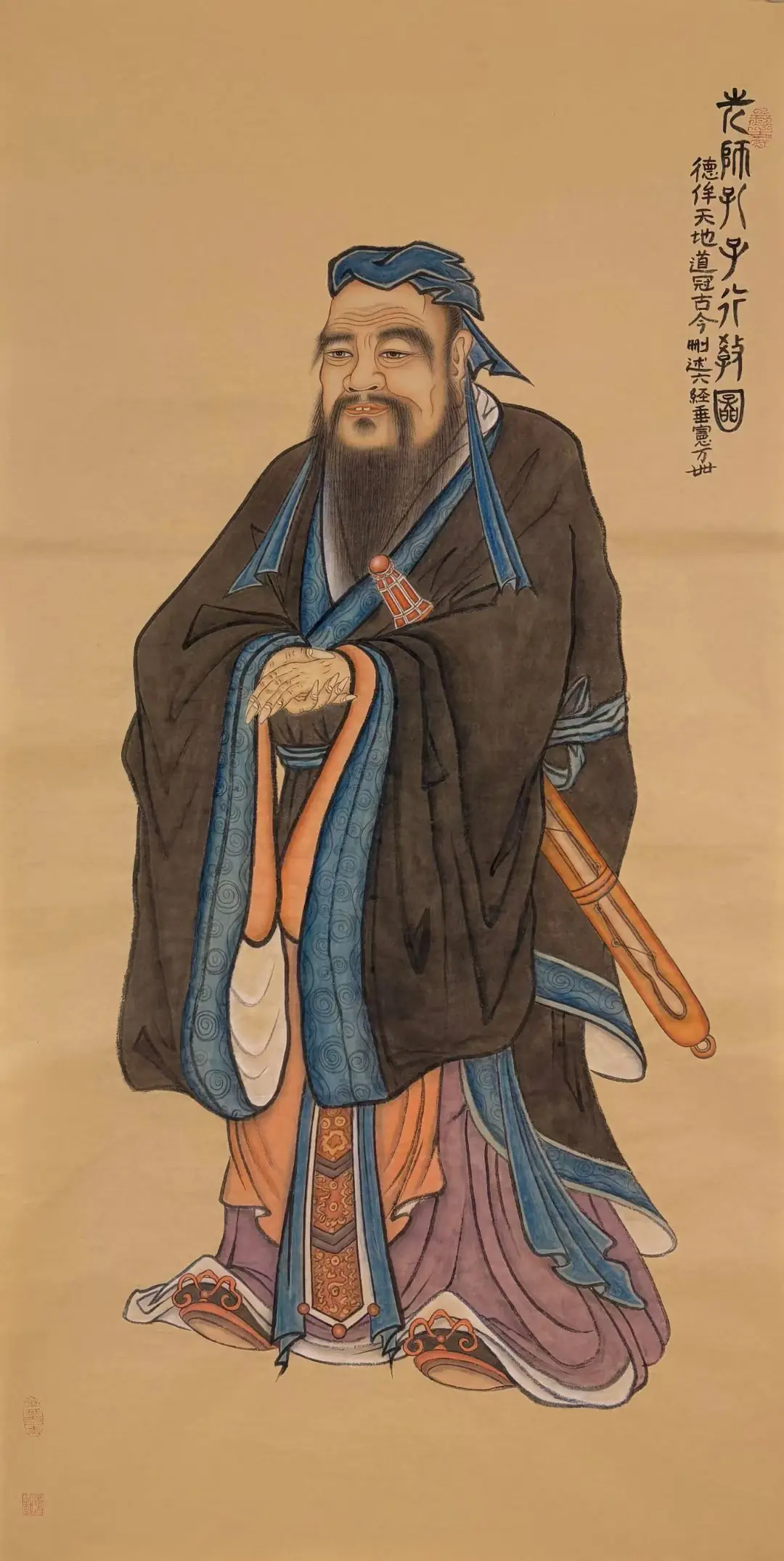
This is from Chapter 2 of The Analects, "Wei Zheng" (On Governance): "Zi Zhang (a disciple of Confucius) asked about seeking an official salary. Confucius said: 'Listen broadly, set aside what is doubtful, and speak cautiously about the rest; then you will make few mistakes. Observe widely, set aside what is perilous, and act cautiously about the rest; then you will have few regrets. When your speech makes few mistakes and your actions have few regrets, your official salary lies within.'"
Zi Zhang (a disciple of Confucius, whose surname was Zhuansun and given name Shi) asked Confucius how to obtain an official salary. Confucius taught him that to be a good official, one must be broadly knowledgeable, so he should listen more, observe more, and gain more experience. When in doubt about something, he should set it aside and wait for an opportunity to ask others. He should be cautious in speech and avoid saying too much. If he can achieve "few faults in words and few regrets in deeds," meaning to speak with few mistakes and act with little to regret later, then the way to earn a living and a salary lies within this. In essence, Confucius was teaching the principles of conducting oneself in the world.
Here is a small story. There was a little boy with a bad temper and poor self-control; whenever things didn't go his way, he would fly into a rage, and everyone disliked him. The boy realized that his problem was his bad temper, but he couldn't control himself. Troubled, he asked his father how to correct this fault. His father led him to the fence in the yard and said, "Son, from now on, every time you lose your temper at someone, hammer a nail into this fence post. After a while, we'll see how many times you've lost your temper, alright?" The boy agreed. Whenever he lost his temper, he hammered a nail into the fence. After a month, he looked and saw a pile of nails already in the fence post! His father said, "Look at these nails—they are like the impact of your temper on others, deeply driven into their hearts, causing them harm. Now, try to think of these nails in the fence whenever you are about to lose your temper. For every time you successfully control your temper, pull out one nail." Deeply touched, the boy began to restrain himself constantly to reduce the number of nails.
At first, the little boy found it very difficult, but finally, one day, he pulled out all the nails from the fence. He happily went to tell his father. His father pointed to the nail holes on the fence posts and said, "Look, although all the nails have been pulled out, those holes will remain here forever. This is like every time you lose your temper; even if you apologize afterward and make amends, the harm will still remain. So the most important thing is to control your emotions and be careful with your words and actions, to avoid causing harm to others."
Before we do something, we should first consider the consequences—just like a nail that has been hammered in, even if later pulled out, the hole remains. People who act impulsively and let their emotions show easily often end up regretting the most. Therefore, Confucius advised Zi Zhang (a disciple) to be cautious in speech and conduct, not to be reckless, and to ensure that one's words contain little fault and one's actions little regret. By planning carefully before acting, one can avoid harming others and reduce future remorse. With fewer mistakes and regrets in words and deeds, success in life naturally becomes easier.