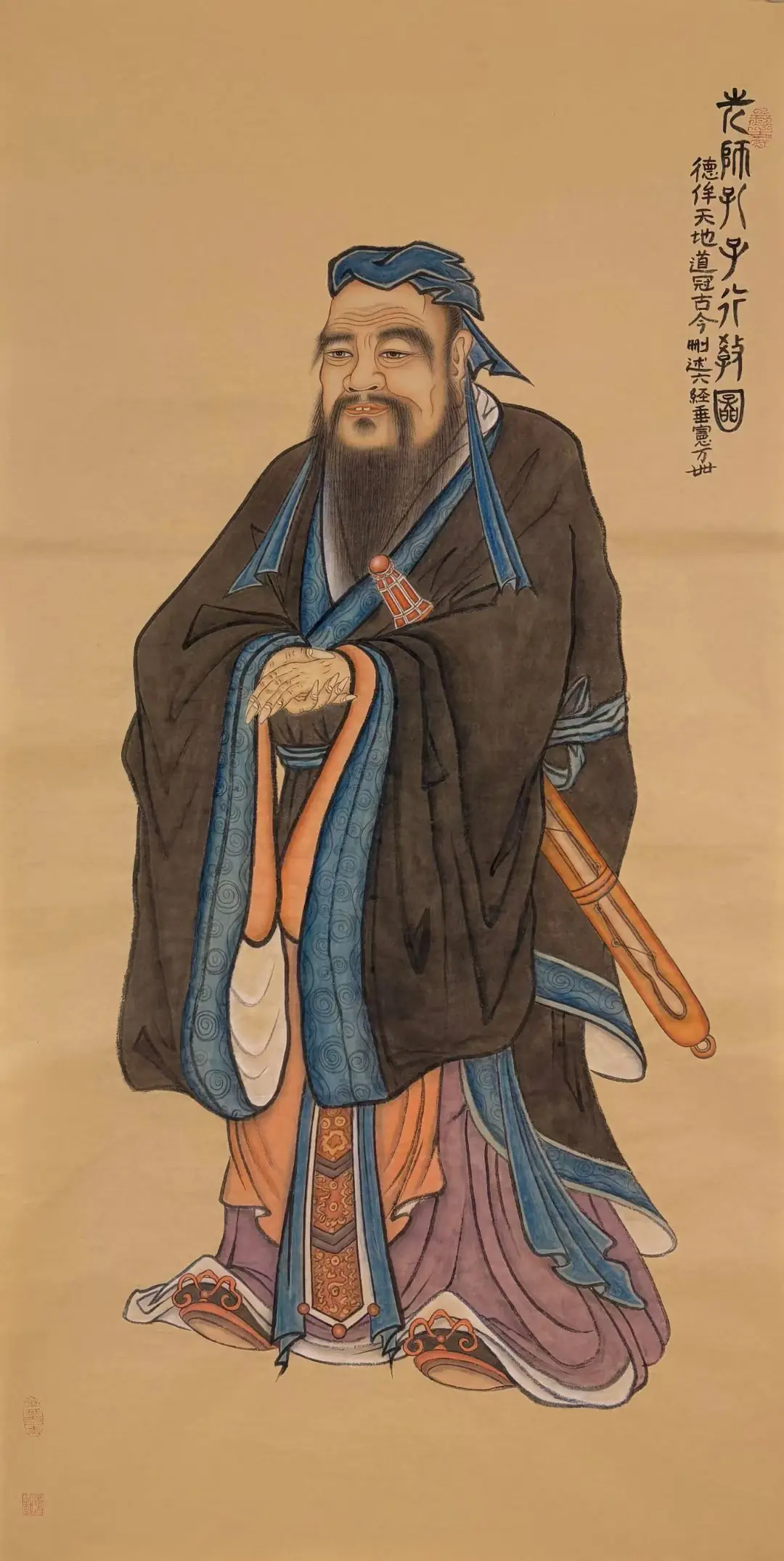
“Zhong” (The Mean) has multiple meanings within Confucius’s system of thought.
One meaning is the most reasonable and unshakable measure selected from two opposing aspects to maintain the optimal balance of things. This practice of "valuing the Mean" (Shangzhong) emerged as a moral category and philosophical concept long before Confucius. The Analects records Yao's instruction to Shun: "The heavenly calendar is on your shoulders; sincerely hold the Mean." (Lunyu, Yao Yue Chapter, 20). The Classic of Poetry also praises Tang of Shang for "neither competing nor striving, neither rigid nor soft" (Shang Song, Chang Fa), indicating that he achieved the Mean. Music, the five flavors, and the five colors also "value the Mean"; when the Mean is attained, it becomes "Zhonghe" (Central Harmony) or "He" (Harmony). The Zuo Commentary, Duke Zhao Year 28, states: "Harmony is like a stew; water, fire, vinegar, salt, and plums are used to cook fish and meat, with firewood beneath. The cook harmonizes them, balancing the flavors, supplementing what is insufficient, and reducing excess. The Junzi (Exemplary Person) eats it to calm his heart... Sound is also like flavor... clear and turbid, large and small, short and long, fast and slow, sorrowful and joyful, rigid and soft, slow and quick, high and low, in and out, sparse and dense—all mutually complement one another. The Junzi listens to it to calm his heart; when the heart is calm, De (Virtue) becomes harmonious." This concept of valuing and holding the Mean was later developed by the Confucian school into the doctrine of Zhongyong (Doctrine of the Mean): "What is not biased is called Zhong; what is unchangeable is called Yong"; "Going beyond is as wrong as falling short"; "Before joy, anger, sorrow, and pleasure arise, this is called Zhong; when they arise and all hit the proper measure, this is called He." This profoundly influenced later Chinese politics, thought, and culture.
Additionally, in The Analects, the character "Zhong" (middle/center) has the following meanings: First, as a positional word, e.g., "When your words are few in fault and your actions few in regret, emolument is in their midst" (The Analects, Book II, Chapter 18); Second, meaning "half," e.g., "The Master said, 'Those who lack strength give up halfway. Now you have set a limit for yourself'" (The Analects, Book VI, Chapter 12), where "zhongdao" means "midway"; Third, indicating the middle grade, e.g., "The Master said, 'To those above average, one can speak of higher things; to those below average, one cannot speak of higher things'" (same chapter); Fourth, used as a verb, e.g., "He did not stand in the middle of the gateway, nor did he step on the threshold when entering" (The Analects, Book X, Chapter 4), where "zhongmen" means "standing in the middle of the gate"; Additionally, "Zhong" is also pronounced in the falling tone, sometimes meaning "hitting the mark" or being reasonable, e.g., "The Master said, 'This man does not speak; when he speaks, he hits the mark'" (The Analects, Book XI, Chapter 14); and sometimes meaning precisely fitting something, e.g., "His words accord with propriety (Li), his actions accord with due consideration" (The Analects, Book XVIII, Chapter 8).