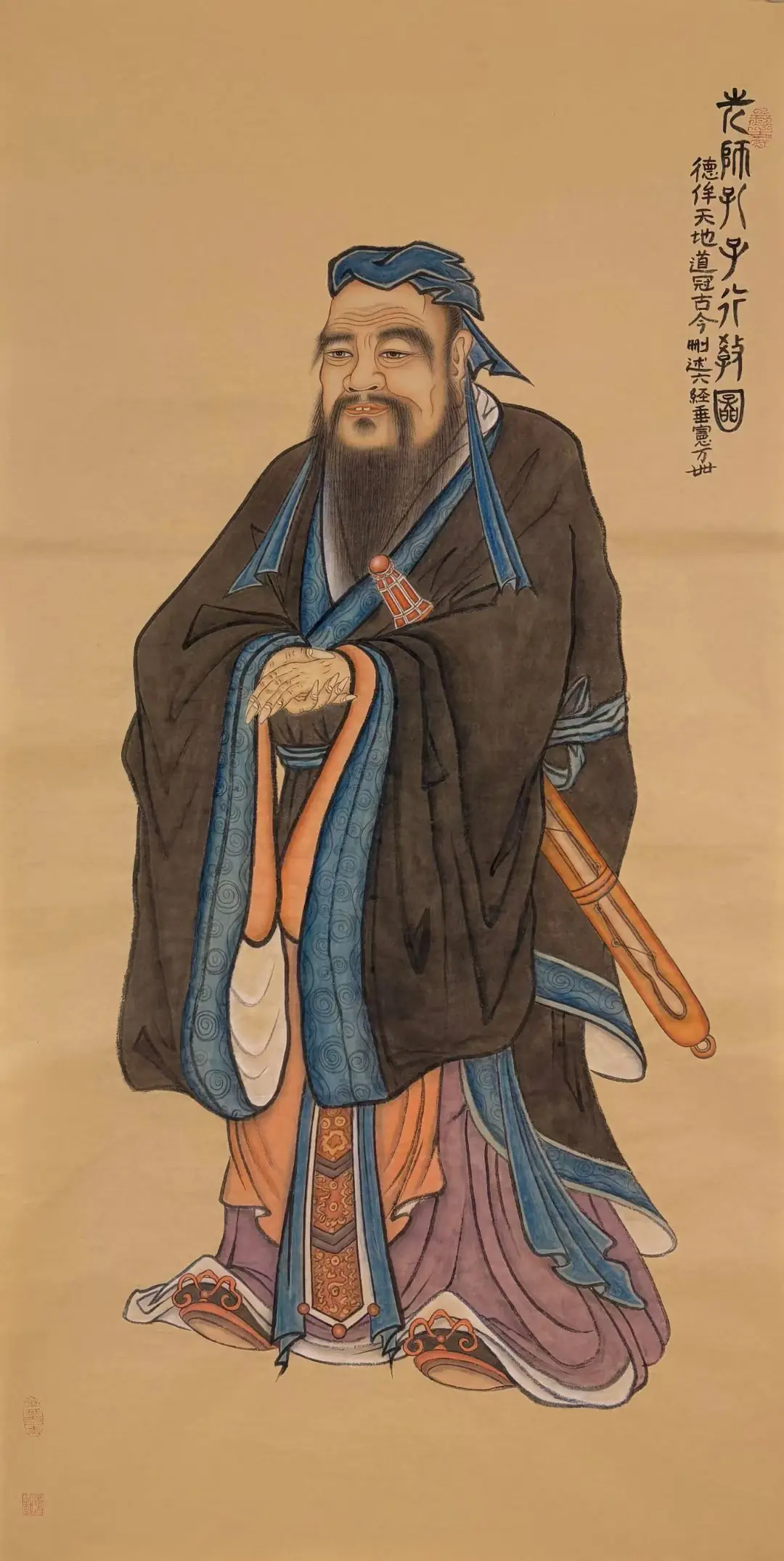
"Xian" refers to being rich in virtue or talent, or to a person who is rich in virtue or talent. Regarding "Xian" (Virtuous/Worthy), Confucius provided excellent discussions.
Confucius advocated for "seeing the worthy and thinking of emulating them." He said, "When you see a worthy person, think of becoming equal to them; when you see an unworthy person, reflect inwardly on yourself." (The Analects, Book 4, "Li Ren") When you see a worthy person, you should think about how to emulate them; when you see an unworthy person, you should conscientiously examine yourself to check if you have similar faults. By engaging in moral cultivation with such conscientiousness and diligence, you will surely become a worthy person yourself.
Confucius advocated respecting worthy individuals. For example, "The Master said: 'If one cherishes the worthy as in the 'Black Robes' (Ziyi) poem, and abhors the wicked as in the 'Xiang Bo' poem, then titles will not be debased and the people will be earnest; punishments will not be used and the people will submit.'" (Book of Rites, "Ziyi" chapter 33) Confucius believed that "Black Robes" (Ziyi) from the Classic of Poetry (Shijing) was a "poem about loving the worthy," hoping people would respect worthy individuals and let them hold state power. He also said, "Yi (Righteousness) means what is fitting, and respecting the worthy is the greatest aspect of it." (Book of Rites, "Doctrine of the Mean" chapter 31) "Respecting the worthy" (Zunxian) is an important aspect of governance. Confucius himself was a person who respected worthy individuals. For instance, Zi Gong (a wealthy merchant and eloquent disciple) asked, "What kind of people were Bo Yi and Shu Qi (two sons of the Lord of Guzhu)?" Confucius said, "They were worthy men of antiquity." (The Analects, "Shu Er" chapter 7) According to The Analects, Confucius repeatedly praised the virtue of Bo Yi and Shu Qi; he also spoke highly of contemporary worthy individuals, such as Zi Chan (a renowned statesman of Zheng State), Yan Ying (Prime Minister of Qi State), and Zuo Qiuming (a historian of Lu State).
Confucius believed that when "worthy people are in low positions without support," the "noble ones" find themselves in a dangerous situation of "being noble without position, high without people." To safeguard the interests of rulers, Confucius advocated for promoting the worthy and employing the capable. He praised the act of "recommending the worthy and promoting the capable," stating: "The scholar-official recommends within his family without avoiding relatives, and outside his family without avoiding those he resents; he evaluates achievements and accumulated deeds, promotes the worthy and advances them, without expecting repayment. If the ruler achieves his aspirations, it benefits the state, and he does not seek wealth or honor. Such is how he recommends the worthy and promotes the capable" (Book of Rites, "Conduct of the Scholar," Section 41). He once criticized the high official of Lu, Zang Wenzhong, for failing to promote the worthy man Liu Xiahui: "Zang Wenzhong—was he not one who usurped a position? He knew the worthiness of Liu Xiahui yet did not give him a standing" (The Analects, Book 15: Wei Ling Gong). Confucius held that employing worthy talents was a crucial aspect of governing the state well. "Zhonggong (a disciple of Confucius) served as steward to the Ji family and asked about governance. The Master said: 'First take charge of your officials, forgive minor faults, and promote worthy talents.' He asked: 'How can I know who is worthy to promote?' The Master said: 'Promote those you know; as for those you do not know, will others neglect them?'" (The Analects, Book 13: Zi Lu). Confucius praised King Wu of Zhou (founder of the Western Zhou dynasty) for his practice of valuing and employing worthy individuals; King Wu employed ten worthy men to overthrow the rule of the tyrant Zhou and establish the Western Zhou regime.
Confucius's view of "seeing the worthy and thinking of equaling them" still holds practical educational significance today. His concept of "honoring the worthy and elevating the worthy" shares similarities with today's principle of "respecting knowledge and respecting talent," and is also worth learning from for modern people.