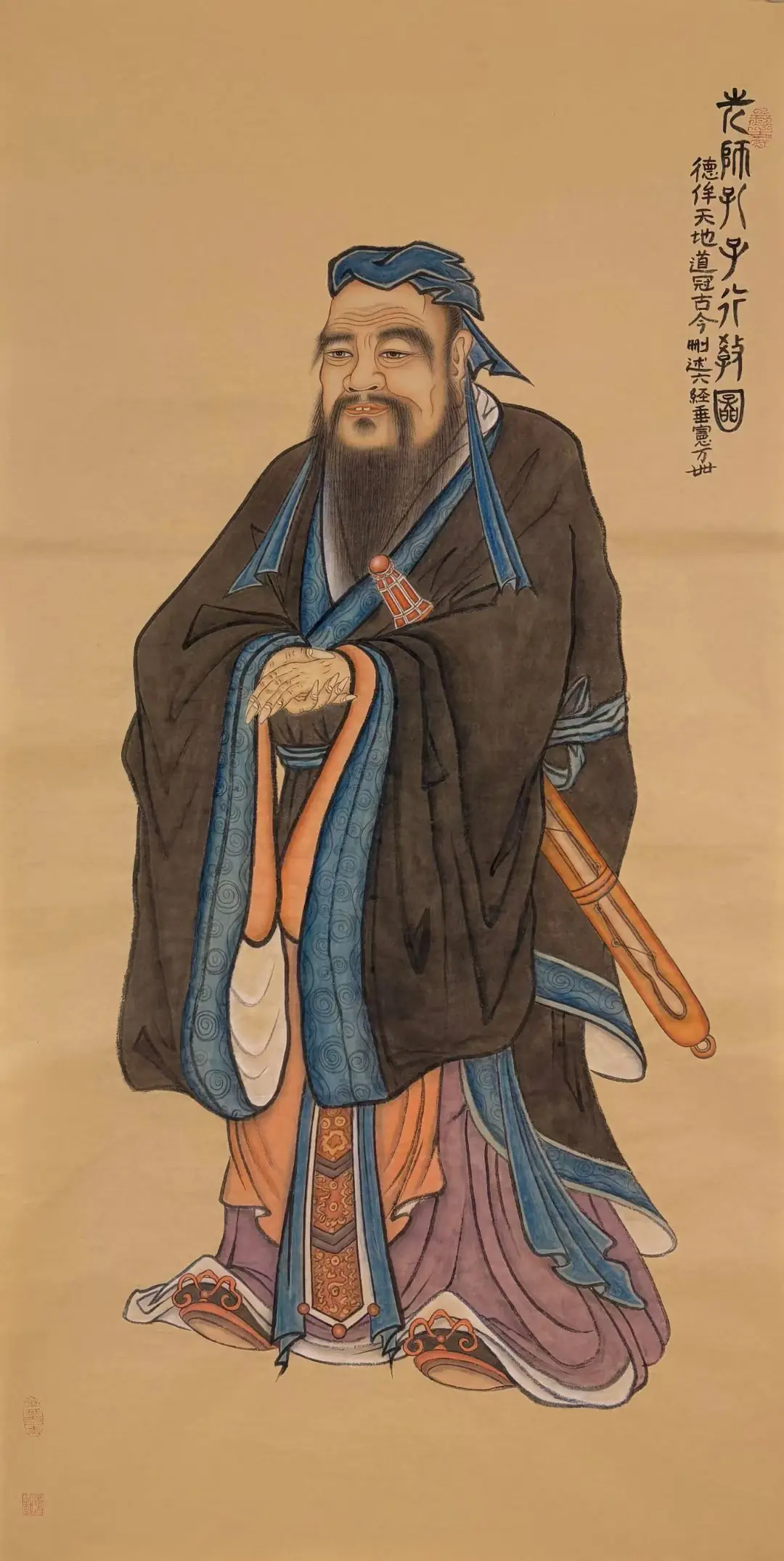
The meaning of “love” (爱) is broad, and one of its aspects refers to the act of caring for others. For example, Confucius said, “Be frugal in expenditure and love your people; employ the people at the proper seasons” (The Analects, Book 1, Chapter 5); when Fan Chi asked about Ren (Benevolence), Confucius replied, “Love others” (The Analects, Book 12, Chapter 22). He also said, “A young man should be filial at home and respectful to elders abroad, be cautious and trustworthy, love the multitude broadly, and draw close to those who are benevolent” (The Analects, Book 1, Chapter 6); and “When the Junzi (Exemplary Person) has learned the Dao (The Way), he loves others” (The Analects, Book 17, Chapter 4). From these examples, it is clear that “loving others” is the core or foundation of the study of Ren. Confucius used “loving others” to define Ren, partly as a result of the developing thought of valuing the people since the Spring and Autumn Period, and partly due to the lingering influence of primitive humanism from residual clan society. The so-called “loving others” means recognizing the personality of others, acknowledging the equality of personality between people, and also implying that rulers and the ruled have equal rights to share in material and spiritual matters. Thus, this love transcends the boundaries of the clan, and even goes beyond class and rank, taking on the nature of “universal love.” This is precisely one of the characteristics of the “Great Harmony” (大同) world that Confucius aspired to.
Starting from the concept of "love" (ai), Confucius advocated for governance through Ren (Benevolence) and rule by virtue in politics. He said: "He who governs by virtue is like the North Star, which remains in its place while all other stars revolve around it" (The Analects, Book II: On Governance). "In ancient times, governance prioritized love for others" (Book of Rites, Chapter 27: Duke Ai's Questions). He also stated: "When you govern, why use killing? If you desire goodness, the people will be good." "The virtue of the Junzi (Exemplary Person) is like wind; the virtue of the Xiaoren (Petty Person) is like grass. When the wind blows, the grass must bend" (The Analects, Book XII: Yan Yuan). He even believed: "When the ruler is upright, orders are carried out without command; when the ruler is not upright, even orders are not obeyed" (The Analects, Book XIII: Zi Lu). "If one can correct oneself, what difficulty is there in governing? If one cannot correct oneself, how can one correct others?" (same source). To change social realities, he preferred the method of "rectifying names" (zhengming) rather than violent revolution. In specific governance, he advocated "guiding them with virtue and aligning them with Li (Propriety)," opposing "guiding them with decrees and aligning them with punishments" (The Analects, Book II: On Governance).
In education, he proposed the principle of "teaching without discrimination" (youjiao wulei) and personally practiced it, recognizing that everyone has the right to education and can perfect themselves throughacquired learning, as birth and status are not determinants of destiny. Confucius believed that "by nature, people are alike; through practice, they become far apart" (The Analects, Yang Huo 17:2), emphasizing the equality of innate human nature, thereby breaking the monopoly of education by the nobility under the system of "learning in the government offices." The embodiment of Confucius's concept of "love" (ai) in his educational theory is precisely the essence and significance of his educational thought.
"Love" also refers to the emotion of affection. In the society that Confucius aspired to, "the elderly are cared for, friends are trusted, and the young are cherished" (The Analects, Book 5, Gongye Chang), which is filled with emotion and love, and only through fulfilling Xiao (Filial Piety) can "the elderly be cared for." The love expressed through filial piety is equal and without discrimination, transforming the hierarchical relationship of subordination between father and son into a bond of human affection, which facilitates psychological acceptance. This is undoubtedly Confucius's contribution. However, the reason filial piety was exploited by successive rulers as a means to consolidate their power and enforce authoritarian rule also lies here. Of course, the love demonstrated by Confucius's emphasis on filial piety also had a positive significance in shaping the national character of the Chinese people, who respect the elderly and care for the young.