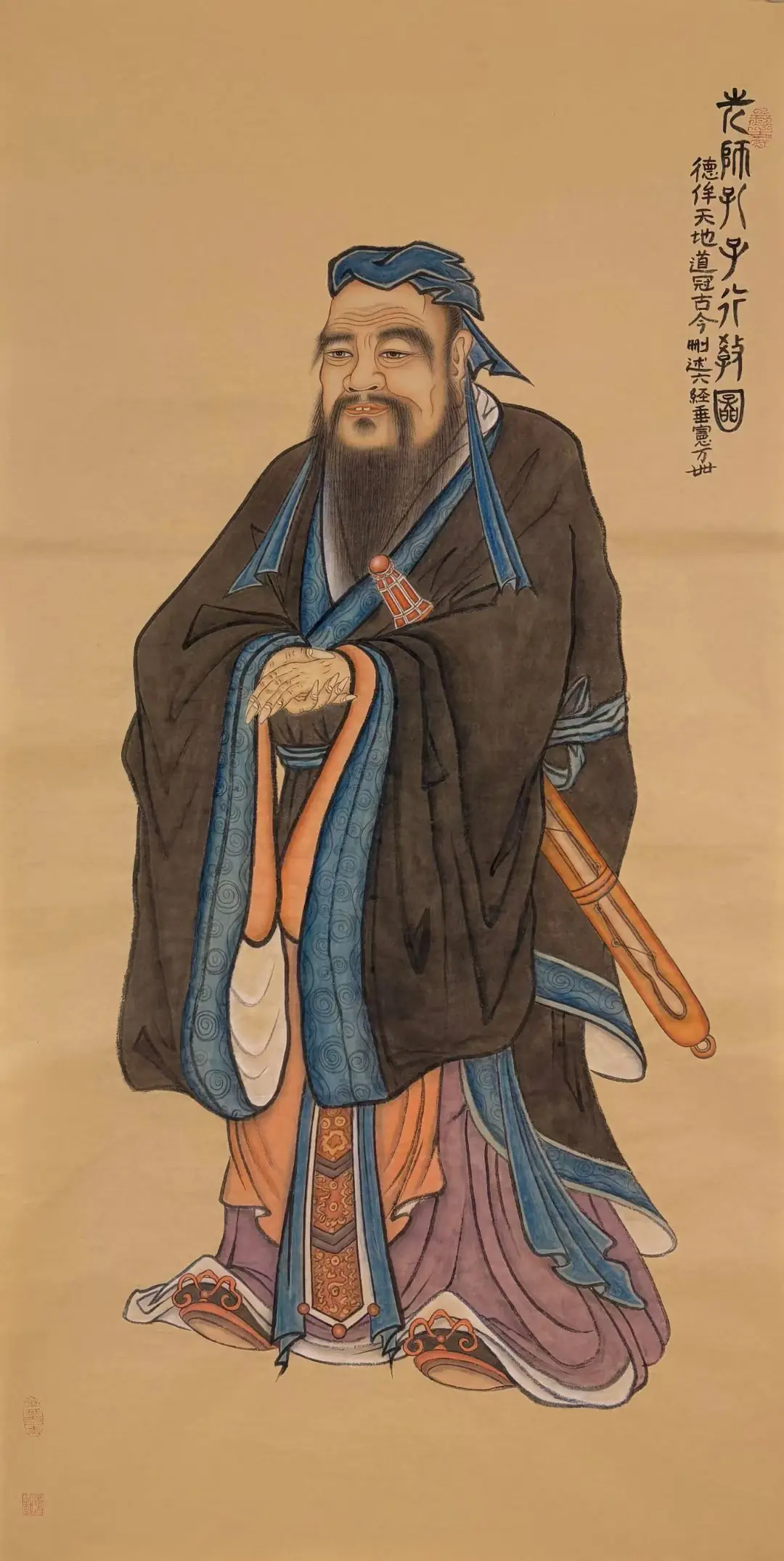
This passage comes from "The Analects, Chapter Wei Ling Gong, Section 15": "The Master said, 'In education, there should be no class distinctions.'" Confucius's educational principle of "teaching without discrimination" (you jiao wu lei) has always been praised by later generations. Before Confucius, learning was reserved for the aristocracy. Confucius was the first person from ancient times through the Spring and Autumn Period to establish a private school and openly recruit students. He said, "From those who bring a bundle of dried meat (as a token of respect) upward, I have never refused to teach anyone" (The Analects, Chapter Shu Er, Section 7). Most of the students he accepted came from poor backgrounds. For example, Yan Hui (Confucius's most beloved disciple) "lived on a single bamboo bowl of rice and a single gourd of water, in a mean alley. Others could not endure such distress, but Yan Hui did not change his joy" (The Analects, Chapter Yong Ye, Section 6), showing his extreme poverty. Zhong Gong's father was a "lowly person," and his family "did not have enough land to stand an awl" (Xunzi, Chapter Fei Shi Er Zi). Zi Lu (a courageous and direct disciple) was a "wild man from Bian," who "once ate coarse herbs and carried rice from a hundred li away" to serve his parents (Shuo Yuan, Chapter Jian Ping). Yuan Xian (a disciple known for his frugality) lived in Lu, "with a room of encircling walls covered with fresh grass, a wicker door not properly closed, and mulberry branches for hinges; with broken jars for windows, stuffed with coarse cloth; the roof leaked, the ground was damp, yet he sat upright and played his lute (and sang)" (Zhuangzi, Chapter Za Pian, Rang Wang).
This was quite remarkable at the time and inevitably raised many questions. Nanguo Huizi (a man of the State of Lu) asked Zi Gong (a wealthy merchant and eloquent disciple of Confucius): "How is it that the disciples at the Master's gate are so diverse in background?" Zi Gong replied wisely: "The Junzi (Exemplary Person) corrects himself and awaits others; he does not turn away those who come, nor does he stop those who leave. Moreover, a good doctor's door is filled with the sick, and beside the tools for straightening wood lies much crooked timber — thus the diversity." (Xunzi, "On the Law and Conduct") This shows that Confucius's practice of education was indeed a concrete embodiment of his concept of Ren (Benevolence/Humaneness) — loving all people.