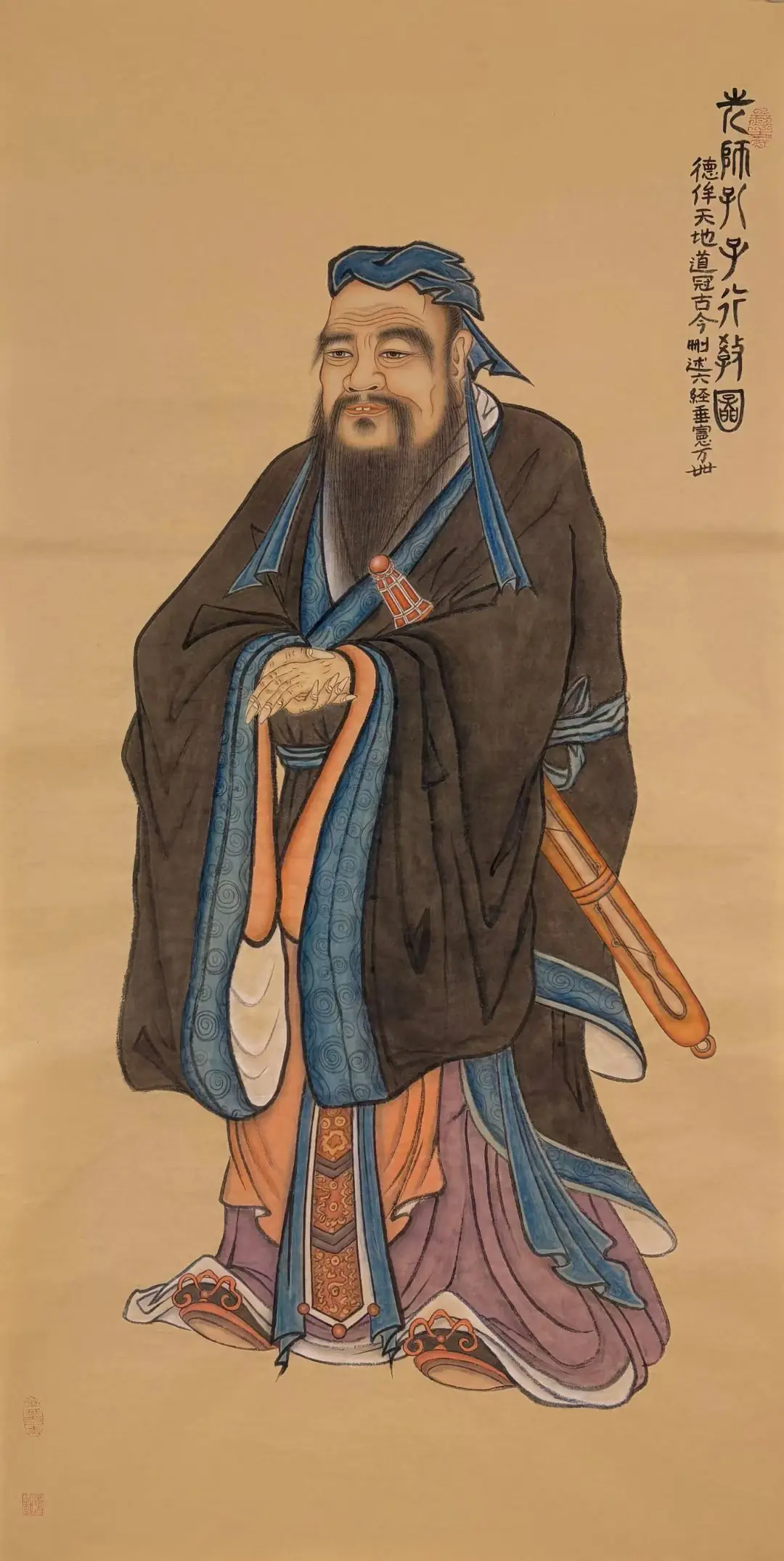
This passage originates from The Analects, Book VII, "Shu Er": "The Master said, 'To quietly remember what I have learned, to learn without satiety, and to teach others without weariness—how do these things apply to me?'" It also appears in Mencius, "Gongsun Chou I": "Confucius said, 'I cannot claim to be a sage. I simply learn without satiety and teach without weariness.'" The Lüshi Chunqiu (Master Lü's Spring and Autumn Annals) also records: "Confucius said, 'How could I deserve such praise? If there is anything I do not stop, it is loving to learn without satiety and loving to teach without weariness.'" The meaning of these sentences is: silently committing what one sees and hears to heart, studying diligently without ever being satisfied, and instructing students tirelessly. Zhu Xi (a Neo-Confucian scholar of the Southern Song Dynasty) wrote in his Collected Commentaries on The Analects: "These three matters are not even the utmost of the sage, yet he still dared not claim them—this is a statement of humility upon humility." The modern scholar Qian Mu believed: "Some view this chapter as a humble remark, but that is not the case" (A New Interpretation of The Analects). The three things Confucius mentions here are: first, the emphasis is on remembering (memory), not on silence, as stated in the Book of Rites, "Zi Yi": "Listen widely, and hold firmly to it," and in The Analects, "Shu Er": "Listen widely, choose the good and follow it; see much and remember it." The second and third express Confucius's unflagging diligence in pursuing knowledge and his fervent enthusiasm in teaching his disciples. At the same time, these are Confucius's reasonable summation, from both an epistemological and methodological perspective, of "learning" and "teaching."
Discover Confucius's timeless wisdom on learning without satiety and teaching without weariness from The Analects.