Pinyin: Wujiapi
Aliases
Nan Wujiapi, Wugupi, Hong Wujiapi.
Source
Plant of the Araliaceae family, *Acanthopanax gracilistylus*Acanthopanax gracilistylusDried root bark of W.W. Smith.
Botanical Description
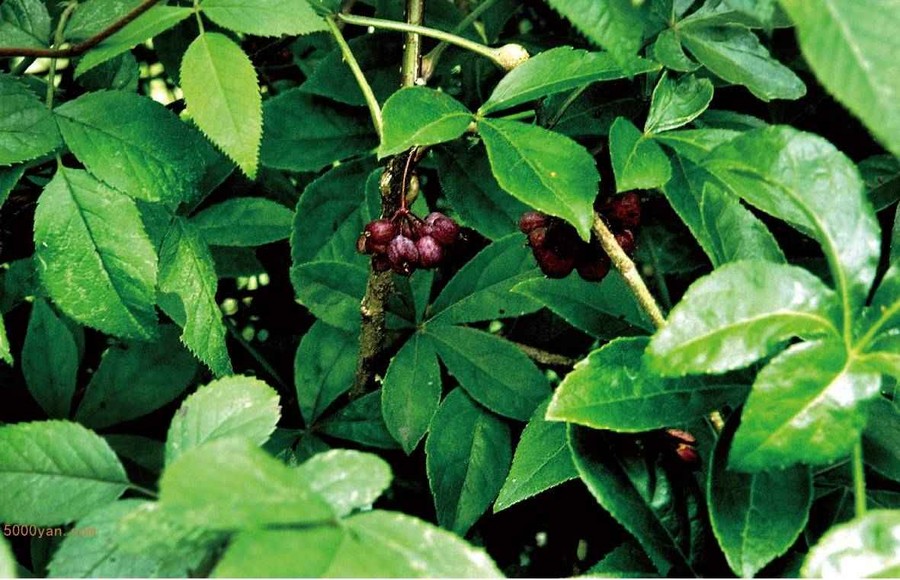
Shrub, sometimes trailing, 2-3 m tall. Branches gray-brown, unarmed or with solitary flat spines at the base of petioles. Leaves palmately compound, alternate on long branches, clustered on short branches; petiole 3-8 cm long, often with fine prickles; leaflets 5, rarely 3 or 4, with the central one largest, obovate to oblanceolate, 3-8 cm long, 1-3.5 cm wide, apex acute or shortly acuminate, base cuneate, both surfaces glabrous or sparsely hispid along veins, with pale brown tufts in the axils of veins beneath, margin finely serrate. Umbels axillary or solitary at the apex of short branches, about 2 cm in diameter; peduncle 1-2 cm long; pedicel 6-10 mm long; calyx 5-toothed; flowers yellowish-green, petals 5, oblong-ovate, apex acute, reflexed at anthesis; stamens 5, filaments slender; ovary 2-locular, styles 2, free or basally connate, stigma capitate. Drupe berry-like, oblately globose, 5-6 mm in diameter, black when ripe, persistent styles recurved. Seeds 2, small, pale brown. Flowering period April to July, fruiting period July to October.
Habitat and Distribution
Found in shrublands, forest edges, hillsides, roadsides, and villages at elevations of 200-1600 m. Distributed in Central China, South China, Southwest China, and in Shanxi, Shaanxi, Jiangsu, Anhui, Zhejiang, Jiangxi, and Fujian.
Harvesting and Processing
In summer and autumn, dig up the roots, wash clean, peel off the root bark, and dry in the sun.
Medicinal Properties
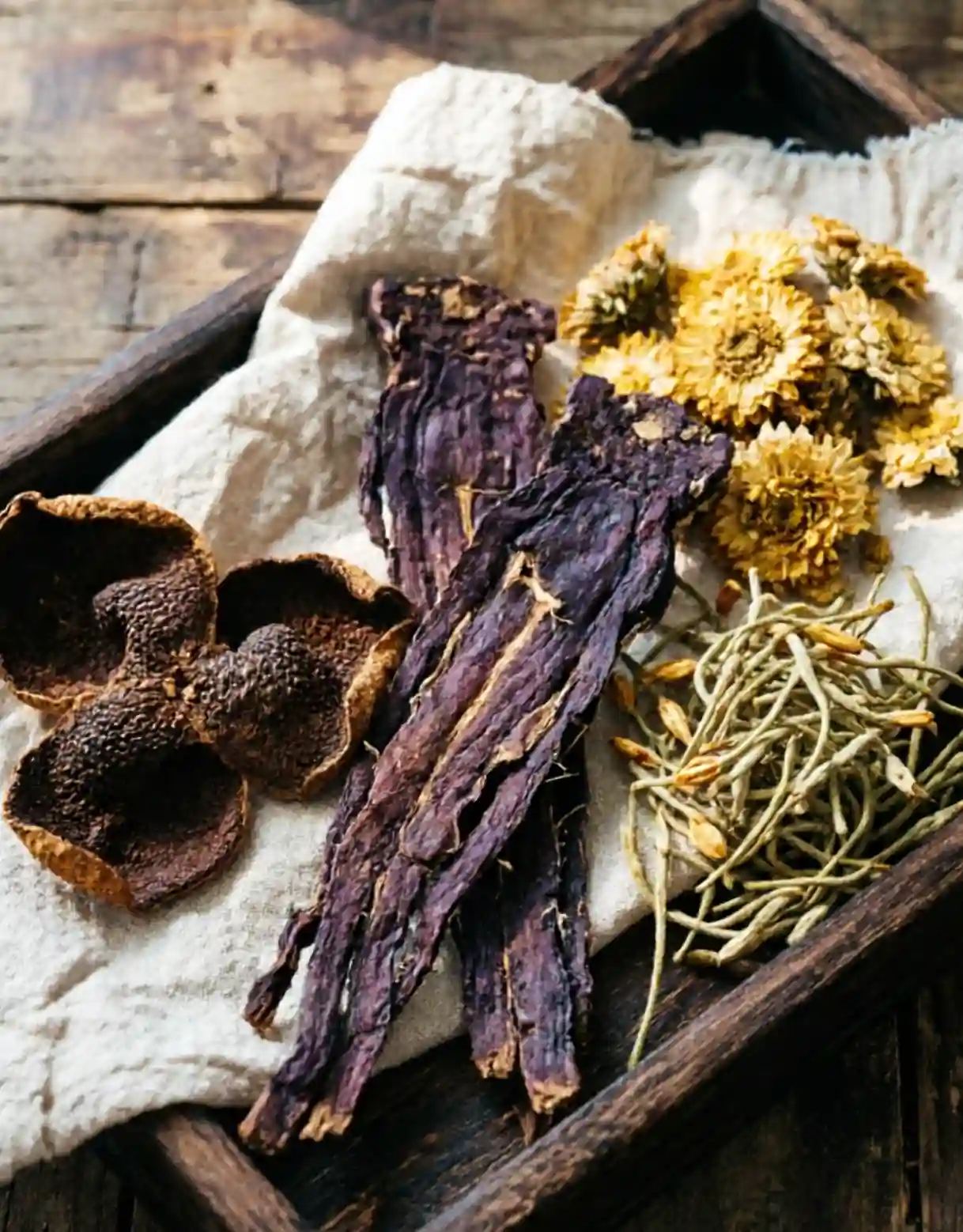
This product appears as irregular rolled tube shapes, 5-15 cm long, 0.4-1.4 cm in diameter, and approximately 0.2 cm thick. The outer surface is grayish-brown with slightly twisted longitudinal wrinkles and transversely elongated lenticel-like scars; the inner surface is pale yellow or grayish-yellow with fine longitudinal striations. The texture is light and brittle, easily broken, with an uneven, grayish-white fracture surface. Odor: faintly aromatic; Taste: slightly pungent and bitter.
Chemical Constituents
This product contains syringin, eleutheroside, acanthoside A, acanthoside B, acanthoside C, acanthoside D, acanthoside K2, acanthoside K3, wujiaside B1, campesterol,β- β-sitosterol.β-Contains components such as sitosterol glucoside and linolenic acid.
Pharmacology
It has anti-inflammatory, anti-stress, and anti-radiation effects, and has a protective effect on hematopoietic function. It can significantly reduce the vitamin C content in the adrenal glands and promote adrenal cortex function in animals. It has a similar excitatory effect on isolated intestinal muscle or isolated uterus, slightly increasing the tension of the intestinal muscle or uterus and enlarging the contraction amplitude. It has an inhibitory effect on S180 solid tumors. It has a significant antioxidant effect, increasing the activity of glutathione peroxidase in the blood and significantly increasing the content of lipid peroxides.
Properties and Channel Entry
Acrid, bitter, and warm. Enters the Liver and Kidney channels.
Functions and Indications
Dispels Wind and eliminates Dampness, tonifies the Liver and Kidneys, strengthens sinews and bones, promotes urination to reduce edema. Used for Wind-Damp Bi disorder (rheumatic conditions), limp and weak sinews and bones, delayed walking in children, physical weakness and fatigue, edema, and beriberi (jiaoqi).
Dosage and Administration
Internal: decoct in water, 6-9 g, double for fresh product; steep in wine or incorporate into pills or powders. External: appropriate amount, decoct for steam-washing or grind into powder for application.
Precautions and Contraindications
Those with Yin deficiency and exuberant Fire should use with caution.
Prescriptions
1. For scrotal edema: Acanthopanax bark 9 g, radish root 30 g. Decoct in water for oral administration. (Southern Medicine *Chinese Herbal Medicine*) 2. For chronic back pain due to old injury: Acanthopanax root bark, wild buckwheat root, each 30 g. Soak in child's urine for 7 days, remove, dry in the sun, and grind into powder. Take 6 g per dose, 2 times daily, with rice wine. (*Jiangxi Herbal Medicine*) 3. For traumatic injury with bruising and pain: Acanthopanax bark, *Lycopus lucidus* leaf, *Trillium tschonoskii*. Pound into a paste, stir-fry with wine while hot, and apply as a poultice to the affected area. (*Sichuan Journal of Chinese Materia Medica*, 1960) 4. For senile low back pain and weak legs, and pediatric rickets: Acanthopanax bark 120 g, deer antler cream 60 g, liquor 0.5 g. Soak for 10 days, filter out the residue, add an appropriate amount of brown sugar. Take 2-3 times daily, in moderate amounts. (*Food Herbal Medicine and Simple Prescriptions*) 5. For kidney deficiency low back pain, sequelae of polio, cold feet, and impotence: Acanthopanax root bark 9-15 g. Decoct in water for oral administration, or stew with pork bones. (*Guangxi Selected Herbal Prescriptions*)