Pinyin: Tujingpi
Aliases
Luohan Song Pi, Tu Jin Pi, Jing Shu Pi, Jin Qian Song Pi.
Source
1. For pneumonia: Renshen 6 g, decoct in water and take orally.Pseudolarix amabilisDried root bark or bark near the root of (Nelson) Rehd.
Botanical Description
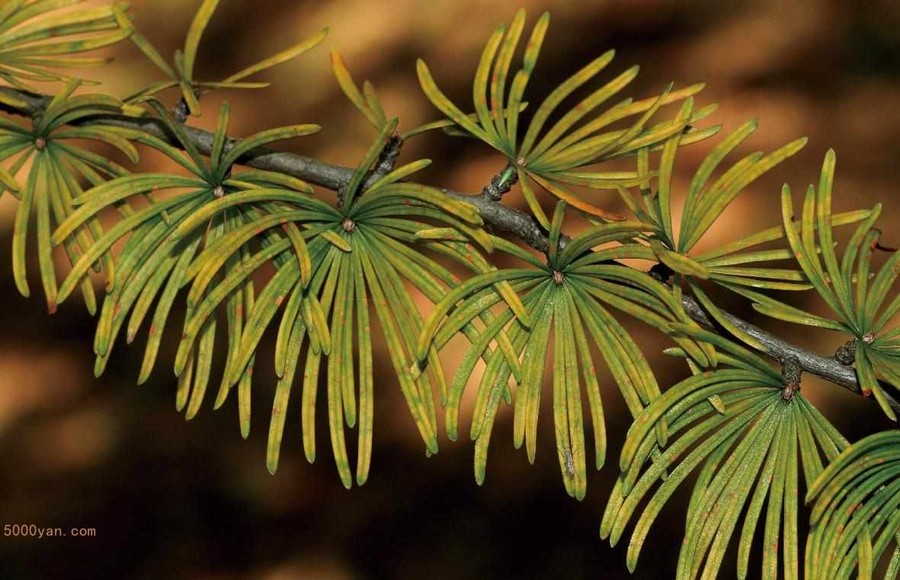
Arbor, up to 40 m tall, with a chest circumference of up to 1.5 m. Trunk straight, bark gray-brown, rough, irregularly scaly and fissured. Annual branches light reddish-brown or light reddish-yellow, glossy; older branches and short branches gray or dark gray. Leaves linear, soft, flat, 2-5.5 cm long, 1.5-4 mm wide, apex acute or pointed, upper surface green with slightly prominent midvein, lower surface bluish-green with prominent midvein, with 5-14 stomatal lines on each side; leaves on long branches radially spreading, leaves on short branches clustered. Male cones yellow, cylindrical, pendulous; female cones purplish-red, erect, ellipsoid, approximately 1.3 cm long, with short peduncle. Cones ovoid or obovoid, 6-7.5 cm long, 4-5 cm in diameter, light reddish-brown when mature; middle seed scales ovate-lanceolate, 2.8-3.5 cm long, auriculate on both sides, apex obtuse with a notch, densely pubescent on the ridge; bract scales approximately 1/4 to 1/3 the length of the seed scales, ovate-lanceolate, margin finely serrate. Seeds ovoid, white; seed wings triangular-lanceolate, pale yellow or pale brownish-yellow, glossy. Flowering period: April to May; fruit maturation period: October to early November.
Habitat and Distribution
Found in mixed coniferous and broad-leaved forests at elevations of 100-1500 m. Distributed in Jiangsu, Anhui, Zhejiang, Jiangxi, Fujian, Hubei, Hunan, Sichuan and other regions. Mostly cultivated.
Harvesting and Processing
Peeled in summer and dried in the sun.
Medicinal Properties
The root bark is irregularly long-strip-shaped, twisted and slightly curled, varying in size, 2-5 mm thick. The outer surface is grayish-yellow, rough, with wrinkles and grayish-white transverse lenticel-like protrusions; the rough bark often peels off in scales, revealing a reddish-brown color beneath. The inner surface is yellowish-brown to reddish-brown, smooth, with fine longitudinal striations. The texture is tough, and the broken surface is lamellar, easily peeling off in layers. Odor: faint; Taste: bitter and astringent.
Chemical Constituents
This product contains pseudolaric acid B, pseudolaric acid A, pseudolaric acid B, pseudolaric acid C, pseudolaric acid D, pseudolaric acid E, pseudolaric acid B-β- D-glucose glycosides and other constituents.
Pharmacology
Antifungal, anti-fertility, hemostatic, and has an effect on the activity of liver cancer cells.
Properties and Channel Entry
Acrid, warm; toxic. Enters the Lung and Spleen channels.
Functions and Indications
Kills parasites, treats tinea, and relieves itching. Used for scabies, tinea, and pruritus.
Dosage and Administration
External use: appropriate amount, soak in wine for topical application or grind into powder for mixing and applying.
Precautions and Contraindications
This product is toxic and for external use only; not suitable for oral administration.
Prescriptions
1. For skin tinea: Tujingpi 30 g, Baijiu 60 g, soak for 7 days, rub on the affected area; before applying, rub the tinea scab with an old ginger slice to break it open. (Anhui Zhongcaoyao) 2. For leprosy: Tujingpi 1 jin, Baiji, Jianbinglang, and Baizhi 30 g each, grind into fine powder and rub on for three days. (Yangyi Daquan) 3. For tinea: Tujingpi 30 g, two Banzao, three Jixinbinglang, four Fanmubie, and half a jin of Huojiu, soak for one full season, then dip and rub onto the tinea. (Yangyi Daquan) 4. For dry tinea: Tujingpi 15 g, Zhangnao 3 g, Baijiu 60 g, soak for 3 days then rub on the affected area. (Qingdao Caoyao Shouce) 5. For eczema with itching: Tujingpi, decoct into a concentrated juice, warm and wash the affected area. (Anhui Zhongcaoyao)