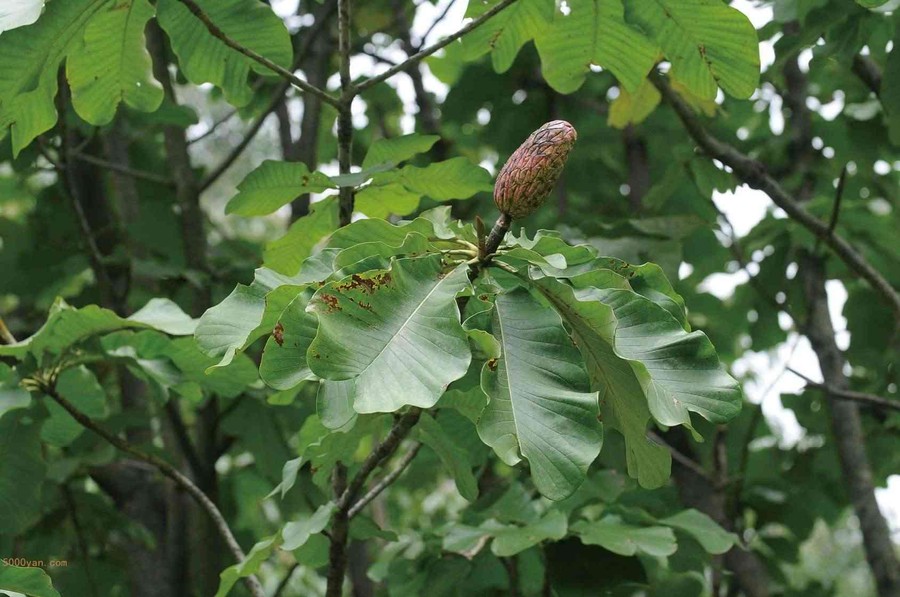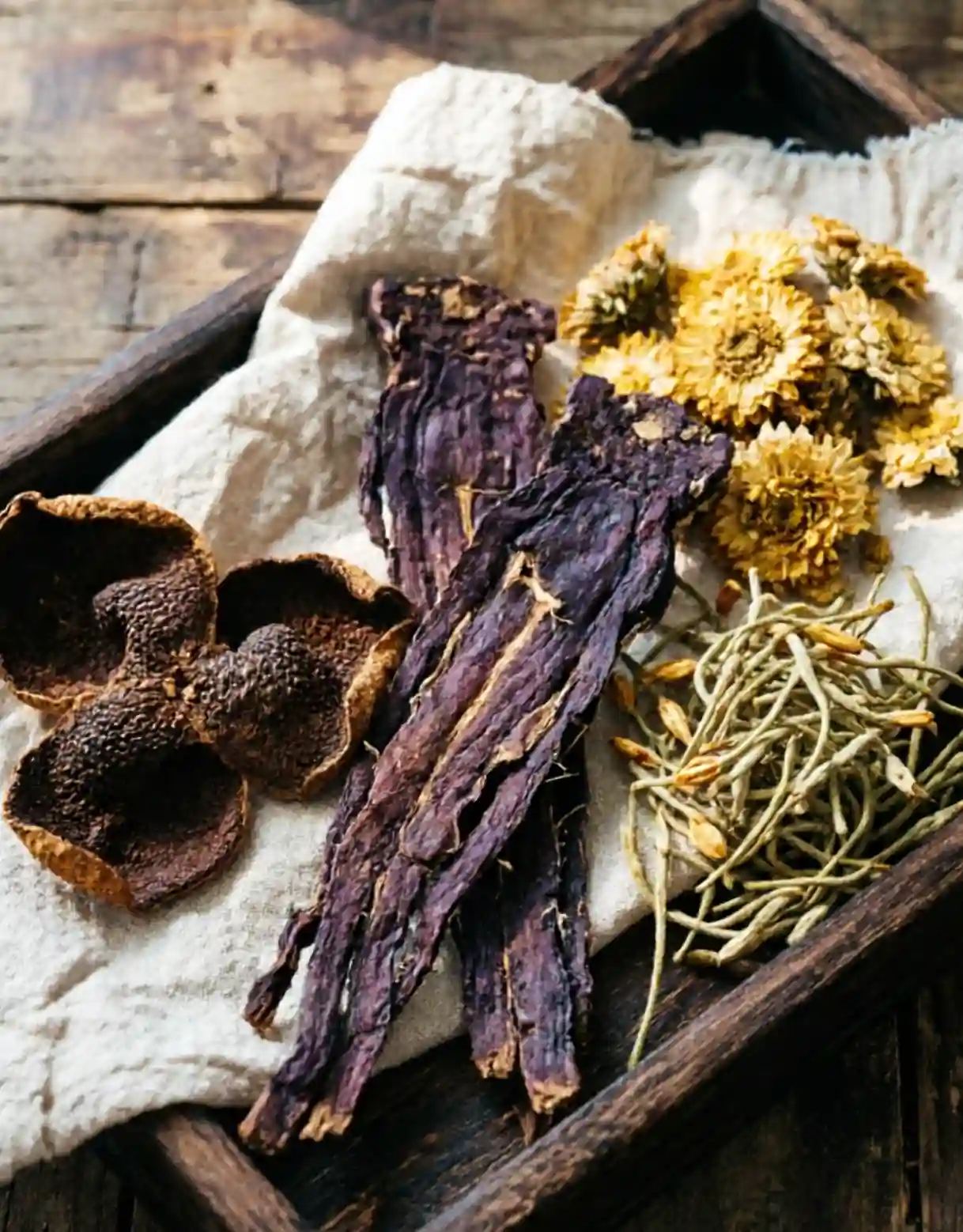
Pinyin: Houpo
Aliases
Houpi, Zhongpi, Chipu, Chuanpu, Ziyou Houpu.
Source
Magnoliaceae plants *Magnolia officinalis* and *Magnolia officinalis* var. *biloba*.Magnolia officinalisRehd.et Wils.var.bilobaDried trunk bark, root bark, and branch bark of Rehd. et Wils.
Botanical Description
See the entry under "Houpo Hua" (Magnolia Flower).
Harvesting and Processing
Collected from April to June, the root bark and branch bark are stripped and dried directly in the shade; the dried bark is briefly boiled in boiling water, then stacked in a cool, damp place to "sweat" until the inner surface turns purplish-brown or brownish-brown, then steamed until soft, removed, rolled into a tube shape, and dried.
Medicinal Properties
1. Dried bark: In roll-like or double roll-like form, 30-35 cm long, 2-7 mm thick, commonly called "Tongpu"; the bark near the root base spreads open like a trumpet mouth, 30-35 cm long, 0.3-0.8 cm thick, commonly called "Xuetongpu." The outer surface is gray-brown or gray-brown, rough, sometimes scaly, easily peeling, with distinct elliptical lenticels and longitudinal wrinkles; scraping off the rough outer layer reveals a yellow-brown color. The inner surface is purple-brown or deep purple-brown, relatively smooth, with fine longitudinal striations, showing oily marks when scratched. The texture is hard, not easily broken. The fracture is granular, with a gray-brown outer layer and a purple-brown or brown inner layer, oily, sometimes with numerous small shiny specks visible. The odor is aromatic; the taste is pungent and slightly bitter.
2. Root bark (Genpo): The bark of the main root and lateral roots, 3-5 mm thick, in single tubular pieces or irregular fragments; some are curved like chicken intestines, commonly known as "Jichangpo" (chicken intestine bark). Texture hard, relatively easy to break, fracture surface fibrous. 3. Branch bark (Zhipo): In single tubular pieces, 10-20 cm long, 1-2 mm thick. Texture brittle, easy to break, fracture surface fibrous.
Chemical Constituents
This product contains magnolol and honokiol, syringaresinol-4′-O-β-D-glucopyranoside, magnolignan A, magnolignan B, magnolignan C, magnolignan D, magnolignan E, magnolignan F, magnolignan G, magnolignan H, magnolignan I, bornylmagnolol and other components.
Pharmacology
It exhibits muscle relaxant effects; at low doses, it stimulates intestinal smooth muscle, while at high doses, it has an inhibitory effect; it possesses anti-ulcer activity, significant central nervous system depressant effects, lowers blood pressure, is anti-pathogenic and anti-tumor; it also has anti-platelet and intracellular calcium mobilization inhibitory effects.
Properties and Channel Entry
Bitter, acrid, and warm. Enters the Spleen, Stomach, Lung, and Large Intestine channels.
Functions and Indications
Dries Dampness, dissolves Phlegm, descends Qi, and relieves fullness
Dosage and Administration
Oral administration: decocted in water, 3-10 g; or made into pills or powder. For drying Dampness and relieving fullness, use raw; for stopping vomiting, use stir-fried with ginger juice.
Precautions and Contraindications
For those with Qi deficiency, fluid damage, and blood depletion, as well as pregnant women, use with caution.
Prescriptions
1. For parasitic infestation: Houpo (Magnoliae Officinalis Cortex) 6 g and Binglang (Arecae Semen) 6 g, with two Wumei (Mume Fructus); decoct in water and take orally. (From Bao Chi Quan Shu) 2. For disharmony between the Heart and Spleen with Kidney Qi deficiency, or turbid white urine: Houpo (Magnoliae Officinalis Cortex) 30 g (prepared with ginger juice, lightly stir-fried) and Baifuling (Poria alba) 3 g. Grind the above ingredients evenly into one dose, add one bowl each of water and wine, and decoct to one bowl. Divide into two doses, take warm before meals. (From Pu Ji Fang, Ying Quan San) 3. For abdominal fullness, pain, and constipation: Houpo (Magnoliae Officinalis Cortex) 240 g, Dahuang (Rhei Radix et Rhizoma) 120 g, and Zhishi (Aurantii Fructus Immaturus) five pieces. Decoct the first two ingredients in one dou and two sheng of water until five sheng remain, then add Dahuang and decoct until three sheng remain. Take one sheng warm, continue until bowel movements occur. (From Jin Gui Yao Lue, Houpo Sanwu Tang) 4. For pediatric vomiting and diarrhea due to Stomach deficiency or phlegm-induced convulsions: Houpo (Magnoliae Officinalis Cortex) 30 g and Banxia (Pinelliae Rhizoma) 3 g (soaked seven times, steeped in ginger juice for half a day, then sun-dried). Soak both in three sheng of rice-washing water for one hundred ke (a unit of time) until the liquid is fully absorbed. If not fully absorbed, heat gently to dry. Remove Houpo, grind only Banxia. Take 1.5 g per dose, mixed with Bohe (Menthae Haplocalyctis Herba) decoction. (From Xiao Er Yao Zheng Zhi Jue, Houpo San) 5. For Stomach deficiency diarrhea, especially effective in elderly visceral diarrhea: Wutou (Aconiti Radix, processed) 0.9 g, Houpo (Magnoliae Officinalis Cortex, ginger-fried) 0.3 g, Gancao (Glycyrrhizae Radix et Rhizoma, honey-fried) 0.3 g, and Ganjiang (Zingiberis Rhizoma, processed) 0.3 g. Take 3 g per dose, with three he of water and two slices of Shengjiang (Zingiberis Rhizoma Recens), decoct to two he. Take hot, stop after two doses. (From Su Shen Liang Fang, Jianpi San)