Pinyin: Huangbo
Aliases
Bomu, Bopi, Huangbo
Source
Decect in water and take orally, 3-10 g.Phellodendron chinenseThe dried bark of *Phellodendron chinense* Schneid., commonly known as "Chuan Huangbai".
Botanical Description
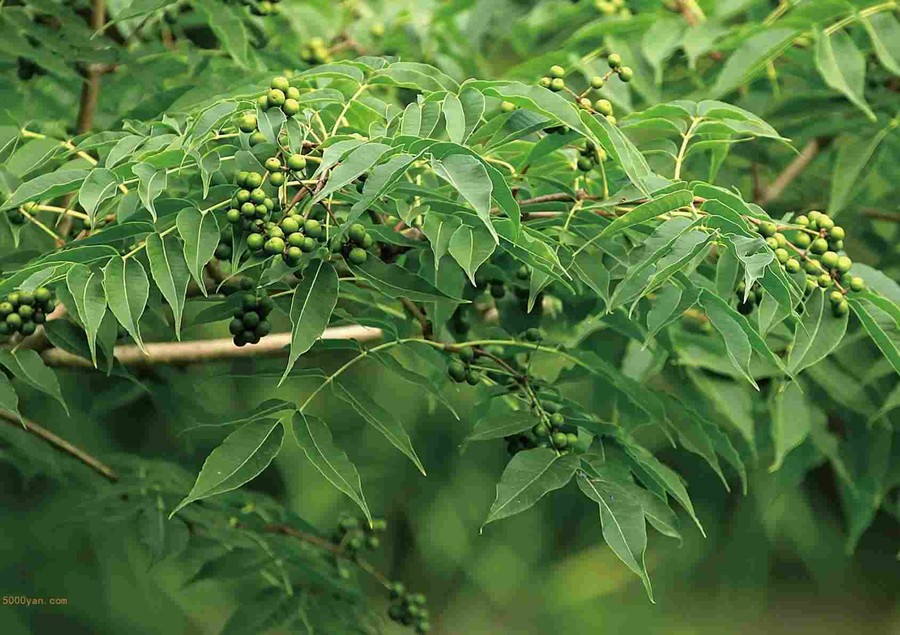
Deciduous tree, 10-12 m tall. Bark externally brown, with visible lenticels, outer cork thin. Odd-pinnate leaves opposite; leaflets 7-15, oblong-lanceolate to oblong-ovate, 9-15 cm long, 3-5 cm wide, apex long acuminate, base broadly cuneate to rounded, asymmetrical, nearly entire, upper surface with rusty short hairs along midvein, lower surface densely rusty long pubescent, leaflets thickly papery. Flowers unisexual, dioecious; arranged in terminal panicles, rachis densely short-haired. Flowers purple; male flowers with 5-6 stamens longer than petals, rudimentary pistil subulate; female flowers with 5-6 staminodes, ovary superior, shortly stalked, 5-locular, style short, stigma 5-lobed. Fruiting rachis and pericarp coarse, often densely short-haired; berry-like drupe subglobose, 1-1.5 cm in diameter, densely clustered, turning black when ripe, containing 5-6 seeds. Flowering May-June, fruiting October-November.
Habitat and Distribution
1. Grows in mixed forests, distributed in southern Shaanxi, Zhejiang, Jiangxi, Hubei, Sichuan, Guizhou, Yunnan, Guangxi, and other regions.
Harvesting and Processing
After stripping the bark, remove the rough outer layer and sun-dry.
Medicinal Properties
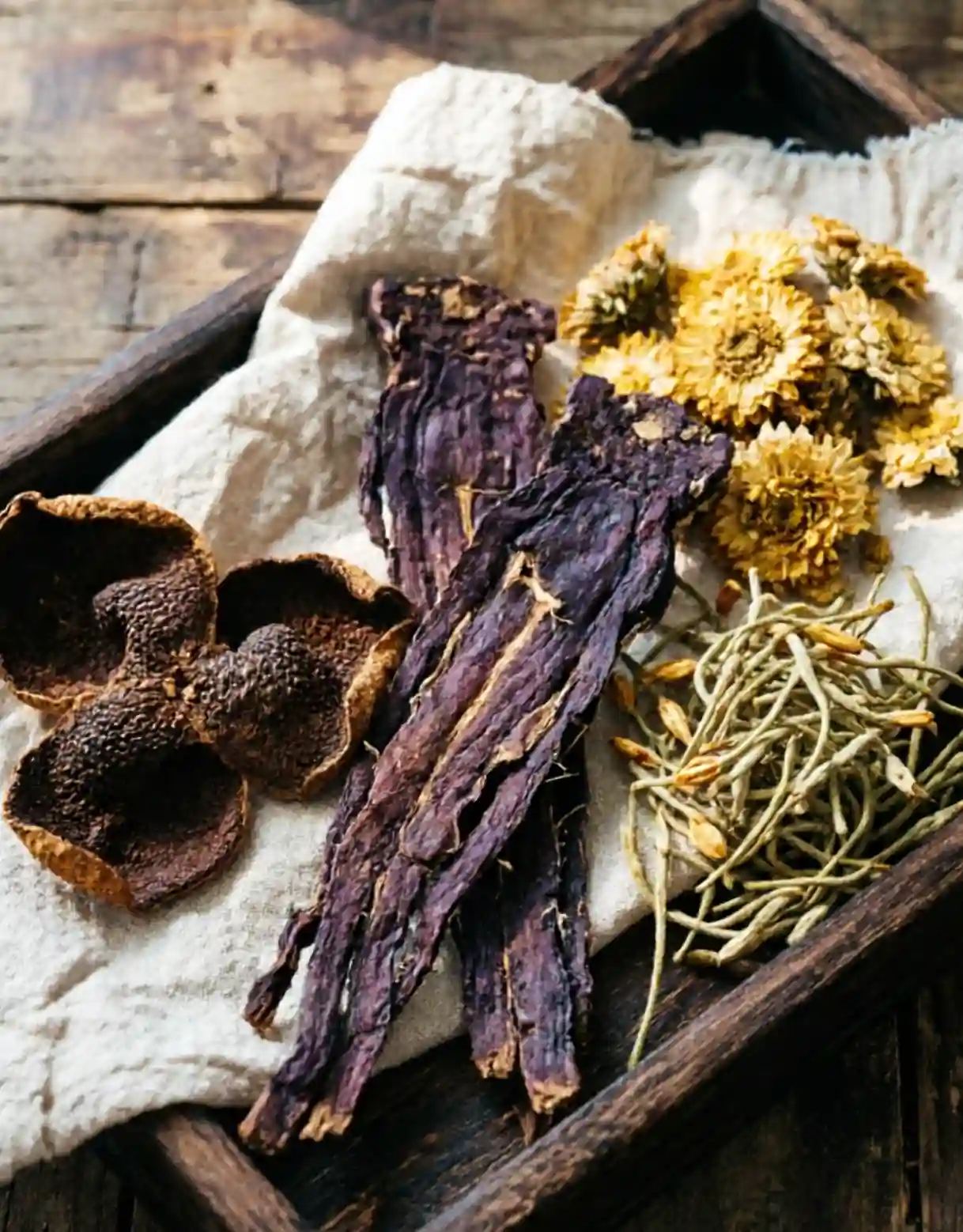
This product appears as board-like pieces or shallow troughs, of varying lengths and widths, 1-6 mm thick. The outer surface is yellowish-brown or yellowish-brown, smooth or with longitudinal wrinkles, sometimes with visible lenticel scars and remnants of grayish-brown rough bark; the inner surface is dark yellow or pale brown, with dense longitudinal ridges. Light in weight, hard in texture, the cross-section is fibrous, showing a lamellar layered structure, deep yellow. Odor: faint; Taste: extremely bitter, with stickiness when chewed.
Chemical Constituents
This product mainly contains flavonoids, alkaloids, volatile oils, sterols, and sugars. The specific constituents include berberine hydrochloride, phellodendrine, magnoflorine, phellodendroside, sitosterol, and obacunone.
Pharmacology
Has anti-pathogenic microorganism and anti-parasitic effects; has certain antipyretic and anti-inflammatory effects; has effects of lowering blood pressure and stimulating the heart, with obvious anti-arrhythmic effects; affects digestive system function and inhibits the central nervous system, also has anti-platelet aggregation effects, and has effects of lowering blood sugar, analgesia, expectoration, etc.
Properties and Channel Entry
Bitter, cold. Enters the Kidney and Bladder channels.
Functions and Indications
Clears Heat and dries Dampness, drains Fire and eliminates steaming, resolves toxicity and treats sores. Used for Damp-Heat diarrhea and dysentery, jaundice with dark urine, vaginal discharge and genital itching, painful urinary dribbling due to Heat, beriberi with muscle weakness, bone-steaming and consumptive fever, night sweats, nocturnal emission, sores and ulcers, eczema and damp sores. Salt-processed Huangbai (Phellodendron) nourishes Yin and descends Fire, used for Yin deficiency with Fire effulgence, night sweats, and bone-steaming.
Dosage and Administration
Oral: decoct in water, 3-9 g; or prepared into pills or powder. External use: appropriate amount, grind into powder for topical application, or decoct in water for soaking and washing. To descend excess fire, use raw; to clear deficient heat, stir-fry with salt water; to stop bleeding, use charred.
Precautions and Contraindications
Contraindicated in cases of Spleen deficiency with diarrhea and Stomach weakness with reduced appetite.
Prescriptions
1. For burns and scalds: Chicken eggshell, Huangbai (Phellodendron bark), Mangxiao (Mirabilite), Dahuang (Rhubarb), and Hanshuishi (Calcite) in equal parts, grind into fine powder, mix with plain water and apply externally. (From *Shiyi Dexiaofang*: Huangbai Powder). 2. For all types of swelling and toxin: Huangbai and Dahuang in equal parts, grind into powder, mix with vinegar and apply externally. If it dries, moisten with water. (From *Yongju Yanfang*: Erhuang Ointment). 3. For male genital sores with erosion: Huanglian (Coptis rhizome) and Huangbai in equal parts, grind into powder, boil in fatty pork juice, wash the sores, then dust with the powder. (From *Zhouhou Fang*). 4. For infant pustular sores that do not dry over the entire body: Huangbai powder, add a small amount of calcined alum, and sprinkle onto the affected area. (From *Jianbian Danfang*). 5. For bloody dysentery: Huangbai and Huanglian each 120 g. Soak in five *sheng* of bitter wine, decoct to two and a half *sheng*, take warm in divided doses without regard to time. (From *Weisheng Yijian Fang*).