Pinyin: Rougui
Aliases
Jungui, Gui, Tonggui, Yugui.
Source
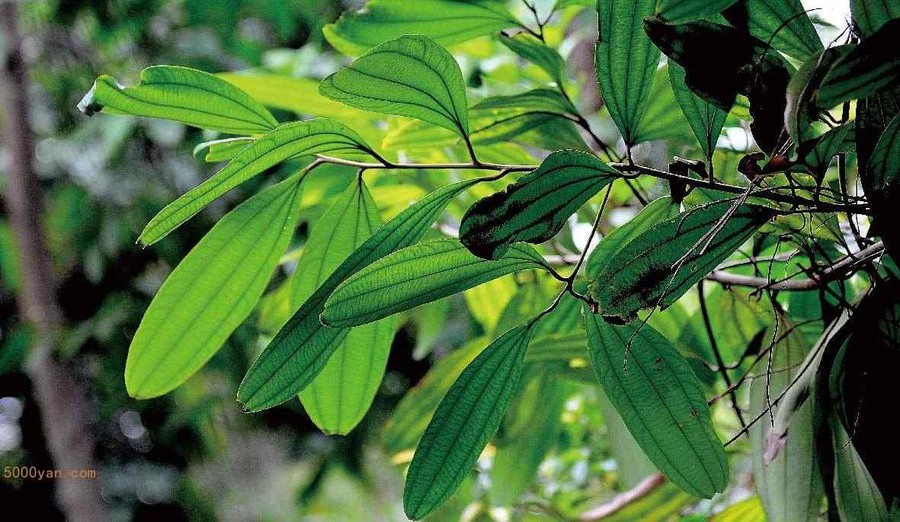
Plant from the Lauraceae family: Cinnamomum cassiaCinnamomum cassiaPresl.
Botanical Description
This is NOT a prescription or formula. It is a botanical description of an evergreen tree. Please provide the correct text for translation.
Habitat and Distribution
Born in evergreen broad-leaved forests, but mostly cultivated. It is cultivated in tropical and subtropical regions such as Fujian, Taiwan, Hainan, Guangdong, Guangxi, and Yunnan, with the most cultivation in Guangxi, mostly in artificial forests.
Harvesting and Processing
Mostly harvested by peeling in autumn and dried in the shade.
Medicinal Properties
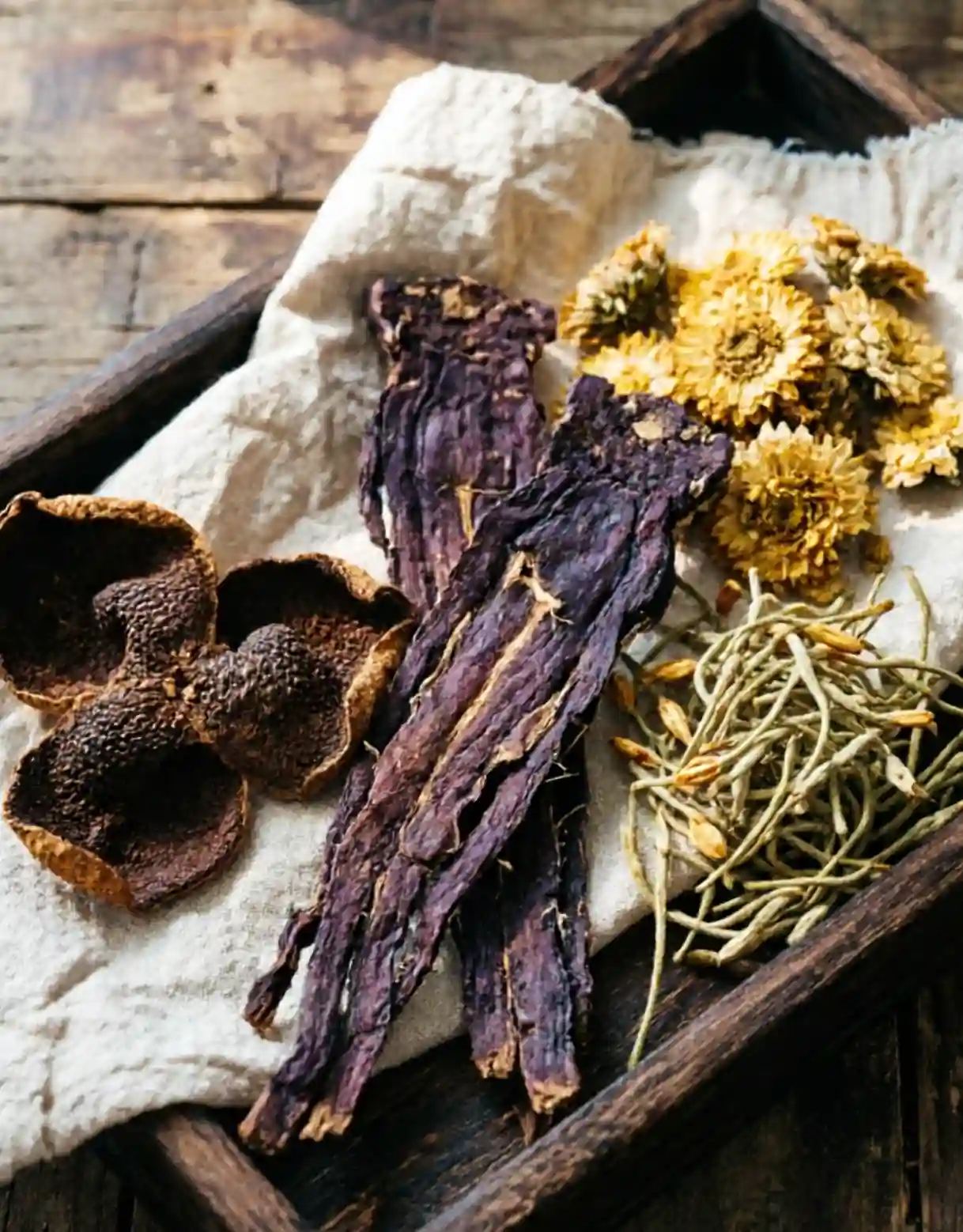
The material is in a trough or roll shape, 30-40 cm long, 3-10 cm wide or in diameter, and 0.2-0.8 cm thick. The outer surface is grayish-brown, slightly rough, with irregular fine wrinkles and transversely protruding lenticels, some with visible grayish-white spots; the inner surface is reddish-brown, relatively flat, with fine longitudinal striations, and shows an oily mark when scratched. The texture is hard and brittle, easily broken; the fracture is uneven, with the outer layer brown and rough, the inner layer reddish-brown and oily, and a yellowish-brown line between the two layers. The odor is strong and aromatic, and the taste is sweet and pungent.
Chemical Constituents
This product contains cinnamaldehyde, cinnamyl acetate, benzyl benzoate, trans-cinnamic acid, cinnamoside, and other components.
Pharmacology
It has a mild stimulating effect on the gastrointestinal tract, can relieve spasms of gastrointestinal smooth muscle, and has a strong anti-ulcer effect; it can antagonize platelet aggregation, improve the cardiovascular system, and regulate the body's immune function; it has sedative, analgesic, antipyretic, and anticonvulsant effects on the central nervous system; it has preventive and protective effects on Yang deficiency and Yin deficiency models; it has a certain anti-inflammatory effect; it has a strong fungicidal effect; it is anti-tumor; it can significantly lower serum triacylglycerol in mice and prolong the survival time of mice poisoned with sodium nitrite.
Properties and Channel Entry
Acrid, sweet, and greatly hot. Enters the Kidney, Spleen, Heart, and Liver channels.
Functions and Indications
Tonifies Fire and assists Yang, leads Fire back to its origin, disperses Cold and alleviates pain, warms and unblocks the channels and vessels. Used for impotence and uterine coldness, cold pain in the lower back and knees, Kidney deficiency causing wheezing, floating of deficient Yang, dizziness and red eyes, cold pain in the heart and abdomen, vomiting and diarrhea due to deficient Cold, Cold hernia with abdominal pain, dysmenorrhea and amenorrhea.
Dosage and Administration
Oral administration: decoct in water, 2-5 g, do not decoct for too long; grind into powder, 0.5-1.5 g; or taken in pill form. External use: appropriate amount, grind into powder and apply with a liquid; or soak in wine and apply by rubbing.
Precautions and Contraindications
Contraindicated in cases of Yin deficiency with blazing Fire, internal Excess Heat, bleeding due to Blood-Heat moving recklessly, and in pregnant women; incompatible with Halloysitum Rubrum (Chishizhi).
Prescriptions
1. For sudden heart pain, also for chronic heart pain occurring at specific times: Rougui (Cinnamomi Cortex) and Danggui (Angelicae Sinensis Radix) each 30 g, Zhizi (Gardeniae Fructus) 14 pieces. Grind into powder, take 1 g with wine, 3-5 times daily. (From Zhou Hou Fang) 2. For breast abscess: Guixin (Cinnamomi Cortex) and Gancao (Glycyrrhizae Radix et Rhizoma) each 0.6 g, Wutou (Aconiti Radix) 0.3 g (processed), grind into powder, mix with vinegar, apply to paper and cover the affected area; the pus will turn to water, with miraculous effect. (From Zhou Hou Fang) 3. For postpartum residual blood stasis causing pain with masses: Rougui (Cinnamomi Cortex) and Jianghuang (Curcumae Longae Rhizoma). Grind the equal amounts into powder, take 1 g with wine; the blood will descend completely with excellent results. (From Jing Xiao Chan Bao) 4. For traumatic injuries with abdominal blood stasis: Rougui (Cinnamomi Cortex) and Danggui (Angelicae Sinensis Radix) each 60 g, Puhuang (Typhae Pollen) one sheng. Grind the three ingredients, sift. Take 1 g with wine, three times during the day and once at night. (From Qian Jin Yao Fang) 5. For leukorrhea with fishy odor, excessive sadness and lack of joy, severe Cold: Huangbai (Phellodendri Chinensis Cortex, as guiding herb) and Zhimu (Anemarrhenae Rhizoma) each 1.5 g, Rougui (Cinnamomi Cortex) 3 g, Fuzi (Aconiti Lateralis Radix Praeparata) 9 g. Decoct in two cups of water down to one cup. Remove the residue, take warm after meals. (From Lan Shi Mi Cang, Gui Fu Tang)