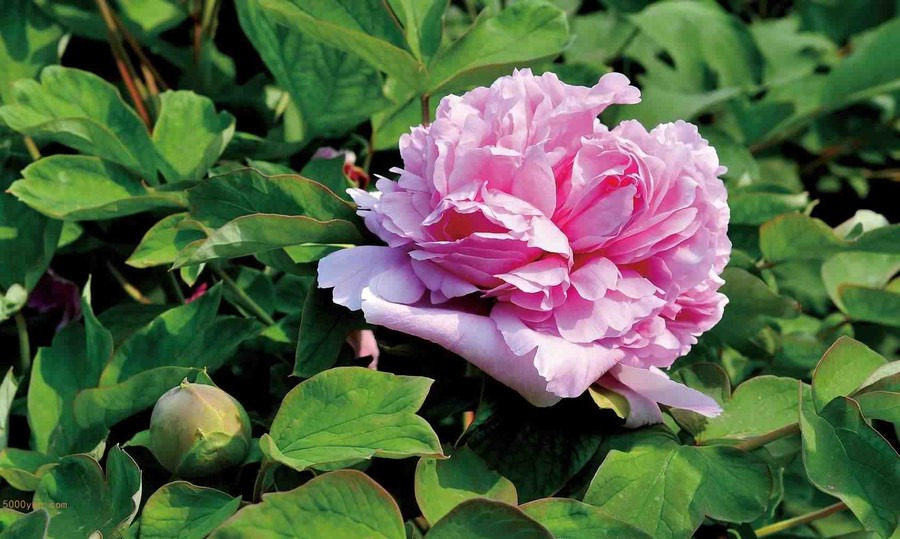
Pinyin: Mudanpi
Aliases
Mudan genpi, Danpi, Dangen.
Source
1Paeonia suffruticosaDried root bark of Andr.
Botanical Description
Deciduous small shrub, 1-2 m tall. Roots thick and large. Stem erect, branches stout, bark dark grayish-black. Leaves alternate, papery; petiole 5-11 cm long, glabrous; leaves usually bipinnately compound or biternate, those near branch apex with three leaflets, terminal leaflet often deeply 3-lobed, 7-8 cm long, 5-7 cm wide, lobes 2-3 shallowly lobed or unlobed, upper surface green, glabrous, lower surface pale green, sometimes glaucous, sparsely pubescent along veins or nearly glabrous, petiolule 1.2-3 cm long; lateral leaflets narrowly ovate or oblong-ovate, 4.5-6.5 cm long, 2.5-4 cm wide, 2-3 shallowly lobed or unlobed, nearly sessile. Flowers bisexual, solitary at branch apex, 10-20 cm in diameter; pedicel 4-6 cm long; bracts 5, oblong-elliptic, unequal in size; sepals 5, broadly ovate, unequal, green, persistent; petals 5, or double, obovate, 5-8 cm long, 4.2-6 cm wide, apex irregularly undulate, purple, red, pink, rose, yellow, bean-green, or white, highly variable; stamens numerous, 1-1.7 cm long, filaments also purple-red, anthers yellow; disc cup-shaped, leathery, apex with several sharp teeth or lobes, completely enclosing the carpels, splitting at carpel maturity; carpels 5, rarely more, free, green, densely pubescent. Follicles oblong, dehiscing along ventral suture, densely covered with yellowish-brown stiff hairs. Flowering period April to May, fruiting period June to July.
Habitat and Distribution
Cultivated in many regions across the country for ornamental purposes.
Harvesting and Processing
Harvest the roots in autumn, remove the fine roots and soil, peel off the root bark and dry in the sun, or scrape off the rough outer bark, remove the woody core, and dry in the sun. The former is commonly known as Liandanpi, and the latter is commonly known as Guadanpi.
Medicinal Properties
1. Lian Dan Pi: In tubular or semi-tubular form, with longitudinal split cracks, slightly curled inward or open, 5-20 cm long, 0.5-1.2 cm in diameter, 0.1-0.4 cm thick. The outer surface is grayish-brown or yellowish-brown, with numerous transversely elongated lenticel-like protrusions and fine root scars, and the areas where the cork layer has peeled off are pinkish; the inner surface is pale grayish-yellow or light brown, with distinct fine longitudinal striations, and often visible shiny crystals. The texture is hard and brittle, easily broken, with a relatively flat cross-section, pale pink, and powdery. Odor: aromatic; Taste: slightly bitter and astringent.
2. Scraped Moutan Cortex (Guadanpi): the outer surface shows knife-cut marks, appearing reddish-brown or pale grayish-yellow, occasionally with grayish-brown spotted remnants of the outer bark.
Chemical Constituents
This product mainly contains paeonolide, benzoylpaeoniflorin, benzoyloxypaeoniflorin, oxypaeoniflorin, paeoniflorin, paeonidin, gallic acid, and other constituents.
Pharmacology
Has central inhibitory effects; improves cardiovascular system function; has significant anticoagulant effects; anti-inflammatory and antibacterial; can enhance immune function; significantly inhibits stress-induced gastric ulcers and gastric secretion in rats, also inhibits ileal and uterine contractions, and has diuretic effects; in vitro, significantly inhibits calcium channel blocker receptors.
Properties and Channel Entry
Bitter, acrid, slightly cold. Enters the Heart, Liver, and Kidney channels.
Functions and Indications
Clears Heat and cools the Blood, activates Blood and resolves stasis. Used for Heat entering the Nutritive and Blood levels, Warm toxin causing macules, hematemesis and epistaxis, night fever with morning coolness, bone steaming without sweating, amenorrhea and dysmenorrhea, traumatic injuries with pain and swelling, and carbuncles, swellings, and sores with toxicity.
Dosage and Administration
Internal use: decoct 6-9 g; or made into pills or powder. For clearing Ying-level Heat, relieving steaming bone fever, and eliminating abscesses, use raw; for cooling Blood and stopping bleeding, use stir-fried; for activating Blood and dispersing stasis, use stir-fried with wine. For those with Stomach deficiency, steam with wine; for those with Excess Heat, use raw.
Precautions and Contraindications
Blood deficiency, various deficiency-cold patterns, pregnancy, and women with excessive menstruation are contraindicated.
Prescriptions
1. For kidney deficiency with lower back pain: Moutan bark 9 g, with equal parts of Dioscorea septemloba, Atractylodes macrocephala, and Cinnamomum cassia (with rough bark removed). Grind the four ingredients into a powder. Take 9 g per dose, mixed with warm wine. (From "Sheng Ji Zong Lu" - Moutan Powder) 2. For dysmenorrhea: Moutan bark 6-9 g, together with Agrimonia pilosa 9-12 g, Serissa japonica 9-12 g, and Sophora japonica flower 9-12 g. Decoct in water, add yellow rice wine and brown sugar. Take on an empty stomach morning and evening during menstruation. Avoid sour, spicy, and mustard greens. (From "Qingdao Chinese Herbal Medicine Manual") 3. For blood stasis from wrist fracture: Tabanus bivittatus twenty pieces, Moutan bark 30 g. Grind the two ingredients into a powder. Take 1 g with wine; the blood stasis will dissolve like water. (From "Qian Jin Yao Fang") 4. For internal bleeding from metal wounds with no blood exiting: Grind Moutan bark into powder, take three finger-pinch amounts with water; immediately urinate out the blood. (From "Qian Jin Yao Fang") 5. For allergic rhinitis: Moutan bark 9 g, decoct in water and take. Continue for 10 days as one course of treatment. (From "Qingdao Chinese Herbal Medicine Manual")