Pinyin: Wujiugenpi
Aliases
1
Source
Euphorbiaceae plant, Sapium sebiferum (Chinese tallow tree).SapiumsebiferumThe dried root bark or stem bark of (L.) Roxb.
Botanical Description
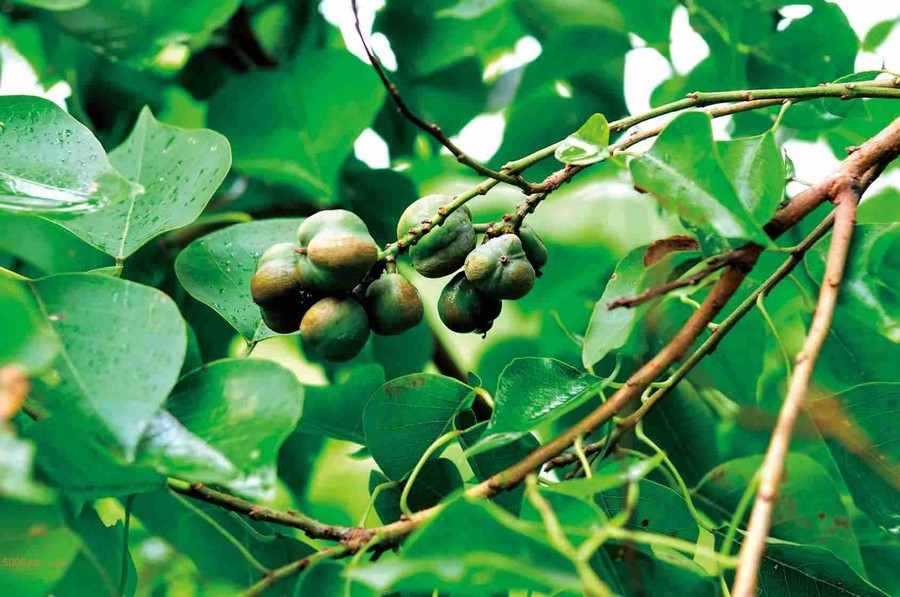
Deciduous tree, up to 15 m tall, with latex. Bark dark gray, with longitudinal cracks. Leaves alternate; petiole 2.5-6 cm long, with 2 glands at the apex; leaf blade papery, rhombic to broadly rhombic-ovate, 3-9 cm long and wide, apex slightly mucronate to acuminate, base broadly cuneate; lateral veins 5-10 pairs. Spike inflorescence terminal, 6-12 cm long; flowers unisexual, monoecious, without petals or disc; initially all male, then 1-4 female flowers borne at the base of the inflorescence; male flowers small, 10-15 clustered in the axil of a bract, bract rhombic-ovate, apex acuminate, with 1 gland on each side near the base, calyx cup-shaped, 3-lobed, stamens 2, rarely 3, filaments divided; female flowers pedicellate, pedicel 2-4 mm long, with 1 subreniform gland on each side at the base, bracts 3, rhombic-ovate, calyx deeply 3-lobed, ovary smooth, 3-locular; style base fused, stigmas recurved. Capsule ellipsoid-globose, 1-1.5 cm in diameter, brown at maturity, loculicidally dehiscing into 3 valves, each valve with 1 seed; seeds subglobose, black, coated with white wax. Flowering period April to July, fruiting period October to December.
Habitat and Distribution
Wild or cultivated. Distributed in East China, Central South China, Southwest China, and Taiwan.
Harvesting and Processing
It can be harvested year-round, peel off the bark, remove the cork layer, and dry in the sun.
Medicinal Properties
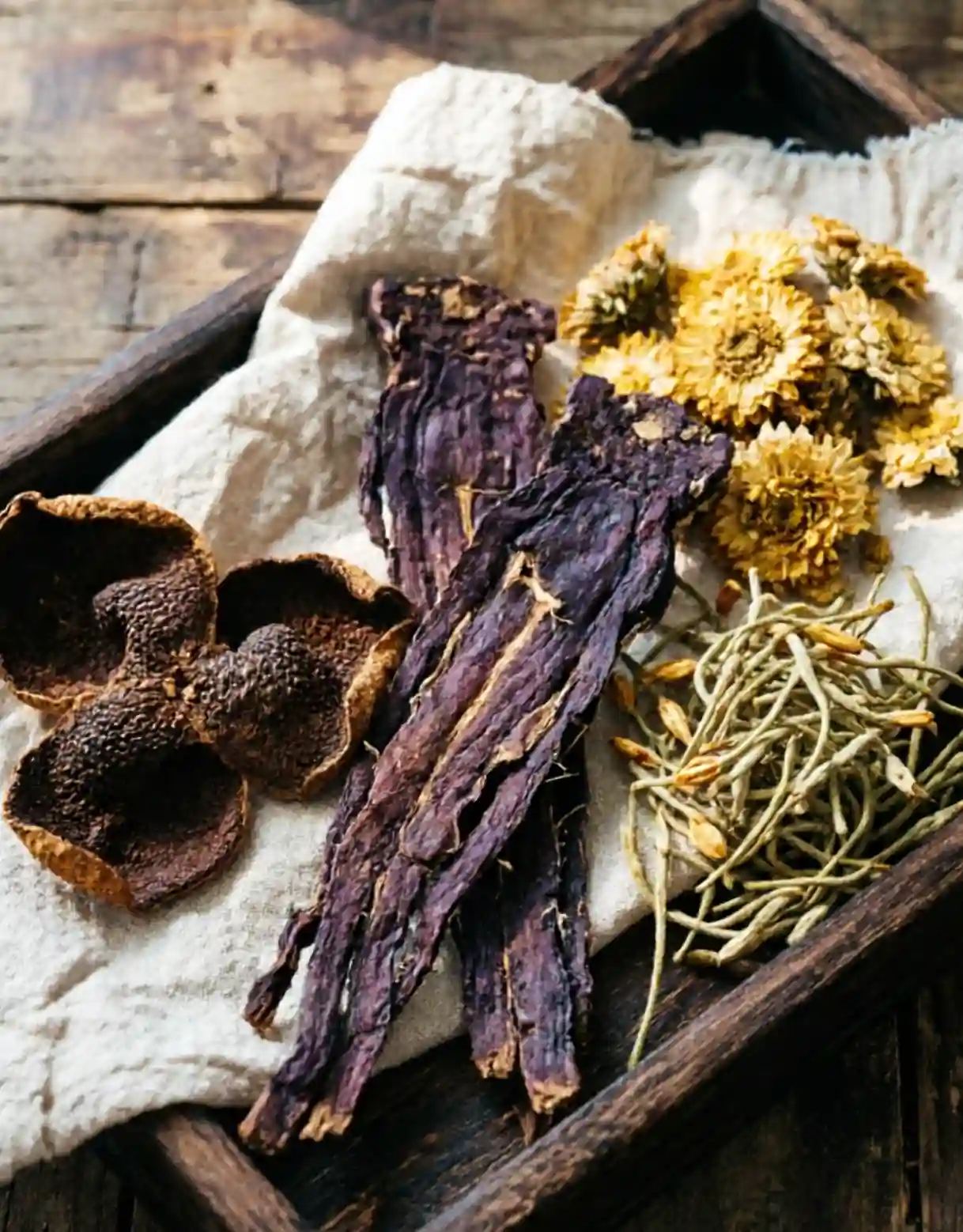
This product appears as irregular pieces. The outer surface is light yellowish-brown with fine longitudinal wrinkles; the cork layer is thin and easily peeled off. The inner surface is yellowish-white or light yellowish-brown with dense, fine, straight longitudinal striations. The cut surface appears fibrous. The texture is hard and tough. Odor: faint; Taste: slightly bitter and astringent.
Chemical Constituents
This product mainly contains werneria coumarin, scopoletin, xanthoxylin, moreltenone, moreltenol, 3-epimoreltenol, 6,7,8-trimethoxycoumarin, and other constituents.
Pharmacology
In experimental mice, it has a promoting effect on cervical cancer, with a potency slightly weaker than that of croton oil extract.
Properties and Channel Entry
Bitter, slightly warm; toxic. Enters the Lung, Kidney, Stomach, and Large Intestine channels.
Functions and Indications
Purges downward and drives out water, reduces swelling and dissipates masses, and relieves snake and insect toxicity. Main indications: edema, abdominal masses and accumulations, tympanites, urinary and fecal obstruction, furuncles, carbuncles, and swellings, eczema, scabies and tinea, and venomous snake bites.
Dosage and Administration
Oral: decoct 9-12 g in water; or made into pills or powder. External: apply an appropriate amount, decoct in water for washing or grind into powder for topical application.
Precautions and Contraindications
Patients with weak constitution, pregnant women, and those with ulcer disease should avoid taking this medication.
Prescriptions
1. For edema, dysuria, and general body swelling: 60 g of Chinese tallow bark, 30 g of Akebia stem (sliced), 30 g of betel nut. Grind the above ingredients into a fine powder. Take 6 g with rice porridge at any time. (Sheng Hui Fang) 2. For tympanites: a. 30-90 g of the second layer of Chinese tallow root bark (chopped), 1 pinch of white rice, stir-fry until slightly yellow. Add 9 g of Astragalus root and decoct in water, or grind with rice and add sugar to cook. Take once daily for 3-6 consecutive days. b. 90 g of Chinese tallow root, 30 g of mulberry root. Decoct in 5 bowls of water down to 1 bowl, take in 3 divided doses. (Lingnan Herbal Records) 3. For urinary retention: a. Decoction of Chinese tallow bark taken orally. (Zhou Hou Fang) b. Decoction of Chinese tallow bark taken with Wuling Powder for immediate relief; if the powder is unavailable, the decoction alone may be taken. (Wei Sheng Yi Jian Fang) 4. For eczema, urticaria, axillary odor, scabies, and tinea: Concentrated decoction of Chinese tallow root bark or leaves for external washing. (Selected Chinese Herbal Medicines of Shaanxi, Gansu, Ningxia, and Qinghai) 5. For traumatic injuries: 15 g of the second layer of dried Chinese tallow root bark, stewed with wine; fresh leaves mashed and applied to the affected area. (Fujian Chinese Herbal Medicine)