Pinyin: Digupi
Aliases
Qigen, Digu, Gouqigen, Gouqigenpi
Source
1. For pneumonia: Renshen 6 g, decoct in water and take orally.Lycium chinenseMill. or Lycium barbarum L.Lycium barbarumDried root bark of L.
Botanical Description
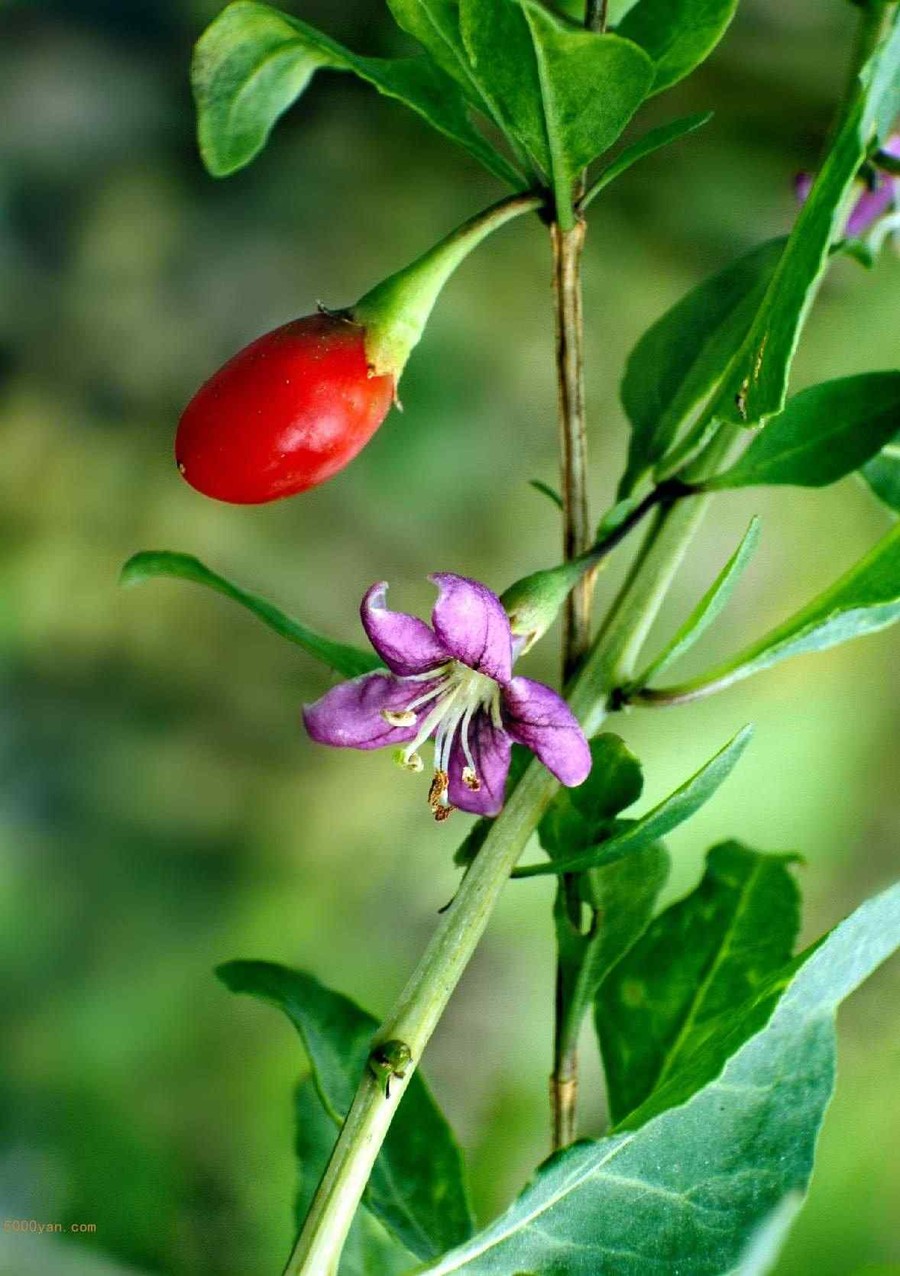
1. Gouqi: Deciduous shrub, plant relatively short, height about 1 m. Trailing, stem thin, outer bark gray, with short spines born in leaf axils, 0.5-2 cm long. Leaves slightly smaller, ovate, ovate-rhombic, oblong-elliptic, or ovate-lanceolate, 2-6 cm long, 0.5-2.5 cm wide, apex acute or obtuse, base narrowly cuneate, margin entire, both surfaces glabrous. Flowers purple, margin with dense ciliate hairs; calyx campanulate, 3-5 lobed; corolla tube and lobes equal in length, tube abruptly narrowed at base then widening upward into a funnel shape, both tube and lobes relatively broad; stamens 5, inserted on corolla, slightly shorter than corolla, anthers versatile. Filaments usually exserted. Berry ovoid or oblong, 10-15 mm long, 4-8 mm in diameter, seeds yellow. Flowering period June to September, fruiting period July to October.
2. Ningxia wolfberry: see item "Gouqizi".
Habitat and Distribution
1. For pneumonia: Renshen 6 g, decoct in water and take orally.
Harvesting and Processing
Harvest the roots in early spring or after autumn, wash clean, peel off the root bark, and sun-dry.
Medicinal Properties
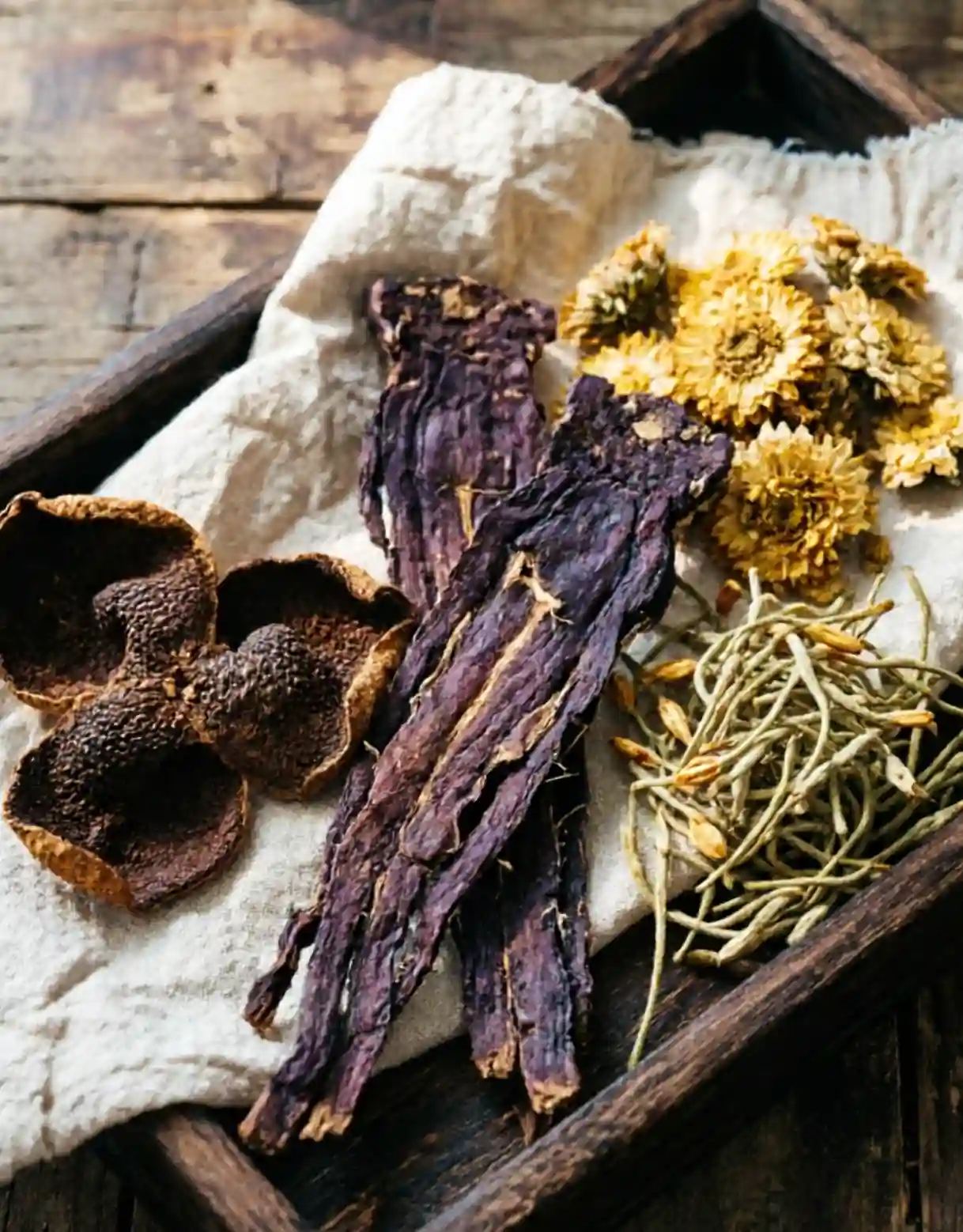
This product is tubular or trough-shaped, 3-10 cm long, 0.5-1.5 cm wide, and 0.1-0.3 cm thick. The outer surface is grayish-yellow to brownish-yellow, rough, with irregular longitudinal cracks that easily peel off in scaly layers. The inner surface is yellowish-white to grayish-yellow, relatively smooth, with fine longitudinal striations. Light in weight, brittle, easily broken; the fracture is uneven, with a yellowish-brown outer layer and a grayish-white inner layer. Odor: faint; Taste: slightly sweet followed by bitter.
Chemical Constituents
This product contains components such as betaine, kukoamine, lycium cyclic octapeptide, lycium amide, and scopoletin.
Pharmacology
Has antipyretic, blood pressure-lowering, blood sugar-lowering, and blood lipid-lowering effects; has antimicrobial effects; has significant excitatory effects on isolated uterus of non-pregnant rats, and also has a leukocyte-increasing effect, while having no significant impact on immune organ weight and normobaric hypoxia tolerance.
Properties and Channel Entry
Sweet, cold. Enters the Lung, Liver, and Kidney channels.
Functions and Indications
Cools Blood, eliminates steaming bone sensation, clears Lung Heat, and descends Fire
Dosage and Administration
Internal: decoct in water, 9-15 g; large doses may use 15-30 g.
Precautions and Contraindications
Those with Spleen and Stomach deficiency-cold should use with caution.
Prescriptions
1. For toothache due to wind parasites: *Digupi* (Cortex Lycii), decoct in vinegar and use as a mouth rinse; the parasites will emerge; it can also be decocted in water and taken orally. (From *Zhou Hou Fang*) 2. For deafness with persistent purulent discharge: *Digupi* 15 g, *Wubeizi* (Galla Chinensis) 0.3 g. Grind the two ingredients into a fine powder. Apply a small amount into the ear. (From *Sheng Ji Zong Lu*) 3. For chronic leg ulcers (lichen): *Digupi*, remove the rough outer bark, scrape the inner powder with a bamboo knife, dry over low heat, and grind into a fine powder. Apply topically. (From *Pu Ji Fang*) 4. For corns: *Digupi* and *Honghua* (Carthami Flos), grind together into a fine powder. Apply to the painful area of the corn; also apply if suppuration occurs; a scab will form the next day. (From *Ren Shu Bian Lan*, Jin Lian Wen Bu Gao) 5. For scalds and burns: *Digupi* and *Liujinu* (Herba Artemisiae Anomalae), equal parts. Grind into powder. For moist wounds, apply directly; for dry wounds, mix with sesame oil and apply. (From *Xin Yi Ji*)