Pinyin: Qinpi
Aliases
Cenpi, Qinbaipi, Lashupi.
Source
1. For pneumonia: Renshen 6 g, decoct in water and take orally.Fraxinus chinensisDried branch bark or dried bark of *Eucommia ulmoides* Oliv.
Botanical Description
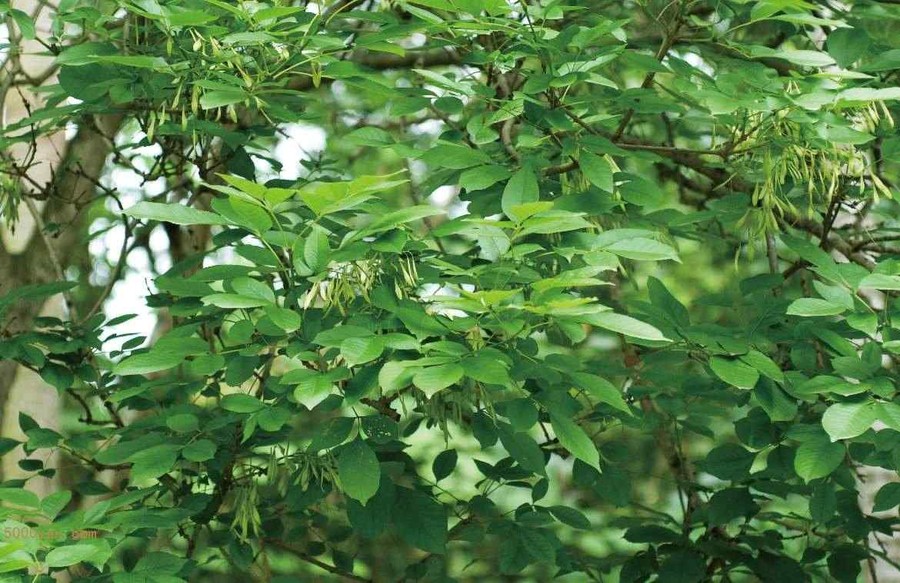
Deciduous large tree. Height 12-15 m. Bark gray-brown, smooth, shallowly fissured with age. Winter buds broadly ovoid, apex acute, black-brown, glossy, densely covered with brown curly soft hairs on the inside. Current year branches pale yellow, straight, glabrous; previous year branches dark brown, with scattered lenticels. Leaf rachis with shallow grooves on the upper surface; leaflets articulate at attachment points, sometimes with fascicles of brown curly soft hairs at the nodes; leaflets 5-7, leathery, ovate, obovate-oblong to lanceolate, 3-11 cm long, 2-6 cm wide; leaflets on vegetative branches broader and larger, terminal leaflet significantly larger than lateral ones, the lowest pair smallest; apex acuminate, abruptly acuminate, or caudate; base obtuse-rounded; margin irregularly coarsely serrate, serrations slightly inwardly curved, sometimes undulate, usually nearly entire near the base; white soft hairs along axils of veins, gradually becoming glabrous. Panicles terminal or axillary on current year branch tips, about 10 cm long; bracts long-lanceolate, about 5 mm long, early deciduous; pedicels about 5 mm long; male and bisexual flowers on separate plants; calyx tubular, sepals triangular, glabrous; corolla absent; bisexual flowers with 2 stamens, about 4 mm long; pistil with short style, stigma 2-cleft deeply; male flowers with small calyx, filaments slender, up to 3 mm long. Samaras linear, nutlet at apex about 1 cm long, slightly raised; with persistent calyx. Flowering period April-May, fruiting period September-October.
Habitat and Distribution
Mostly cultivated. Distributed throughout northern and southern China.
Harvesting and Processing
Peeled in spring and autumn, dried in the sun.
Medicinal Properties
1. Branch bark: in rolled tubular or trough-like form, 10-60 cm long, 1.5-3 mm thick. Outer surface gray-white, gray-brown to dark brown or mottled, flat or slightly rough, with gray-white round lenticels and fine oblique wrinkles, some with branch scars. Inner surface yellow-white or brown, smooth. Texture hard and brittle, fracture fibrous, yellow-white. Odor: faint; Taste: bitter.
2. Dried bark: elongated strips or pieces, 3-6 mm thick. Outer surface grayish-brown, with tortoise-shell-like fissures and red-brown round or transversely elongated lenticels. Texture hard, fracture strongly fibrous.
Chemical Constituents
This product contains components such as aesculin, aesculetin, fraxin, fraxetin, aesculin, aesculetin, ursolic acid, and daucosterol.
Pharmacology
Antibacterial, anti-inflammatory, and analgesic, may be used for gouty arthritis, affecting arachidonic acid metabolism; also has antitussive, expectorant, and antiasthmatic effects.
Properties and Channel Entry
Bitter, astringent, and cold. Enters the Liver, Gallbladder, and Large Intestine channels.
Functions and Indications
Clears Heat and dries Dampness, astringes to stop dysentery, stops leukorrhea, and brightens the eyes. Used for Damp-Heat diarrhea and dysentery, red and white leukorrhea, red, swollen, and painful eyes, and nebula (corneal opacity).
Dosage and Administration
Internal: decoct 6-12 g in water for oral administration. External: appropriate amount, decoct in water for eye washing or extract juice for eye drops.
Precautions and Contraindications
Contraindicated in patients with Spleen and Stomach deficiency cold.
Prescriptions
1. For acute bacillary dysentery: Cortex Fraxini and Radix Sophorae Flavescentis 12 g each, fried Semen Raphani and Radix Aucklandiae 9 g each. Grind into fine powder, take with boiling water, 9-12 g per dose, 3-4 times daily. [Guoyi Luntan 1986, (2), 52] 2. For chronic bacillary dysentery: Cortex Fraxini 12 g, unprocessed Radix Sanguisorbae and Cortex Ailanthi 9 g each. Decoct in water for oral administration. (Hebei Chinese Herbal Medicine Handbook) 3. For acute hepatitis: Cortex Fraxini 9 g, Herba Artemisiae Scopariae and Herba Taraxaci 30 g each, Cortex Phellodendri 9 g, Radix et Rhizoma Rhei 9 g. Decoct in water for oral administration. (Shanxi Chinese Herbal Medicine) 4. For hordeolum with dry stools: Cortex Fraxini 9 g, Radix et Rhizoma Rhei 6 g. Decoct in water for oral administration. Contraindicated in pregnancy. (Hebei Chinese Herbal Medicine Handbook)