Pinyin: Baixianpi
Aliases
Xianpi, Bei Xianpi, Ye Huajiao Genpi, Chou Genpi
Source
Internal use: decoct 3-10 g.Dic-tamnus dasycarpusDried root bark of Turcz.
Botanical Description
A perennial herb, woody at the base, reaching up to 1 m in height. The entire plant has a distinctive fragrance. The root is fleshy with numerous lateral roots, the outer bark is yellow-white to yellow-brown. Odd-pinnate compound leaves are alternate; the rachis has narrow wings, no petiole; leaflets 9-13. Leaf blades are ovate to elliptic, 3.5-9 cm long, 2-4 cm wide, apex acute, base cuneate, margin finely serrate, upper surface dark green with dense glandular dots, lower surface white-green with sparser glandular dots. Racemes terminal, up to 30 cm long; the inflorescence axis and pedicels are mixed with white pubescence and black glandular hairs; pedicels 1-2.5 cm long, with a linear bract at the base; sepals 5, ovate-lanceolate, about 5 mm long, about 2 mm wide, fused at the base; petals 5, pale red with purplish-red lines, oblanceolate or oblong, about 25 mm long, 5-7 mm wide, base gradually narrowed into a claw; stamens 10; ovary superior, 5-loculed. Capsule, densely covered with glandular hairs, splitting into 5 at maturity, each valve with a pointed tip at the apex. Seeds 2-3, nearly spherical, about 3 mm in diameter, apex shortly pointed, black, shiny. Flowering period April-May, fruiting period June.
Habitat and Distribution
It grows on slopes and in thickets. It is distributed in Northeast, North, East, and Central China, as well as Shaanxi, Gansu, Henan, Sichuan, and Guizhou.
Harvesting and Processing
Harvest the roots in spring and autumn, remove soil and coarse bark, peel off the root bark, and dry.
Medicinal Properties
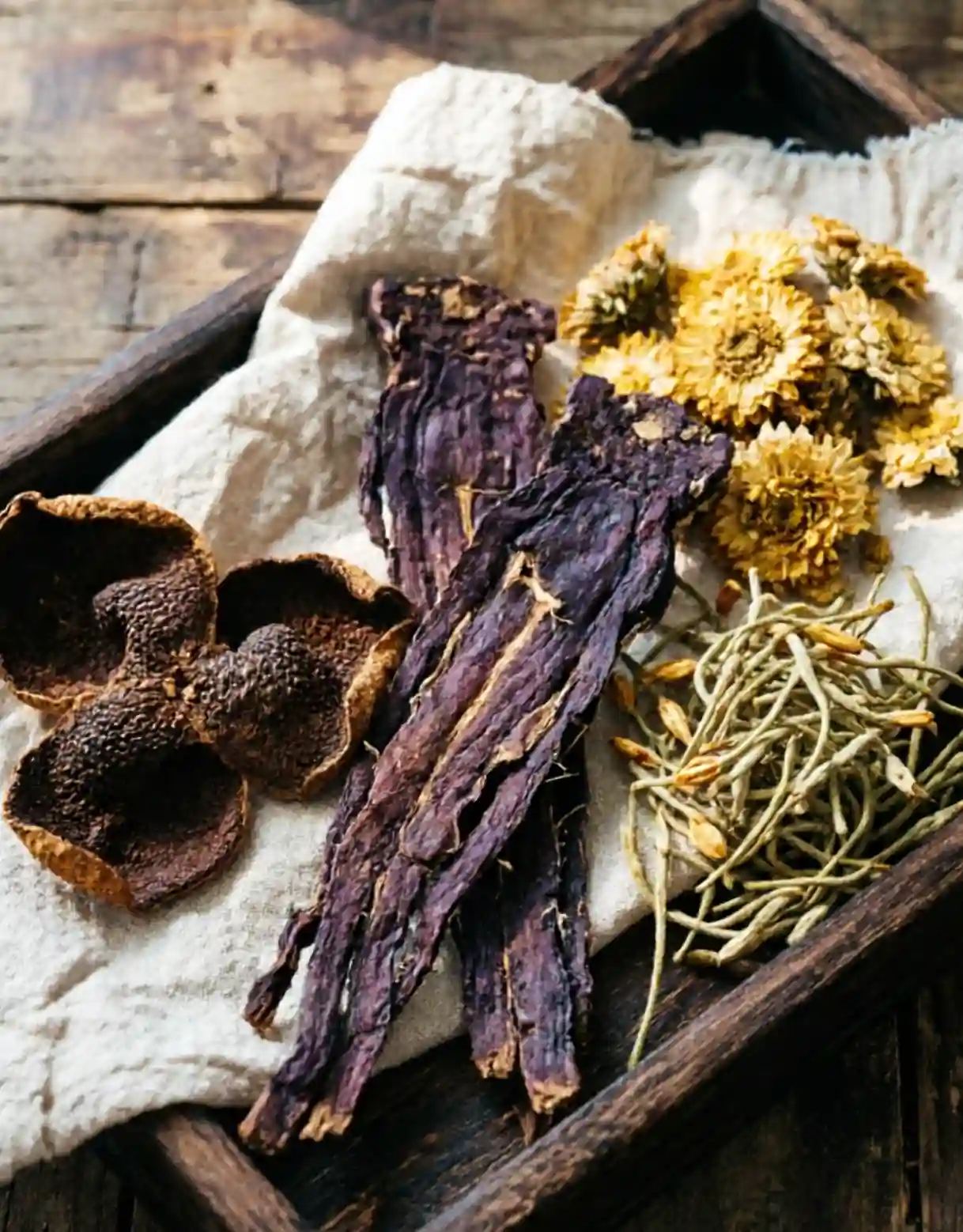
This specimen is rolled into a tube shape, 5-15 cm long, 1-2 cm in diameter, and 0.2-0.5 cm thick. The outer surface is gray-white or pale gray-yellow, with fine longitudinal wrinkles and fine root scars, often with raised granular spots; the inner surface is off-white with fine longitudinal lines. The texture is brittle, with dust flying when broken, the fracture is uneven, slightly layered, and when the outer layer is peeled off, small shiny spots can be seen against light. It has a goat-like odor and a slightly bitter taste.
Chemical Constituents
This product contains fraxinellone, obacunone, psoralen, xanthotoxin, quercetin, skimmianine, and isoquercetin among its constituents.
Pharmacology
It has inhibitory effects on various pathogenic fungi; can enhance myocardial contractility and constrict blood vessels; has strong contractile effects on uterine and intestinal smooth muscle; suppresses immune function; and also possesses certain anti-cancer effects.
Properties and Channel Entry
Bitter, cold. Enters the Spleen, Stomach, and Urinary Bladder channels.
Functions and Indications
Clears Heat and dries Dampness, expels Wind and resolves toxicity
Dosage and Administration
Internal: decoct 6-15 g in water, or use in pills or powder. External: apply an appropriate amount, decoct in water for washing, or grind into powder for application.
Precautions and Contraindications
Contraindicated in Deficiency-Cold patterns.
Prescriptions
1. For skin eczema and pruritus: Baixianpi (Cortex Dictamni) and Kushen (Radix Sophorae Flavescentis) 90 g each, grind into water pills. Take 6 g per dose, 2 times daily, with warm boiled water. Alternatively, use Baixianpi alone in appropriate amount, decoct in water, and wash externally. 1-2 times daily. (Qingdao Chinese Herbal Medicine Manual) 2. For tinea manuum (goose-foot wind): Chew Baixianpi in the mouth until pulpy, then rub with the hands. (Wan's Secret Surgery Experience) 3. For acute hepatitis: Baixianpi 9 g, Yinchen (Herba Artemisiae Scopariae) 15 g, Zhizi (Fructus Gardeniae) 9 g, Dahuang (Radix et Rhizoma Rhei) 9 g. Decoct in water and take orally. (Inner Mongolia Chinese Herbal Medicine) 4. For postpartum wind deficiency: Baixianpi and Duhuo (Radix Angelicae Pubescentis) 90 g each. Coarsely grind, add 2 cups each of wine and water, decoct to 2 cups. Divide into 3 doses. Alternatively, using Baixianpi alone is also effective. (Weisheng Yijian Fang) 5. For traumatic bleeding: Grind Baixianpi into fine powder and apply externally. (Ningxia Chinese Herbal Medicine Manual)

