Pinyin: Duzhong
Aliases
Chěsīpí, Sīliánpí, Yùsīpí, Sīmiánpí.
Source
1. For waist and knee soreness and weakness: Eucommia ulmoides 10 g, decoct in water and take orally. 2. For threatened miscarriage: Eucommia ulmoides 15 g, decoct in water and take orally.Eucommia ulmoidesDried bark of *Wikstroemia indica* (L.) C.A. Mey.
Botanical Description
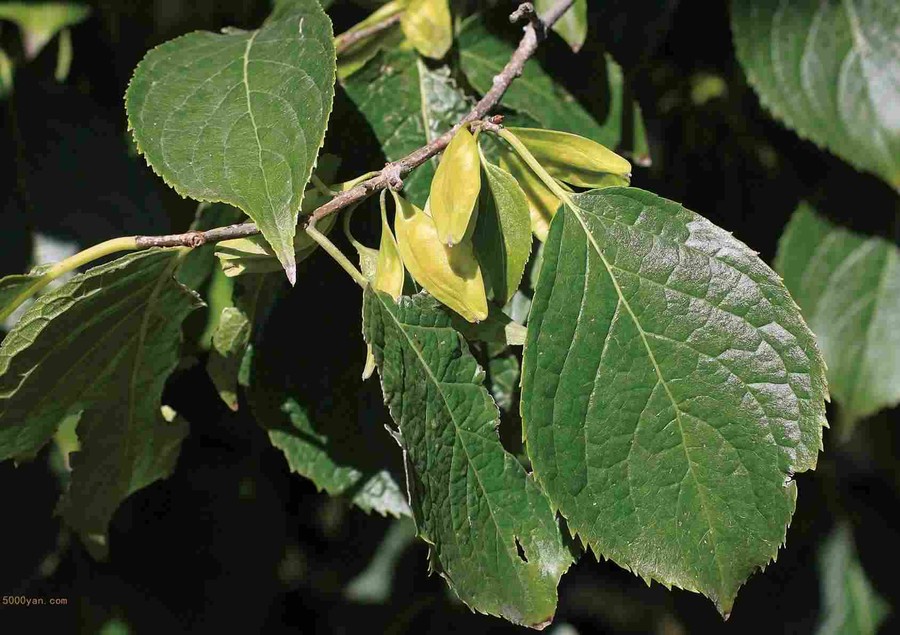
Deciduous tree, up to 20 m tall. Bark grayish-brown, rough, breaking to reveal numerous fine silky fibers when pulled apart. Young branches with yellowish-brown hairs, later glabrous, old branches with lenticels. Leaves simple, alternate; petiole 1-2 cm long, grooved above, sparsely covered with long hairs; leaf blade elliptic, ovate, or oblong, 6-15 cm long, 3.5-6.5 cm wide, apex acuminate, base rounded or broadly cuneate, upper surface dark green, lower surface pale green, slightly wrinkled on older leaves, margin serrate; lateral veins 6-9 pairs. Flowers unisexual, dioecious, borne at the base of the current year's branches; male flowers without perianth, pedicel glabrous; stamens about 1 cm long, glabrous, without vestigial pistil; female flowers solitary, pedicel about 8 mm long, ovary 1-locular, apex 2-lobed, ovary stalk very short. Samara flat, oblong, apex 2-lobed, base cuneate, surrounded by a thin wing; nutlet located in the center, jointed at the junction with the fruit stalk. Flowers in early spring, fruit matures in autumn.
Habitat and Distribution
It grows at altitudes of 300-500 m in low mountains, valleys, or sparse forests. It is distributed in Shaanxi, Gansu, Zhejiang, Henan, Hubei, Sichuan, Guizhou, Yunnan, and other regions. It is now widely cultivated in various areas.
Harvesting and Processing
4-6 months peeled, scrape off the rough outer bark, pile up for "sweating" until the inner bark turns purplish-brown, then sun-dry.
Medicinal Properties
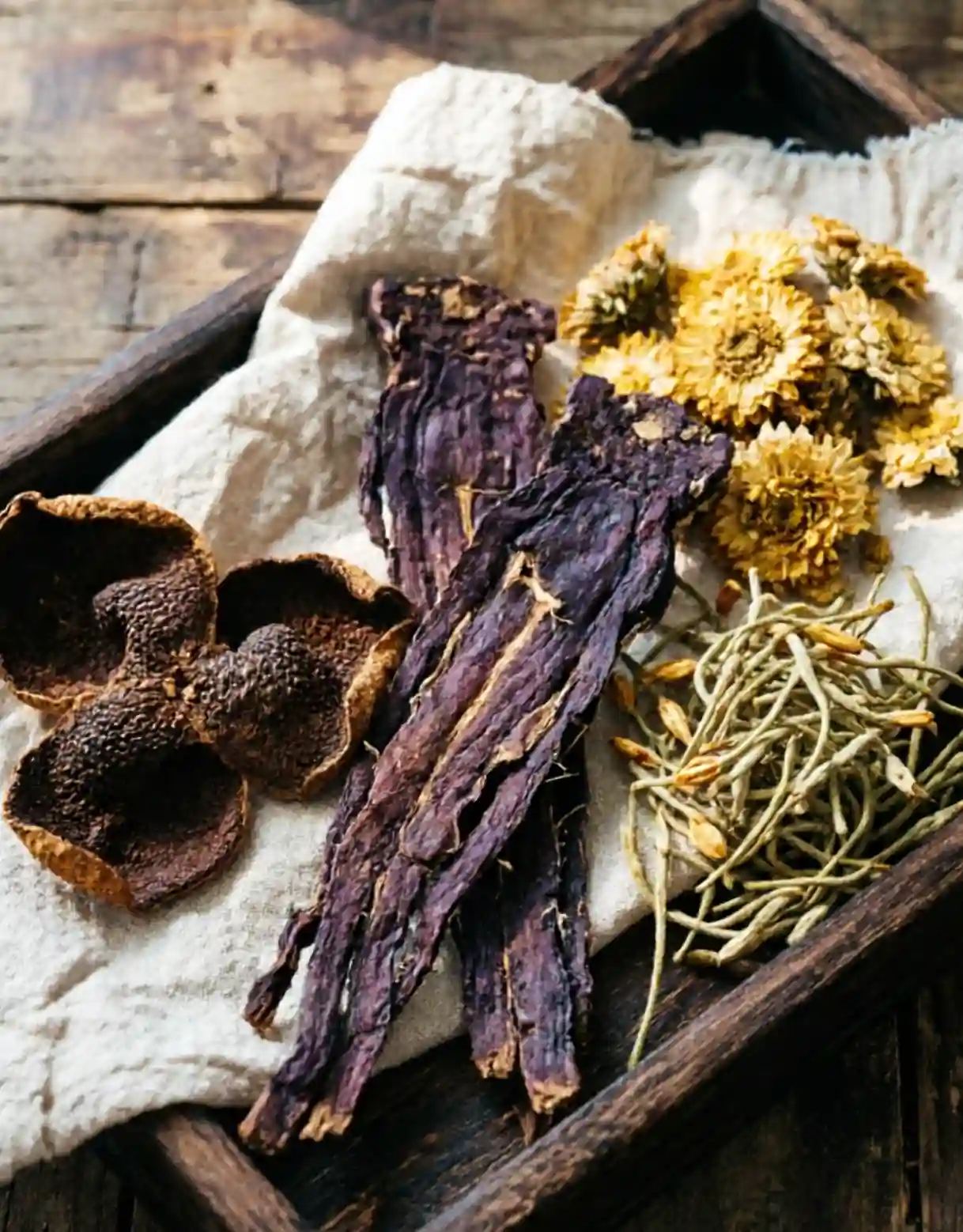
This product appears in plate-like pieces or with both sides slightly curled inward, of varying sizes, 3-7 mm thick. The outer surface is light brown or grayish-brown, with obvious wrinkles or longitudinal fissures; some pieces have thinner bark with the rough outer bark still present, revealing distinct lenticels. The inner surface is dark purple and smooth. The texture is brittle, easily broken, with a cross-section showing fine, silvery-white, elastic rubber-like threads connecting the fragments. Odor: faint; Taste: slightly bitter.
Chemical Constituents
This product contains pinoresinol diglucoside, dextrorotatory syringaresinol, eucommioside, eucommiin A, and erythro-dihydroxy-dehydrodiconiferyl alcohol, among other constituents.
Pharmacology
Has antihypertensive effects; enhances immune function; influences the pituitary-adrenocortical system function; inhibits isolated uterus; has diuretic effects; exhibits significant analgesic and anti-inflammatory actions.
Properties and Channel Entry
Sweet, warm; enters the Liver and Kidney channels.
Functions and Indications
Tonifies the Liver and Kidneys, strengthens the sinews and bones, and calms the fetus
Dosage and Administration
Oral: decoct in water, 6-15 g, or steep in wine; or taken as pills or powder.
Precautions and Contraindications
Those with Yin deficiency and exuberant Fire should use with caution.
Prescriptions
1. For nephritis: Duzhong 30 g, *Rhus chinensis* root 30 g, stew with an appropriate amount of pork and take orally. (*Fujian Materia Medica*) 2. For kidney damage due to Wind-Cold, low back pain with inability to bend or straighten: Duzhong 1 jin (sliced, processed with ginger juice, stir-fried to remove fibers). Soak in 3 sheng of unblanched wine for 10 days. Take 2-3 he per dose, 4-5 doses daily. (*Sanyin Fang* Duzhong Wine) 3. For restless fetus in women: Duzhong (any amount, remove rough bark, finely cut, dry-bake on a tile). Grind into powder, form into pills with boiled jujube paste, each pill the size of a *tanzi* (large pill). Take 1 pill, chew thoroughly, and swallow with glutinous rice soup. (*Shengji Zonglu* Duzhong Pill) 4. For hypertension: a. Raw Duzhong 12 g, Sangjisheng 15 g, raw Muli 18 g, Bai Juhua 9 g, Gouqizi 9 g. Decoct in water and take orally. (*Shandong Chinese Herbal Medicine Handbook*) b. Duzhong 15 g, Huangqin 15 g, Xiakucao 15 g. Decoct in water and take orally. (*Shaanxi Chinese Herbal Medicine*) 5. For Wind-deficiency with excessive sweating, especially severe at night: Duzhong (remove rough bark, dry-fry, finely cut) 60 g, Huangqi (finely cut) 90 g, Muli (calcined red) 90 g, Mahuanggen 15 g. Grind the above four ingredients into a fine powder. Take 6 g per dose, adjust with decoction of *Baishantang* (a specific herb), take after meals, twice daily. (*Shengji Zonglu* Duzhong Powder)