Pinyin: xiangjiapi
Aliases
Bei Wujiapi, Gangliupi, Chou Wujia, Xiang Wujiapi
Source
Plant of the Asclepiadaceae family, *Periploca sepium*.Periploca sepiumDried root bark of Bge.
Botanical Description
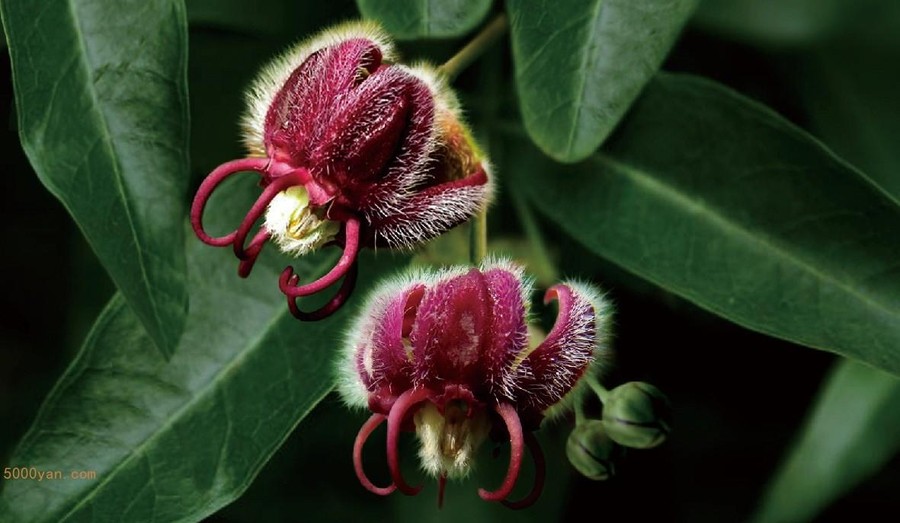
Deciduous climbing shrub, up to 1.5 m tall. Contains milky sap; entire plant glabrous except for flowers. Leaves opposite; petiole approximately 3 mm long; leaf blade membranous, ovate-oblong, 5-9 cm long, 1.5-2.5 cm wide, apex acuminate, base cuneate; lateral veins numerous. Inflorescence axillary cymose, with several flowers; calyx 5-lobed, lobes obtuse at apex, with 10 small glands at base inside; corolla purple-red, 1.5-2 cm in diameter, lobes 5, thickened in the center into a fusiform shape, reflexed, inner surface villous; corona annular, 10-lobed, with 5 lobes filiform and elongated, pubescent; stamens inserted inside the corona, anthers surrounding the stigma; carpels separate; pollen granular, enclosed within erect spoon-shaped pollinia. Follicles paired, cylindrical, 7-12 cm long, approximately 5 mm in diameter, with longitudinal striations. Seeds oblong, with a tuft of white silky hairs at the apex approximately 3 cm long. Flowering period May to June, fruiting period July to September.
Habitat and Distribution
Born in plains and low mountain hills at forest edges, ditch slopes, riverside sandy areas, or field ridges.
Harvesting and Processing
Harvested in spring and autumn, the root bark is peeled and dried in the sun.
Medicinal Properties
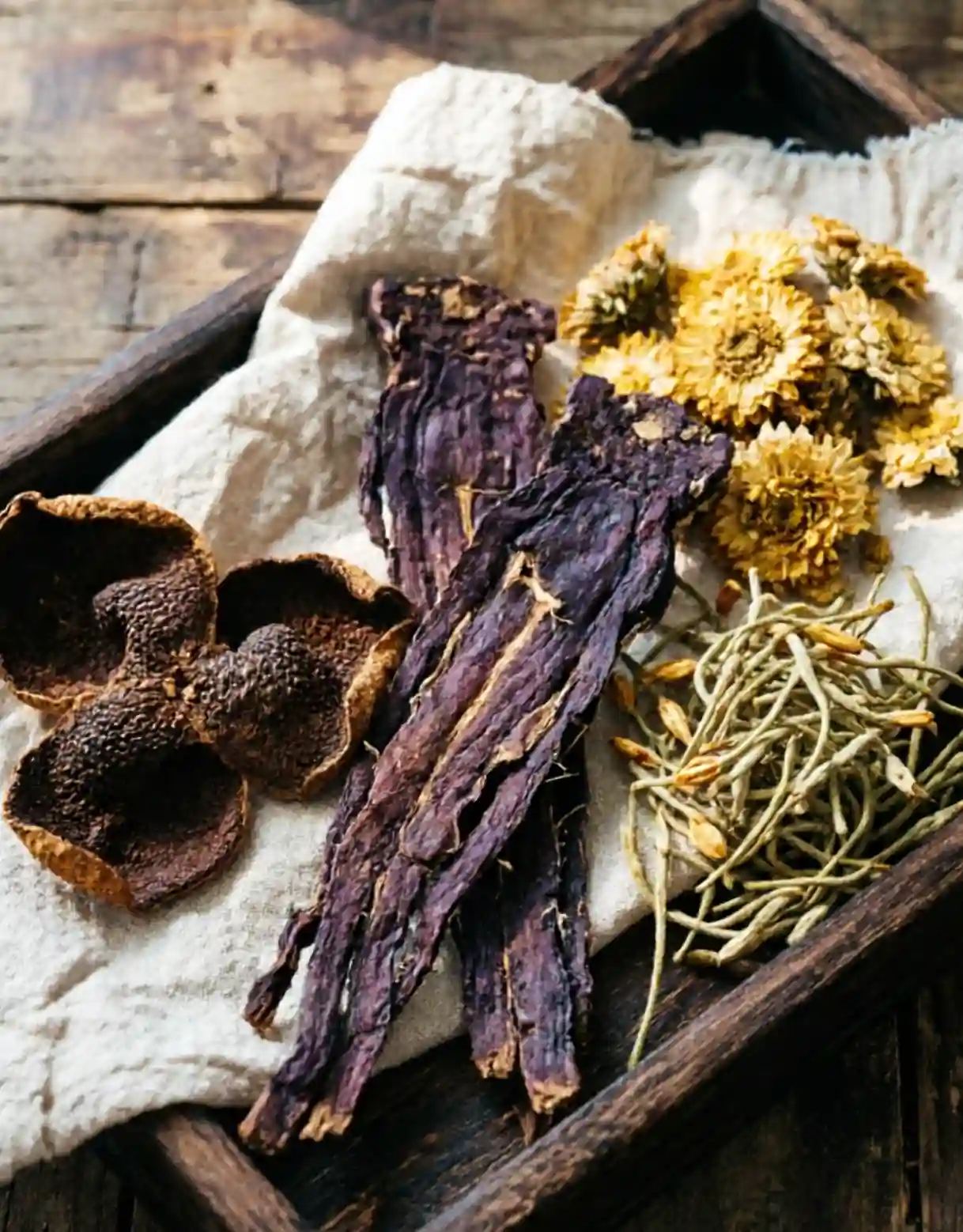
This product appears in rolled or trough-shaped pieces, with a small number of irregular block slices; 3-10 cm long, 1-2 cm in diameter, and 0.2-0.4 cm thick. The outer surface is grayish-brown or yellowish-brown, with loose, corky bark often appearing scaly and easily peeling off. The inner surface is pale yellow or pale yellowish-brown, relatively smooth, with fine longitudinal striations. The texture is light, brittle, and easily broken, with an uneven, yellowish-white fracture surface. It has a distinctive aromatic odor and a bitter taste.
Chemical Constituents
This product contains glycosides G, K, H1, and H2 of Beiwujiapi (northern Periploca cortex), periplocoside A, periplocoside B, periplocoside C, periplocoside of Canadian hemp sugar, 4-methoxysalicylaldehyde, and other constituents.
Pharmacology
Has cardiotonic and pressor effects, but cannot counteract the central inhibitory effects of barbiturates; enhances respiratory system function, and exhibits anticancer, anticholinesterase, anti-radiation, and insecticidal activities.
Properties and Channel Entry
Acrid, bitter, warm; toxic. Enters the Liver, Kidney, and Heart channels.
Functions and Indications
Promotes diuresis to reduce edema, expels Wind-Dampness, and strengthens sinews and bones
Dosage and Administration
Oral: decoct in water, 4.5-9 g; or steep in wine; or use in pills or powder. External: appropriate amount, decoct in water for external wash.
Precautions and Contraindications
This product is toxic and should not be used as a substitute for Acanthopanacis Cortex (Wujiapi) from the Araliaceae family. It is also not advisable to take an excessive dose or use it continuously for a long period.
Prescriptions
1. For rheumatic arthritis with joint contracture and pain: Xiangjiapi (Periploca cortex), Chuanshanlong (Dioscorea nipponica), and Baixianpi (Dictamnus root cortex) 15 g each. Soak in white liquor for 24 hours. Take 10 ml daily. (Selected Chinese Herbal Medicines from Shaanxi, Gansu, Ningxia, and Qinghai). 2. For edema and difficult urination: Xiangjiapi, Chenpi (tangerine peel), Shengjiangpi (fresh ginger peel), Fulingpi (Poria peel), and Dafupi (areca peel) 9 g each. Decoct in water and take orally. (Selected Chinese Herbal Medicines from Shaanxi, Gansu, Ningxia, and Qinghai). 3. For scrotal edema: Xiangjiapi 9 g and Xianrentou (dried fruit of Datura) 30 g. Decoct in water and take orally. (Shandong Chinese Herbal Medicine Manual). 4. For skin and genital itching: Xiangjiapi in appropriate amount. Decoct in water for external wash. (Qingdao Chinese Herbal Medicine Manual).