Pinyin: Haitongpi
Aliases
Dingtongpi, Gutongpi, Citongpi, Citong, Jieguyao.
Source
Fabaceae plant ErythrinaErythrinavariegataThe dried stem bark or root bark of L.
Botanical Description
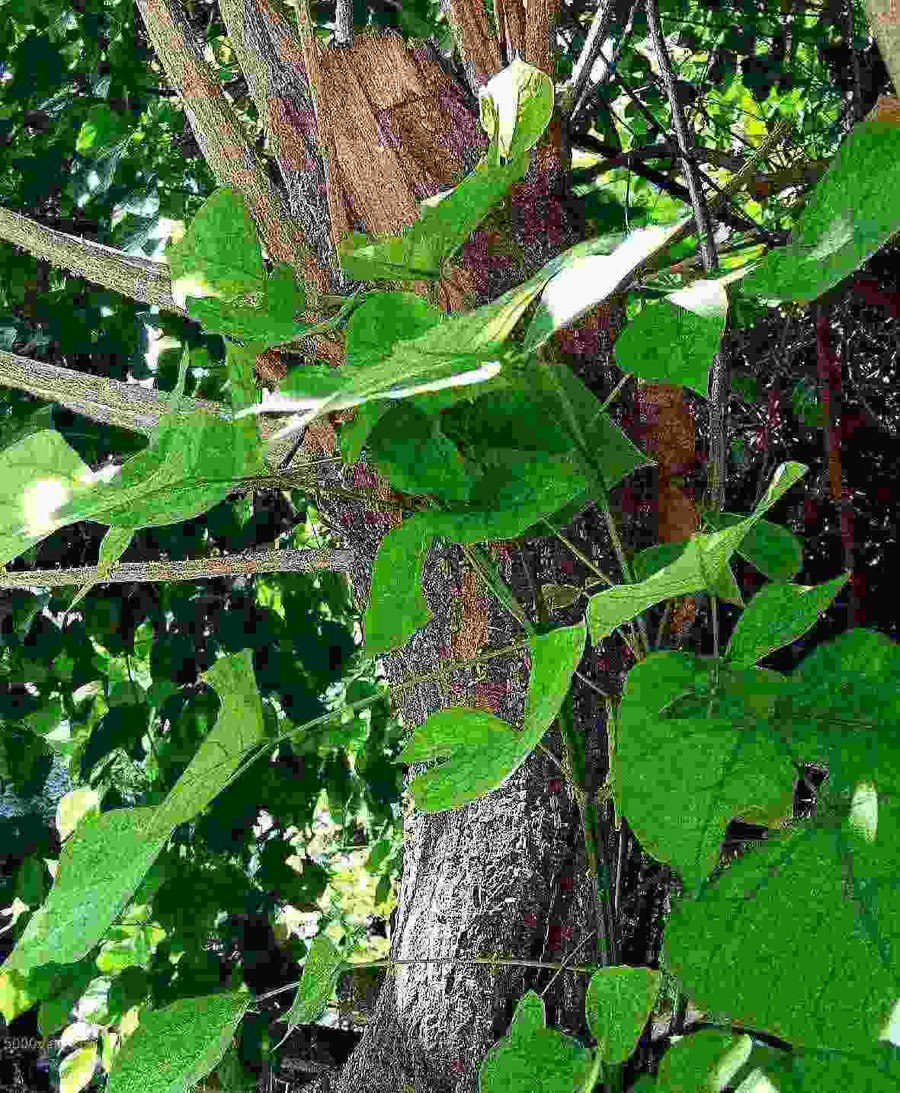
Large tree, up to 20 m tall. Bark gray-brown; branches pale yellow to earthy yellow, densely covered with gray tomentum, with black conical spines that fall off after 2-3 years. Leaves alternate or clustered at branch tips; stipules 2, linear, 1-1.3 cm long, deciduous; trifoliate compound leaves; leaflets broadly ovate to rhomboid-ovate, 10-15 cm long, terminal leaflet wider than long, apex acuminate and obtuse, base nearly truncate or broadly rhomboid, both surfaces with sparse hairs along veins. Racemes about 15 cm long, tomentose; peduncle 7-10 cm long; calyx spathe-like, 2-3 cm long, calyx mouth obliquely split, splitting from the back to the base; corolla butterfly-shaped, bright red, standard petal 5-6 cm long, wing petals and keel petals nearly equal, shorter than calyx; stamens 10, diadelphous, filaments pale purple, 3-3.5 cm long, anthers yellow; pistil 1, pale green, stigma undivided, densely covered with purple soft hairs. Legume moniliform, slightly curved. Seeds 1-8, spherical, dark red. Flowering period: March.
Habitat and Distribution
Wild or cultivated as street trees. Distributed in Zhejiang, Fujian, Taiwan, Hubei, Hunan, Guangdong, Guangxi, Sichuan, Guizhou, Yunnan, and other regions.
Harvesting and Processing
After about 8 years of cultivation, the bark can be stripped, usually in summer or autumn. There are three methods: stripping trunk bark, cutting branches and stripping bark, and digging roots and stripping bark. After stripping, scrape off the dirt and dry in the sun.
Medicinal Properties
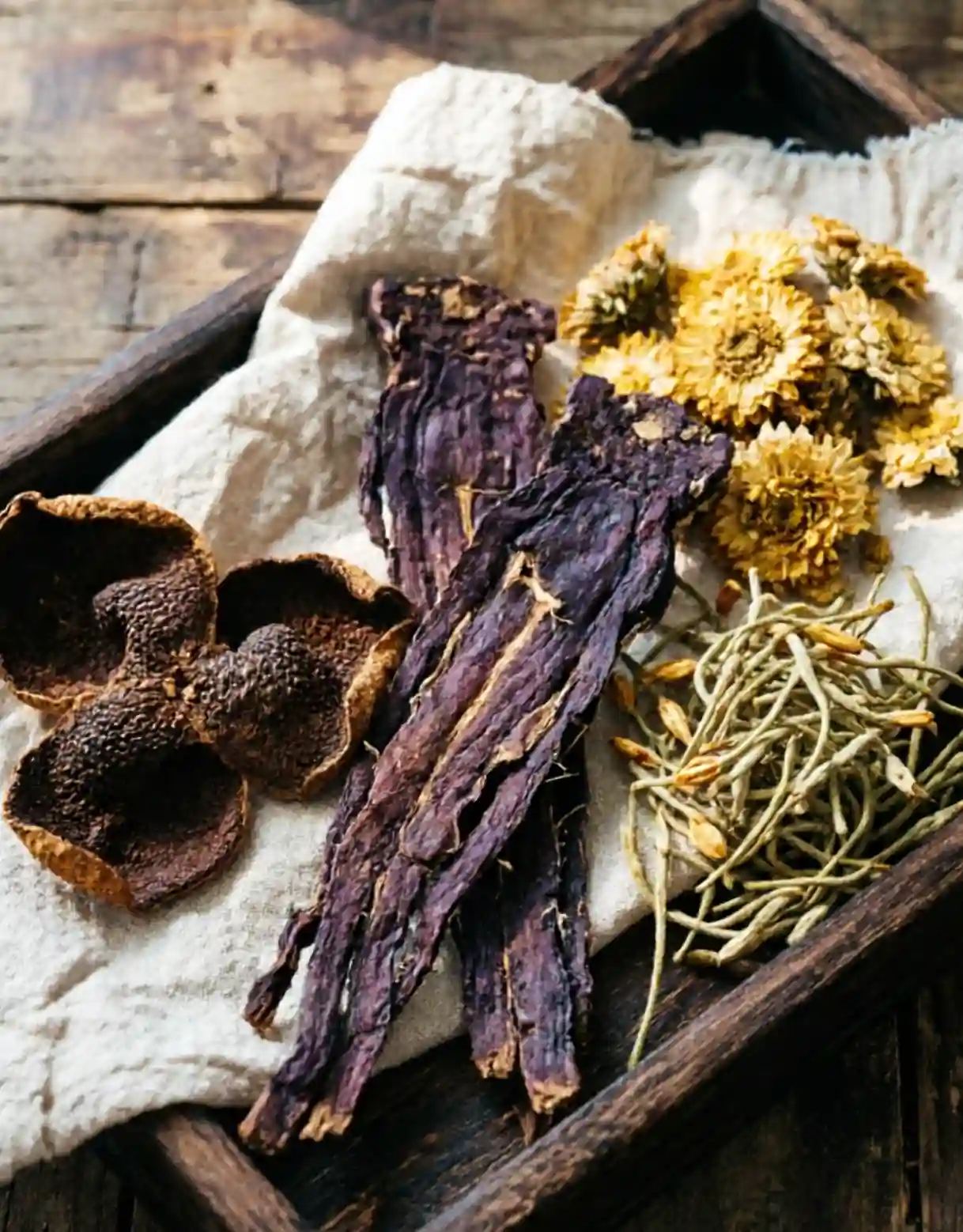
This product is semi-cylindrical or plate-like in shape, slightly curled on both sides, approximately 40 cm long, and 0.25-1.5 cm thick. The outer surface is yellowish-brown to brownish-black, often with longitudinal grooves of varying widths. The cork layer of old bark is relatively thick and is sometimes scraped off. The surface where the cork has not been removed is rough, with yellow lenticels and scattered thorny prickles, or circular scars left after the prickles have been removed; the prickles are long-conical, 5-8 mm high, with sharp tips and a base diameter of 5-10 mm. The inner surface is yellowish-brown and relatively flat, with fine, dense longitudinal reticulations; root bark lacks prickles. The texture is tough and strong, easily splitting longitudinally but difficult to break. The fracture surface is light brown and flaky. Odor: faint; Taste: slightly bitter.
Chemical Constituents
This product contains erythraline, erythratine, erythraline, erythraline, erythraline, erythraline, erythraline, erythraline, erythraline, erythraline, erythraline, erythraline, erythraline, erythraline, erythraline, erythraline, erythraline, erythraline, erythraline, erythraline, erythraline, erythraline, erythraline, erythraline, erythraline, erythraline, erythraline, erythraline, erythraline, erythraline, erythraline, erythraline, erythraline, erythraline, erythraline, erythraline, erythraline, erythraline, erythraline, erythraline, erythraline, erysoflorine, erythraline, erythraline, erythraline, erythraline, erythraline, erythraline, erythraline, erythraline, erythraline, erythraline, erythraline, erythraline, erythraline, erythraline, erythraline, erythraline, erythraline, erythraline, erythraline, erythraline, erythraline, erythraline, erythraline, erythraline, erythraline, erythraline, erythraline, erythraline, erythraline, erythraline, erythraline, erythraline, erythraline, erythraline, erythraline, erythraline, erythraline, and erythraline.
Pharmacology
Has analgesic and sedative effects; antibacterial; also has antagonistic effect on acetylcholine-induced intestinal contraction.
Properties and Channel Entry
Bitter, acrid, and neutral in nature; enters the Liver and Spleen channels.
Functions and Indications
Expels Wind and eliminates Dampness, relaxes tendons and unblocks collaterals, kills parasites and alleviates itching. Mainly indicated for rheumatic Bi pain, joint and limb contracture, traumatic injuries, scabies and tinea, and eczema.
Dosage and Administration
Internal: decoction, 6-12 g; or steep in wine. External: appropriate amount. For fumigation with decoction; or rub with wine-soaked solution; or grind into powder and apply with mixing.
Precautions and Contraindications
For those with Blood deficiency, use with caution.
Prescriptions
1. For treating middle-qi evil and cholera: Decoct *Erythrina* bark in water and take the decoction orally. (From *Sheng Ji Zong Lu*). 2. For treating infantile ascariasis: 1.5-3 g of *Erythrina* bark powder, taken with boiling water. (From *Guangxi Selected Herbal Medicine*). 3. For treating cirrhotic ascites: 30 g of fresh *Erythrina* bark, stewed with pork bones. (From *Guangxi Selected Herbal Medicine*). 4. For treating wind-caused toothache: Gargle with a decoction of *Erythrina* bark. (From *Sheng Hui Fang*). 5. For treating wind tinea with parasites: Equal parts of *Erythrina* bark and *Cnidium* fruit, ground into powder, mixed with lard, and applied topically. (From *Ru Yi Fang*).