Pinyin: Kulianpi
Aliases
Lianmupi, Lianpi, Lianggenpi, Kulianggenpi
1. Lai.
Internal use: decoct 3-10 g, large dose 10-30 g, or grind into powder and take 1-3 g. External use: appropriate amount, grind into powder and apply.
1. For pneumonia: Renshen 6 g, decoct in water and take orally. Internal use: decoct 3-10 g, large dose 10-30 g.Melia azedarachL. or Chuanlian (Toosendan Fructus)Melia toosendanDried bark and root bark of Sieb.et Zucc.
Botanical Description
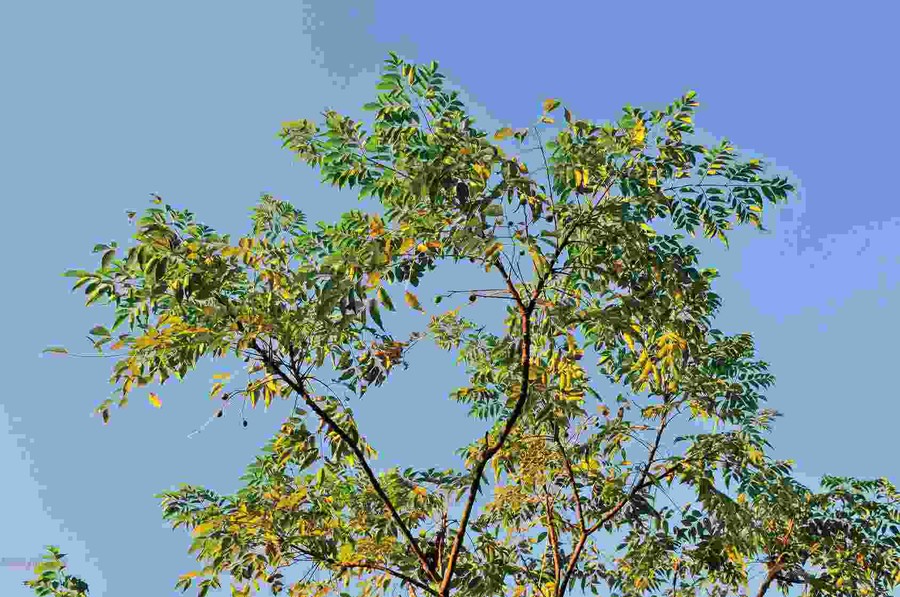
1. Chinaberry: deciduous tree, 15-20 m tall, bark dark brown with longitudinal fissures, old branches purple with numerous small lenticels. Leaves are 2-3 times odd-pinnately compound and alternate; leaflets ovate to elliptic, 3-7 cm long, 2-3 cm wide, apex long-acuminate, base broadly cuneate or rounded, margin with blunt serrations, upper surface deep green, lower surface pale green, young leaves with stellate hairs, later glabrous except for white hairs on veins. Panicles axillary or terminal, flowers pale purple, about 1 cm long; calyx 5-lobed, lobes lanceolate, hairy on both sides; petals 5, spreading or recurved, oblanceolate; stamen tube usually dark purple, about 7 mm long; ovary superior. Drupe subglobose or ovoid, 1.5-2 cm long, pale yellow, 4-5 locules, each locule with 1 seed. Flowering period: April-May, fruiting period: October-November.
2. Chuanlian: see entry under "Chuanlianzi."
Habitat and Distribution
It grows in open fields or along roadsides, often cultivated in front of or behind houses. Distributed from Hebei in the north to Guangxi and Yunnan in the south, and as far west as Sichuan.
Harvesting and Processing
Peeled in spring and autumn, dried in the sun, or the rough outer bark removed and then dried in the sun.
Medicinal Properties
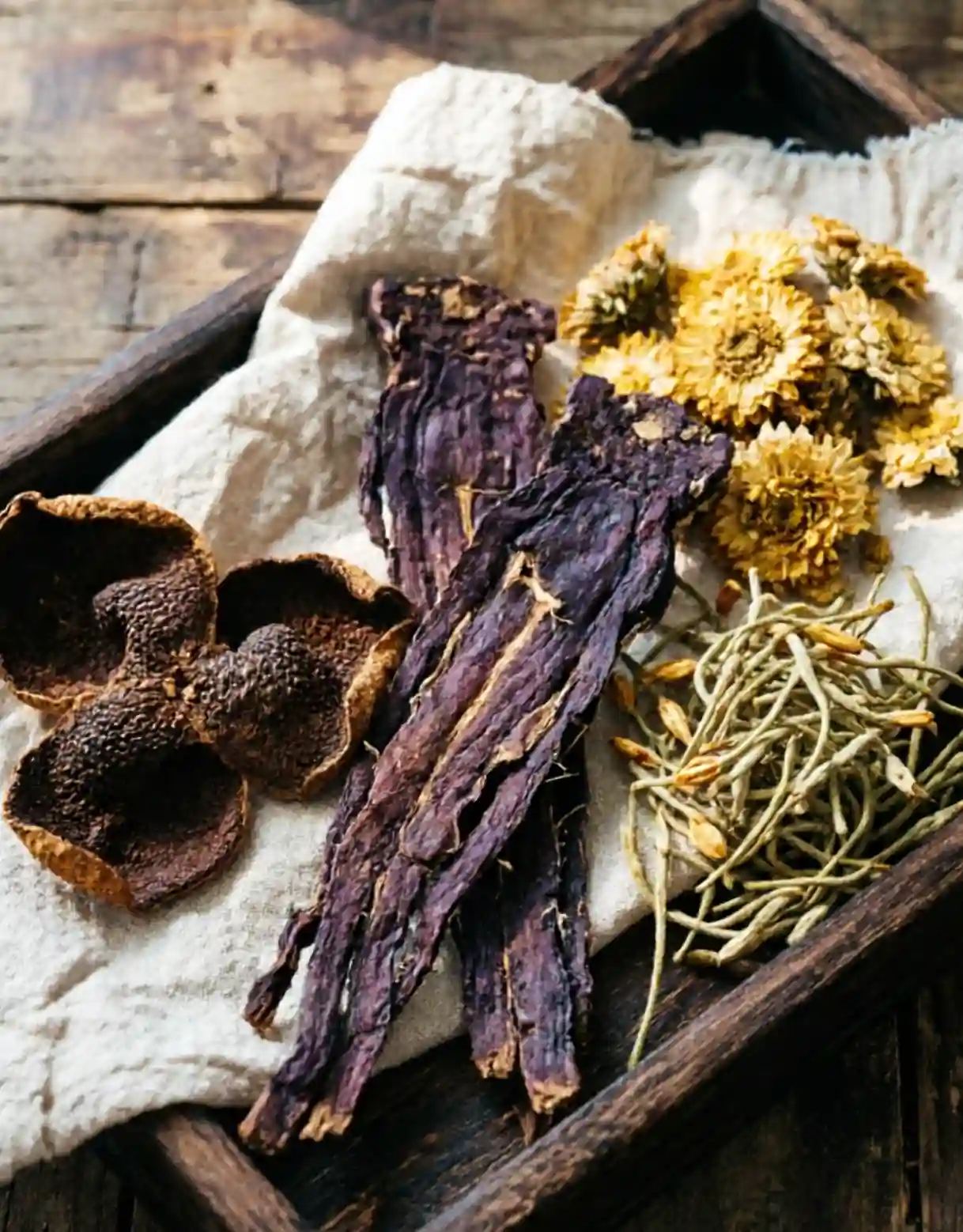
This product appears as irregular slab-like, groove-like, or semi-rolled cylindrical pieces, varying in length and width, with a thickness of 2-6 mm. The outer surface is grayish-brown or grayish-brown, rough, with interwoven longitudinal wrinkles and punctate grayish-brown lenticels; the surface with the rough outer bark removed is pale yellow. The inner surface is off-white or pale yellow. The texture is tough and not easily broken; the fracture surface is fibrous, layered and flaky, easily separated. Odor: faint; Taste: bitter.
Chemical Constituents
This product contains toosendanin, kulinone, kulactone, and meliantriol.β- Contains components such as sitosterol.
Pharmacology
Has anthelmintic effect; inhibits the respiratory center; affects neuromuscular transmission function; has therapeutic effects on botulism, and can influence myocardial electrical and mechanical properties. Shows certain efficacy in experimental Schistosoma mansoni disease.
Properties and Channel Entry
Bitter, cold; toxic. Enters the Liver, Spleen, and Stomach channels.
Functions and Indications
Kills parasites and treats tinea. Used for ascariasis, enterobiasis, and abdominal pain due to parasitic accumulation; externally applied for scabies and tinea with itching.
Dosage and Administration
Oral: decoct 6-15 g, fresh product 15-30 g; or made into pills or powder. External: appropriate amount, decoct for washing or grind into powder for topical application.
Precautions and Contraindications
For those with weak constitution and liver or kidney dysfunction, pregnant women, and individuals with Spleen and Stomach deficiency-cold syndrome, use with caution. Prolonged or excessive use is also not advisable. Ku Lian Pi (Melia toosendan bark) possesses certain toxicity. After poisoning from ingestion, symptoms such as headache, dizziness, nausea, vomiting, and abdominal pain may occur. In severe poisoning, internal organ hemorrhage, toxic hepatitis, mental disorders, respiratory center paralysis, and even shock, coma, and death may develop.
Prescriptions
1. For hookworm disease: Kumianpi (removed coarse outer bark) 5000 g, add water 25000 mL, decoct to 5000 mL; separately, Shiliupi 24 g, add water 2500 mL, decoct to 1000 mL. Mix the two decoctions together and stir well. Adults take 30 mL each time. (Hunan Materia Medica) 2. For dysentery: Kumianpi 12 g, Gusuibu 9 g, Jingjie 6 g, Qingmuxiang 6 g, Jimuhua 9 g. Decoct in water and take orally. (Hunan Materia Medica) 3. For dental caries pain: decoct Kumianpi in water and use as a mouth rinse. (Hunan Materia Medica) 4. For scabies and wind parasites: Kumianpi and Zaojiao (removed peel and seeds), equal parts. Grind into powder, mix with lard and apply topically. (Qixiao Liangfang) 5. For stubborn damp tinea: Kumianpi, wash clean, dry in the sun, burn to ash, mix with tea oil and apply to the affected area. Wash off the next day and reapply. Repeat three to four times. (Fujian Journal of Traditional Chinese Medicine, 1959, (2), 43)