Pinyin: Difengpi
Source
Magnoliaceae plant DìfēngIllicium difengpiDried bark of K.I.B. et K.I.M.
Botanical Description
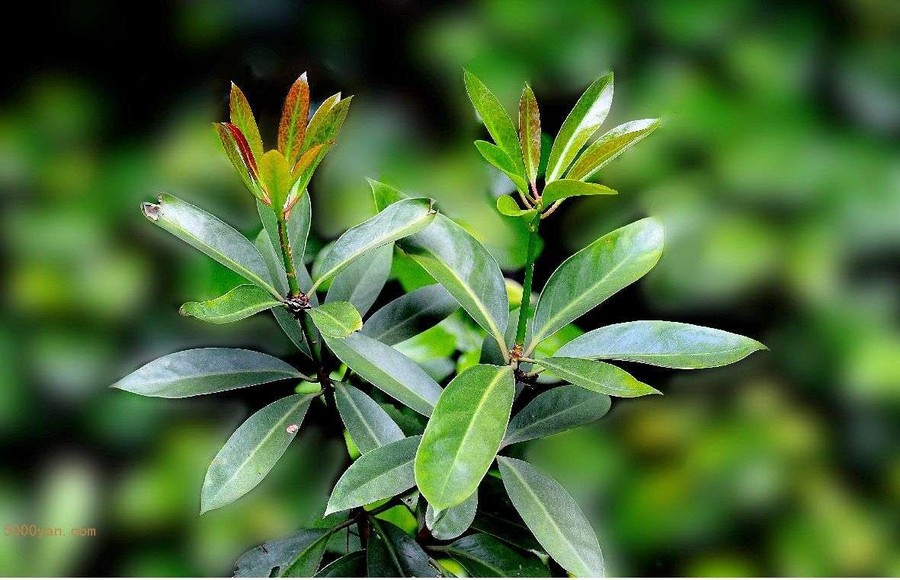
An evergreen shrub, 1-3 m tall. Bark grayish-brown, with longitudinal wrinkles, texture loose and brittle, easily broken, granular in cross-section, aromatic; young branches brown. Leaves often 3-5 clustered at branch tips; petiole relatively thick, 1.3-2.5 cm long; leaf blade leathery or thickly leathery, glossy, oblanceolate, oblong-elliptic, or ovate-elliptic, 10-14 cm long, 3-6 cm wide, apex shortly acuminate, base cuneate or broadly cuneate, margin entire, slightly revolute. Flowers red, axillary or subterminal; pedicel 0.6-1.5 cm long; tepals 15-17, up to 20 in some cases, the largest one broadly elliptic or suborbicular, about 1.3 cm long, 1 cm wide, fleshy; stamens 21, 3.5-4 mm long; carpels usually 13, free, arranged in a whorl. Follicles 9-11, apex with a curved beak, 3-5 mm long, fruit stalk 1-4 cm long. Flowering period April to June, fruiting period July to September.
Habitat and Distribution
Born at altitudes of 200-500 m in limestone mountainous areas, at mountain tops or under sparse forests on rocky mountains. Distributed in the southwestern region of Guangxi.
Harvesting and Processing
Harvested in spring and autumn by peeling, then dried in the sun or at low temperature.
Medicinal Properties
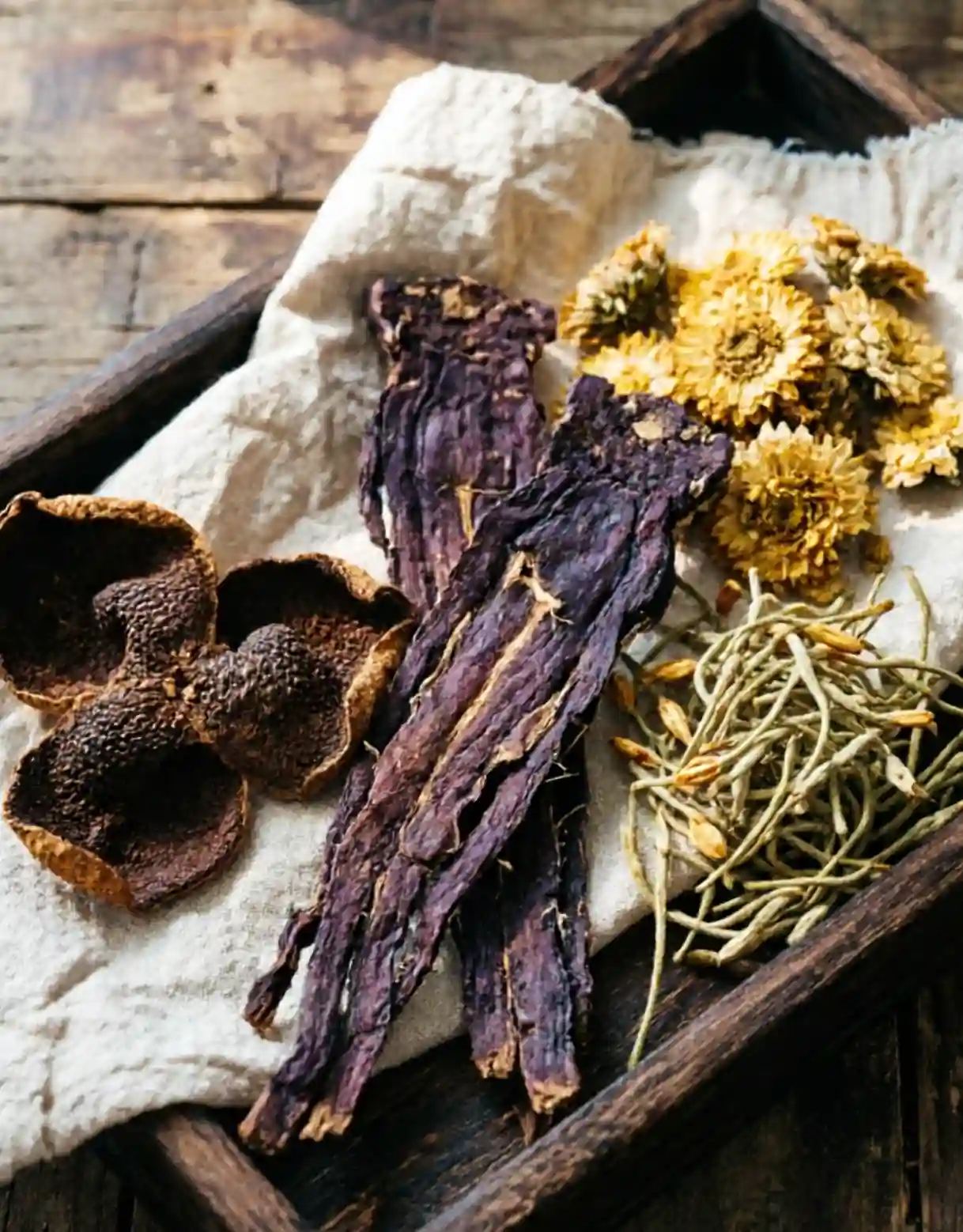
This product is in the shape of a rolled tube or trough, 5-15 cm long, 1-4 cm in diameter, and 0.2-0.3 cm thick. The outer surface is grayish-brown to dark brown, some with visible grayish-white lichen spots, the coarse bark is easily peeled or detached, and the peeled areas are brownish-red. The inner surface is brown or brownish-red with distinct fine longitudinal wrinkles. The texture is loose and brittle, easily broken, with a granular fracture. The odor is faintly aromatic, and the taste is slightly astringent.
Chemical Constituents
This product containsα1. For pneumonia: Renshen 6 g, decoct in water and take orally. Internal use: decoct 3-10 g.β-α-Pinene, camphene, 1,8-cineole, linalool, safrole, camphor, bornyl acetate, myrcene, and other constituents.
Properties and Channel Entry
Slightly acrid, astringent, and warm; with mild toxicity. Enters the Bladder and Kidney channels.
Functions and Indications
Expels Wind and eliminates Dampness, moves Qi and alleviates pain. Used for Wind-Damp Bi pain (rheumatic arthralgia) and lower back pain due to overstrain.
Dosage and Administration
Oral: decoct in water, 6-9 g. External use: apply an appropriate amount, ground into powder and mixed with wine for topical application.
Precautions and Contraindications
Caution should be exercised in pregnant women.