Pinyin: Mujinpi
Aliases
Chuanjinpi, Baijinpi, Lushupi, Wangaihuapi
Source
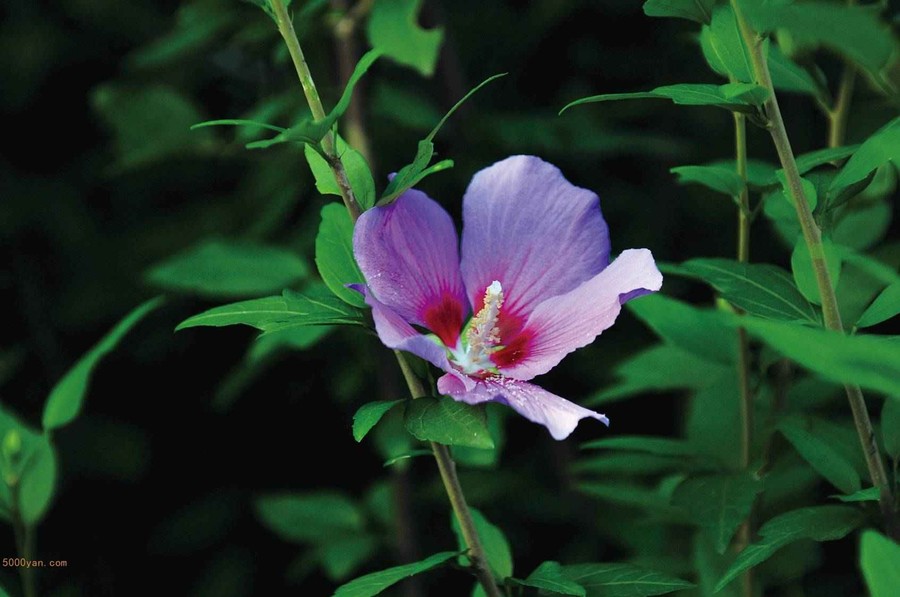
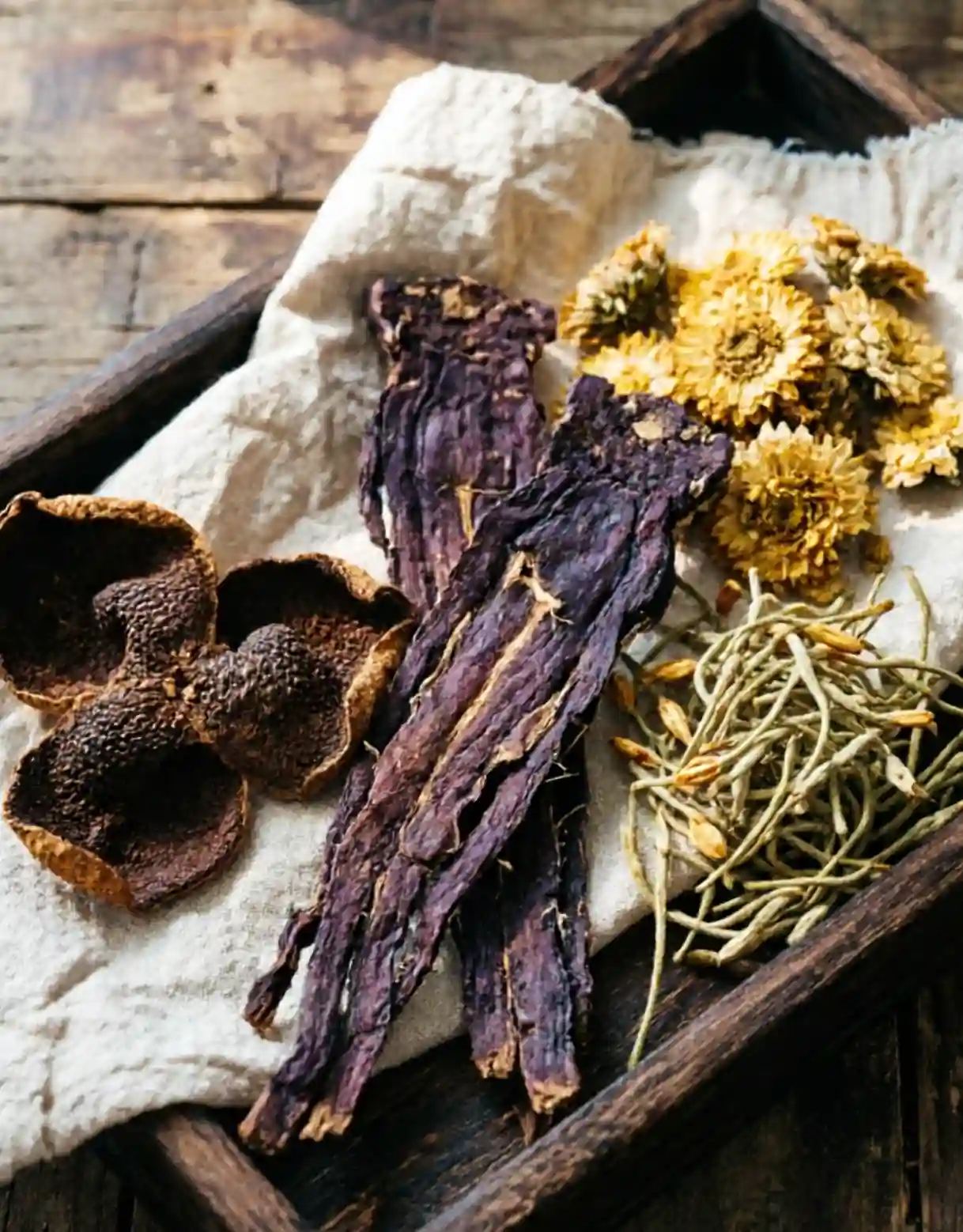
Malvaceae family plant *Hibiscus syriacus*Hibiscus syriacusL. is the dried stem bark or root bark.
Botanical Description
See the entry under "Mujinhua" (Hibiscus Flower).
Harvesting and Processing
The stem bark is collected by peeling in April to May and dried in the sun. The root bark is collected in late autumn by digging up the roots, peeling the root bark, and drying in the sun.
Medicinal Properties
This product is often involuted into long trough-like or single tubular pieces of varying sizes, 1-2 mm thick. The outer surface is bluish-gray or grayish-brown, with fine, slightly curved longitudinal wrinkles and scattered punctiform lenticels. The inner surface is whitish to pale yellowish-white, smooth, with fine longitudinal striations. The texture is tough and tenacious; the fractured surface is strongly fibrous and off-white. The odor is faint, and the taste is bland. Those that are dried, long, wide and thick, and free from mold are considered superior.
Chemical Constituents
This product primarily contains suberic acid, 1-octacosanol,β-β-sitosterol, 1,22-docosanediol, betulin, erythrodiol, myristic acid, and other constituents.
Pharmacology
Has inhibitory effects on tumor cell growth.
Properties and Channel Entry
Sweet, bitter, slightly cold. Enters the Large Intestine, Liver, and Spleen channels.
Functions and Indications
Clears Heat and drains Dampness, kills parasites and stops itching
Dosage and Administration
External use: appropriate amount, steep in wine for external application or decoct in water for fumigation and washing. Internal use: decoct in water 3-9 g.
Precautions and Contraindications
Use with caution in patients without Damp-Heat.
Prescriptions
1. For all types of stubborn tinea: a. Cortex Hibisci 9 g, Mylabris 7 large or 10 small (heads and legs removed), Crotonis Fructus 5 g (oil removed). Grind into fine powder, mix with vinegar and apply externally. After a short while, pain and blistering will occur; once the blisters subside, healing is achieved. (from *Lufu Jin Fang*, "Chuan Jian San") b. Cortex Hibisci 6 g, Calomelas 1.5 g, Mylabris 7 pieces, Hydnocarpi Semen 7 pieces. Mix equal parts river water and well water (one cup total), decoct to half, leave overnight exposed to dew, then apply with a brush. (from *Waike Zhengyong*, stubborn tinea formula) c. Cortex Hibisci 60 g, rice vinegar 120 ml. Soak to extract the juice, apply externally several times daily. (from *Anhui Zhongcaoyao*) 2. For psoriasis: Cortex Hibisci 30 g, Hydnocarpi Semen 15 pieces, Pinelliae Rhizoma 15 g. Use one bowl each of river water and well water, soak and expose to dew for seven nights, then add Calomelas 3 g to the water. Apply with a worn-out brush; it is effective when foul-smelling discharge appears. Avoid bathing, and treatment during summer is especially effective. (from *Chuanya Neibian*) 3. For tinea pedis (athlete's foot): Cortex Hibisci 60 g, 75% ethanol 60 ml. Soak for 2 days, then apply externally to the affected area. (from *Anhui Zhongcaoyao*) 4. For leukorrhea with red and white discharge: Cortex Hibisci radicis 60 g (sliced), mix with one and a half bowls of white wine and one bowl of water, take on an empty stomach. (from *Zuanyao Qifang*) 5. For rectal prolapse: decoct Cortex Hibisci or its leaves in water for steaming and washing, then mix equal parts Alumen and Galla Chinensis into powder and apply externally. (from *Jiuji Fang*)