Pinyin: Zhangmu
Aliases
Zhangcai, Xiangzhangmu, Chuifengsan.
Source
1. Lauraceae plant Cinnamomum camphora (L.) Presl.Cinnamomum camphoraDried wood of (L.) Presl.
Botanical Description
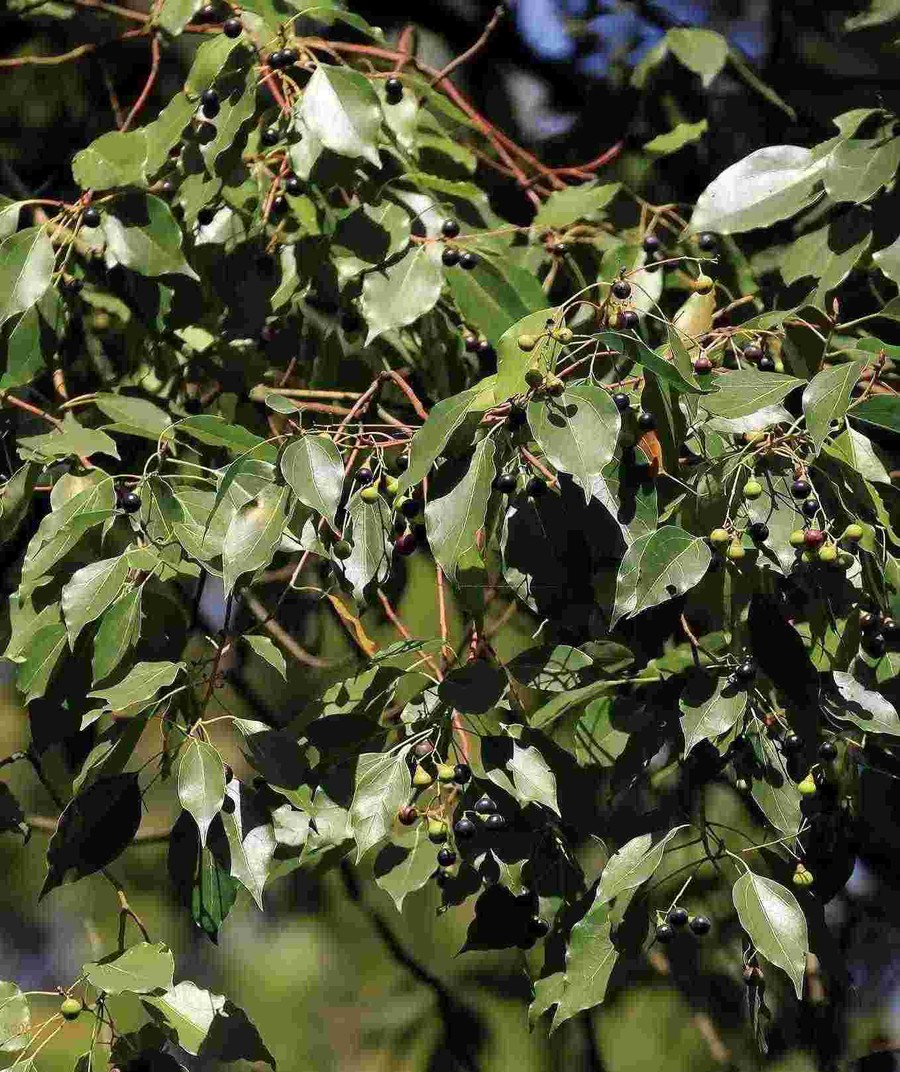
Evergreen large tree, up to 30 m tall. Bark grayish-yellow-brown, longitudinally fissured. Branches, leaves, and wood have a camphor-like odor; branches glabrous. Leaves alternate; petioles slender, 2-3 cm long, glabrous; leaf blades thin leathery, ovate to ovate-elliptic, 6-12 cm long, 2.5-5.5 cm wide, apex acute, base broadly cuneate to subrounded, margin entire, sometimes slightly undulate, upper surface green and glossy, lower surface grayish-green with a slight bloom, both surfaces glabrous, with three basal veins; panicles axillary, 3.5-7 cm long; flowers bisexual, ca. 3 mm long, greenish-white or yellowish-green; pedicels 1-2 mm long; perianth tube obconical, ca. 1 mm long; perianth lobes elliptic, ca. 2 mm long, densely pubescent inside; fertile stamens 9, ca. 2 mm long, filaments pubescent; staminodes 3, arrow-shaped, in the innermost whorl; ovary globose, ca. 1 mm in diameter, glabrous; style ca. 1 mm long. Fruit subglobose to ovoid-globose, 6-8 mm in diameter, purplish-black; fruit cup cup-shaped, ca. 5 mm long, apex truncate, up to 4 mm in diameter. Flowering April to May, fruiting August to November.
Habitat and Distribution
Grown on hillsides or in valleys, often cultivated in low mountains and plains. Distributed in Zhejiang, Jiangxi, Fujian, Taiwan, Hubei, Hunan, Guangdong, Hainan, Guangxi, Sichuan, and Yunnan.
Harvesting and Processing
After 5-6 years of cultivation and reaching maturity, the trunk is usually harvested in winter, cut into sections, split into small pieces, and dried in the sun.
Medicinal Properties
This product consists of irregularly shaped segments or small pieces. The outer surface is reddish-brown to dark brown with straight and orderly grain. Annual rings are visible on the cross-section. The texture is heavy and hard. It has a strong camphor-like aroma, with a pungent taste and a cooling sensation. Those with large pieces and a rich aroma are considered superior.
Chemical Constituents
This product primarily contains d-camphor, eucalyptol, and safrole, as well as camphor alcohol and camphor ketone.
Properties and Channel Entry
Acrid, warm. Enters the Liver and Spleen channels.
Functions and Indications
Dispels Wind and disperses Cold, warms the Middle and regulates Qi, activates Blood and unblocks the collaterals. Indications: Wind-Cold common cold, Cold in the Stomach with distension and pain, Cold-Dampness vomiting and diarrhea, Wind-Dampness Bi pain, Jiaoqi (beriberi), traumatic injury pain, scabies and tinea with Wind itching.
Dosage and Administration
Oral: decoct in water, 10-20 g; or grind into powder, 3-6 g. External: appropriate amount, decoct in water for washing.
Precautions and Contraindications
Contraindicated during pregnancy.
Prescriptions
1. For gastric cold distension and pain: Zhangmu (Camphorwood) 15 g, decoct in two bowls of water and take orally. (Xianggang Zhongcaoyao) 2. For beriberi, phlegm congestion with nausea and vomiting, chest and epigastric fullness and oppression, and poor appetite: Zhangmu (Camphorwood) 30 g (coated with ginger juice and roasted until yellow), pound and sieve into a powder. Take 3 g with rice porridge at any time. (Puji Fang, Zhangmu Powder) 3. For gout, with cold pain in the hands and feet as if bitten by a tiger: Zhangmu (Camphorwood) shavings one dou, boil with one dan of water until bubbling. Place the shavings in a large bucket. Have the patient sit by the bucket and place one foot inside, covering the outside with a straw mat to prevent steam from entering the eyes (which could damage them). The effect is very rapid. (Yixue Zhengzhuan)