Pinyin: Roucongrong
Aliases
Rousongrong, Zongrong, Congrong.
Source
Columnaceae plant CistancheCistanche deserticolaDried fleshy stem with scale leaves of Y.C.Ma.
Botanical Description
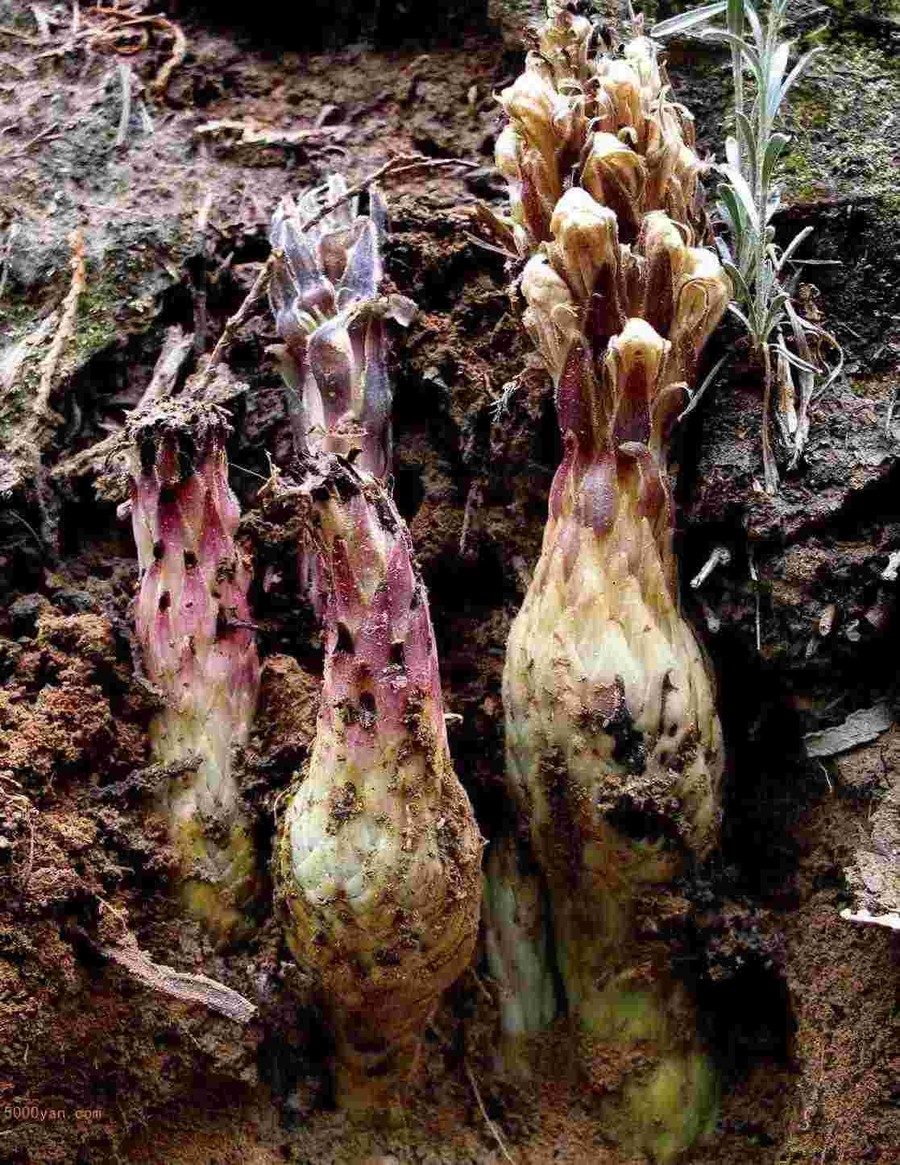
Perennial parasitic herb, 40-160 cm tall. Stem fleshy, solitary or branched into 2 or 3 branches from the base, lower part 5-15 cm wide, upper part gradually tapering, 2-5 cm wide. Leaves numerous, scale-like, spirally arranged, pale yellow-white, sessile; lower leaves densely arranged, broadly ovate or triangular-ovate, 0.5-1 cm long, 1-2 cm wide; upper leaves sparse, linear-lanceolate. Spike inflorescence, 15-50 cm long; bract 1, linear-lanceolate or ovate-lanceolate; bracteoles 2, ovate-lanceolate; calyx campanulate, 1-1.5 cm long, 5-lobed, lobes 3-4 cm long, nearly rounded; corolla tubular-campanulate, 5-lobed, lobes spreading, nearly semicircular; flowers yellow-white, pale purple, turning brownish when dry, with 2 longitudinal bright yellow ridges inside the tube; stamens 4, didynamous, anthers arrow-shaped, villous; ovary superior, style slender, apex incurved, stigma nearly spherical. Capsule ovoid, 2-valved, brown. Seeds numerous, minute, ellipsoid-ovoid, surface reticulate, glossy. Flowering period May-June, fruiting period June-July.
Habitat and Distribution
Born and grown in deserts at altitudes of 225-1150 m, parasitic on the roots of plants such as Haloxylon ammodendron and Haloxylon persicum in the Chenopodiaceae family. Distributed in Inner Mongolia, Shaanxi, Ningxia, Gansu, Qinghai, Xinjiang and other regions.
Harvesting and Processing
Harvest in spring when the seedling first emerges or in autumn before the ground freezes. Remove the stem tips, cut into segments, and dry in the sun.
Medicinal Properties
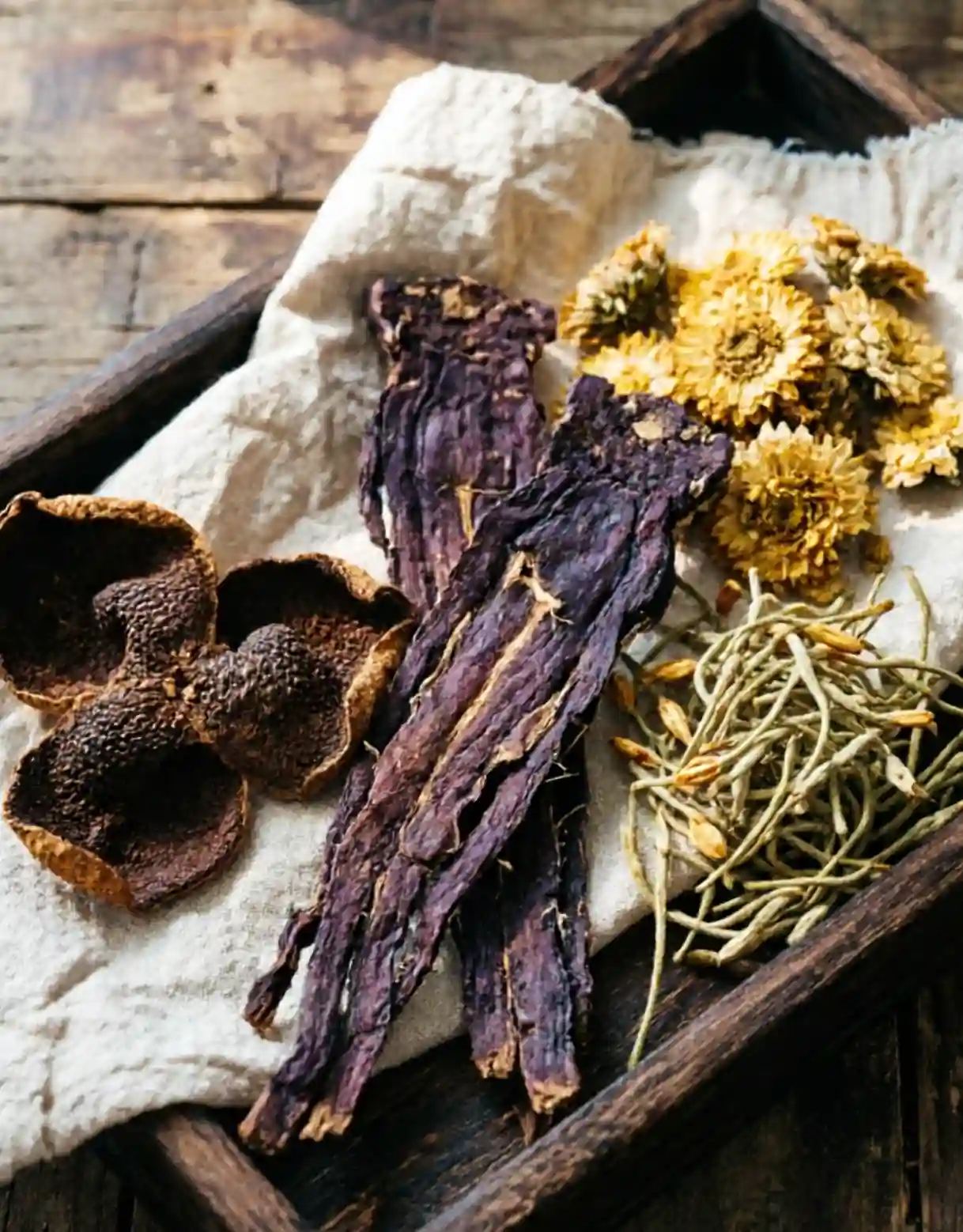
This product is flat-cylindrical, slightly curved, 3-15 cm long, and 2-8 cm in diameter. The surface is brownish or grayish-brown, densely covered with imbricate (overlapping) fleshy scale leaves, usually with broken scale leaf tips. Heavy in weight, hard in texture, slightly flexible, not easily broken; the fracture surface is brownish-brown with light brown punctate vascular bundles arranged in wavy annular lines. Odor: faint; Taste: sweet, slightly bitter.
Chemical Constituents
Contains echinacoside, verbascoside, acteoside, cistanoside A, cistanoside B, cistanoside C, cistanoside D, cistanoside E, cistanoside G, cistanin, mannitol, and other constituents.
Pharmacology
It can enhance humoral and cellular immune function; for the central nervous system, it increases the content of norepinephrine (NE) and 5-hydroxyindoleacetic acid (5-HIAA), and increases the ratio of dopamine (DA) to dihydroxyphenylacetic acid (DOPAC); it has the effect of delaying aging; it can significantly increase the small intestine propulsion rate in mice, shorten the time for defecation, effectively counteract the inhibitory effect of atropine on defecation, and also significantly inhibit the absorption of water in the large intestine. It has antihypertensive, antimutagenic and other effects. It has the effects of regulating endocrine, promoting metabolism and strengthening the body.
Properties and Channel Entry
Sweet, salty, and warm. Enters the Kidney and Large Intestine channels.
Functions and Indications
Tonifies Kidney Yang, nourishes Essence and Blood, and moistens the Intestines to unblock bowels
Dosage and Administration
Oral administration: decoct in water, 10-15 g; or made into pills or powder; or steeped in wine.
Precautions and Contraindications
For patients with hyperactive ministerial fire, loose stools, or constipation due to excess heat, use is contraindicated.
Prescriptions
1. For spermatorrhea: Roucongrong (Cistanche), Sangpiaoxiao (Ootheca Mantidis), and Qianshi (Euryale seed) 15 g each, Lianmi (lotus seed) 18 g, Heizhima (black sesame) 30 g. Grind into powder, form into honey pills. Take 9 g each morning and evening, swallowed with boiled water. (Zhang Jishu, *Jin Fang Xuan Ji*). 2. For strengthening tendons and marrow: Roucongrong (Cistanche) and shanyu (eel). Grind into powder, take with wine pills made with Huangjing (Polygonatum). Strength may increase tenfold. (*Ben Cao Shi Yi*). 3. For treating seminal depletion, dark complexion, and overwork damage: Roucongrong (Cistanche) 120 g, boil in water until thoroughly cooked, slice thinly and grind finely, mix with lean lamb meat in four portions, season with five spices, cook with rice to make porridge, take on an empty stomach. (*Yao Xing Lun*). 4. For treating Kidney deficiency with white turbidity: Roucongrong (Cistanche), Lurong (Cervus elaphus), Shanyao (Dioscorea), and Baifuling (Poria) in equal parts. Grind into powder, form into pills the size of wutong seeds using rice paste. Take 30 pills with jujube decoction each time. (*Sheng Ji Zong Lu*). 5. For treating conditions from sweating or promoting urination leading to fluid loss, severe constipation, suitable for the elderly and deficient individuals: Roucongrong (Cistanche, soaked in wine and baked) 60 g, Chenxiang (Aquilaria, ground separately) 30 g. Grind the above into fine powder, use juice from Maziren (hemp seed) to form into pills the size of wutong seeds. Take 70 pills on an empty stomach, swallowed with rice drink. (*Ji Sheng Fang*, Run Chang Wan).