Pinyin: Sangjisheng
Aliases
Yumu, Sangshangjisheng, Jishengshu, Jishengcao
Source
Plant of the Loranthaceae family: Taxillus chinensis (DC.) Danser.Taxillus chinensisDried leafy stems of (DC.) Danser.
Botanical Description
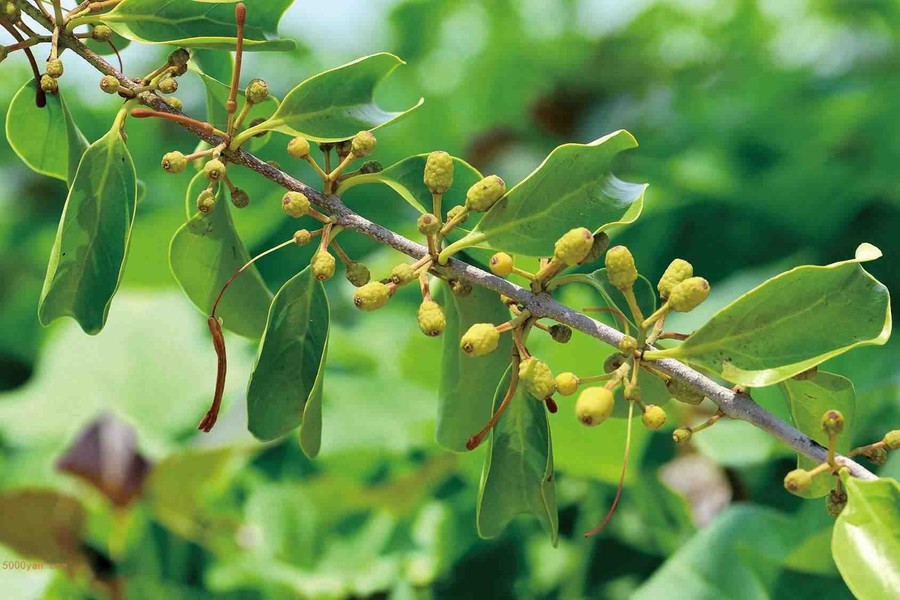
Shrub, 0.5-1 m tall. Young branches and leaves densely covered with rusty stellate hairs, sometimes with sparse, superimposed stellate hairs, later becoming glabrous; branchlets gray-brown, with small lenticels. Leaves opposite or subopposite; petiole 8-10 mm long. Leaf blade thickly papery, ovate to oblong-ovate, 2.5-6 cm long, 1.5-4 cm wide, apex rounded-obtuse, base cuneate to broadly cuneate; lateral veins 3-4 pairs, slightly distinct. Umbels, 1-2 axillary or on leafless axils of branchlets, with 1-4 flowers, usually 2, inflorescence and perianth with stellate hairs; peduncle 2-4 mm long; pedicel 6-7 mm long; bracts scaly; flowers brown; receptacle elliptic or ovoid; epicalyx annular; corolla tubular in bud, 2.5-2.7 cm long, slightly curved, lower half inflated, apex ovoid, lobes 4, spatulate, reflexed; filaments 2/3 shorter than anthers, anther cells with transverse septa; disk cup-shaped; style linear, stigma capitate. Berry ellipsoid or subglobose, pericarp densely with small tubercles, sparsely hairy, mature fruit pale yellow, up to 1 cm long, pericarp becoming smooth. Flowering and fruiting from April to January of the following year.
Habitat and Distribution
It grows in plains or low-mountain evergreen broad-leaved forests, parasitizing on various host plants such as mulberry, peach, plum, longan, lychee, carambola, oil tea, tung oil tree, rubber tree, banyan, kapok, masson pine, and Chinese swamp cypress. It is distributed in regions including Fujian, Guangdong, and Guangxi.
Harvesting and Processing
Harvested in winter to early spring, remove the thick stems, cut into sections, and dry, or dry after steaming.
Medicinal Properties
This stem and branch is cylindrical, 3-4 cm long, 0.2-1 cm in diameter; the surface is reddish-brown or grayish-brown, with fine longitudinal striations and numerous small raised brown lenticels, some young branches show brownish hairs; texture hard, fracture uneven, bark reddish-brown, wood lighter in color. Leaves mostly curled, with short petioles; after flattening, leaves are ovate or elliptical, 3-8 cm long, 2-5 cm wide; surface yellowish-brown, young leaves with fine hairs, apex obtuse-rounded, base rounded or broadly cuneate, entire margin; leathery. Odor faint, taste astringent.
Chemical Constituents
This product primarily contains avicularin, D-catechin, quercetin, quercitrin, and other constituents.
Pharmacology
Has antihypertensive effects, increases coronary blood flow, improves myocardial contractility, also has diuretic and anti-pathogenic microorganism effects, and can inhibit hepatitis B virus.
Properties and Channel Entry
Bitter, sweet, and neutral. Enters the Liver and Kidney channels.
Functions and Indications
Tonifies the Liver and Kidneys, strengthens the sinews and bones, expels Wind-Dampness, and calms the fetus. Mainly indicated for lower back and knee soreness and pain, atrophied and weakened sinews and bones, hemiplegia, Wind-Dampness Bi pain, dizziness and vertigo, threatened miscarriage, and uterine bleeding with spotting and flooding.
Dosage and Administration
Oral: decocted in water, 10-15 g; or used in pills or powders; or steeped in wine; or taken as freshly squeezed juice. External use: appropriate amount, pounded and applied topically.
Prescriptions
1. For dysenteric diarrhea with pus and blood, six pulses minute and weak, without chills or fever: Sangjisheng 60 g, Fangfeng and Chuanxiong 7.5 g each, honey-fried Gancao 9 g. Grind into powder, take 6 g per dose with one cup of water, decoct to eight-tenths, and take with the dregs. (From *Yangshi Huming Fang*) 2. For incessant bleeding followed by deficiency and fatigue of the primordial Qi in the lower abdomen, heavy and weak sensation in the lower back and knees: Grind Sangjisheng into powder, take 3 g per dose with plain boiled water at any time. (From *Yangshi Huming Fang*) 3. For postpartum insufficient lactation: Sangjisheng 90 g, finely cut and crushed, pound and sieve. Take 9 g per dose with one cup of water, decoct to seven-tenths, remove dregs, and take warm, regardless of time. (From *Puji Fang*, Jisheng Tang) 4. For habitual miscarriage: Tusizi (stir-fried) 120 g, Sangjisheng 60 g, Chuangxuduan 60 g, and true Ejiao 60 g. Grind the first three ingredients into fine powder, dissolve Ejiao in water to form pills weighing 0.3 g each. Take 20 pills with boiled water, twice daily. (From *Yixue Zhong Zhong Can Xi Lu*, Shoutai Wan)