Pinyin: Kumu
Aliases
Huanglianbanshu, Xiongdanshu, Yudanshu, Kudanmu.
Source
Simaroubaceae plant Picrasma quassioidesPicrasma quassioidesDried branches and leaves of (D.Don) Benn.
Botanical Description
Deciduous shrub or small tree, 7-10 m tall. Bark gray-black, young branches gray-green, glabrous (hairless), with distinct yellow lenticels. Odd-pinnate compound leaves alternate, often clustered at branch tips, 20-30 cm long; leaflets 9-15, ovate-lanceolate to broadly ovate, 4-10 cm long, 2-4 cm wide, apex acuminate, base broadly cuneate, asymmetrical on both sides, margin irregularly serrate. Dichotomous cymes axillary, peduncle up to 12 cm long, densely pubescent; flowers polygamous, yellow-green; sepals 4-5, ovate, hairy; petals 4-5, obovate, about twice as long as sepals; stamens 4-5, inserted at base of 4-5-lobed disk; female flowers smaller than male, ovary ovoid, 4-5-loculed, styles 4-5, twisted together, basally connate. Drupe obovoid, fleshy, blue to red, 3-4 borne together, with persistent calyx at base. Flowering April-May, fruiting August-September.
Habitat and Distribution
It grows in moist and fertile mountainous areas, forest edges, streamsides, and roadsides below 2400 m elevation. It is distributed throughout the regions south of the Yellow River.
Harvesting and Processing
Harvested in summer and autumn, then dried.
Medicinal Properties
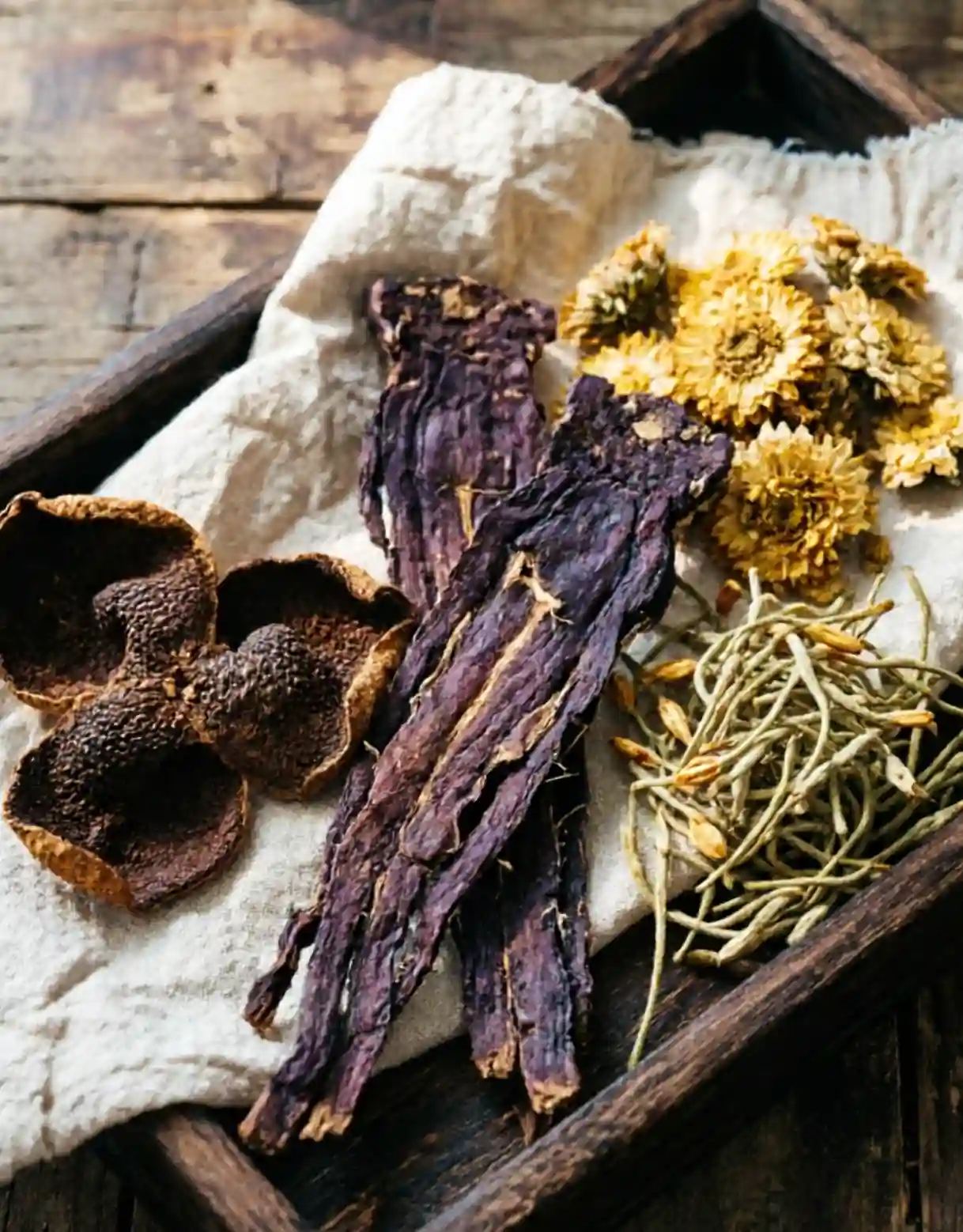
The branches are cylindrical, varying in length, with a diameter of 0.5-2 cm; the surface is grayish-green or brownish-green, with fine longitudinal wrinkles and numerous dotted lenticels; texture is fragile, easily broken, the fracture is uneven, pale yellow, with the young branches having a lighter color and larger pith. The leaves are odd-pinnate compound, easily shed; leaflets are ovate-oblong or ovate-lanceolate, nearly sessile, 4-16 cm long, 1.5-6 cm wide; apex acute, base oblique or slightly rounded, margin with obtuse teeth; both surfaces are usually green, some with a pale purplish-red lower surface, with soft hairs along the midrib. Odor: faint; Taste: extremely bitter.
Chemical Constituents
Contains quassine A-I, quassine C-E, quassinolides A-M, as well as quassin and methylquassin.
Pharmacology
It can increase gastrointestinal blood flow and has anticancer effects
Properties and Channel Entry
Bitter, cold; slightly toxic. Enters the Lung and Large Intestine channels.
Functions and Indications
Clears Heat and resolves toxicity, eliminates Dampness. Used for Wind-Heat common cold, sore throat and swelling, Damp-Heat diarrhea and dysentery, eczema, boils and furuncles, snake and insect bites.
Dosage and Administration
Oral: decoct in water, 6-15 g, or up to 30 g in large doses; or made into pills or powder
Precautions and Contraindications
This product is somewhat toxic and should not be taken in excessive amounts for internal use. Use with caution during pregnancy.
Prescriptions
1. For amebic dysentery: 15 g of Picrasma quassioides stems and branches, 15 g of pomegranate peel, 9 g of bamboo-leaf prickly ash root. Decoct in water and take in 2 divided doses. (Zhejiang Flora Medica) 2. For bacillary dysentery: 9-15 g of Picrasma quassioides stems and branches. Grind into powder and swallow in 3-4 divided doses. (Zhejiang Flora Medica) 3. For local suppurative infections and prevention of traumatic infections: 500 g of Picrasma quassioides, pulverize and sieve, mix with 500 g of Vaseline to make an ointment. Clean the suppurative area with Picrasma quassioides water, then apply externally, 1-2 times daily. [Chinese Herbal Medicine Communications, 1977, (9): 28] 4. For boils, tinea corporis, and eczema: An appropriate amount of Picrasma quassioides stems, decoct in water for external washing. (Guangxi Selected Herbal Prescriptions)

