Pinyin: Guijianyu
Aliases
Weimao, Silengshu, Jianzhongxiao, Mayao.
Source
Celaenaceae plant *Euonymus alatus* (Thunb.) Sieb.Euonymus alatusDried winged branches or wing-like appendages of (Thunb.) Sieb.
Botanical Description
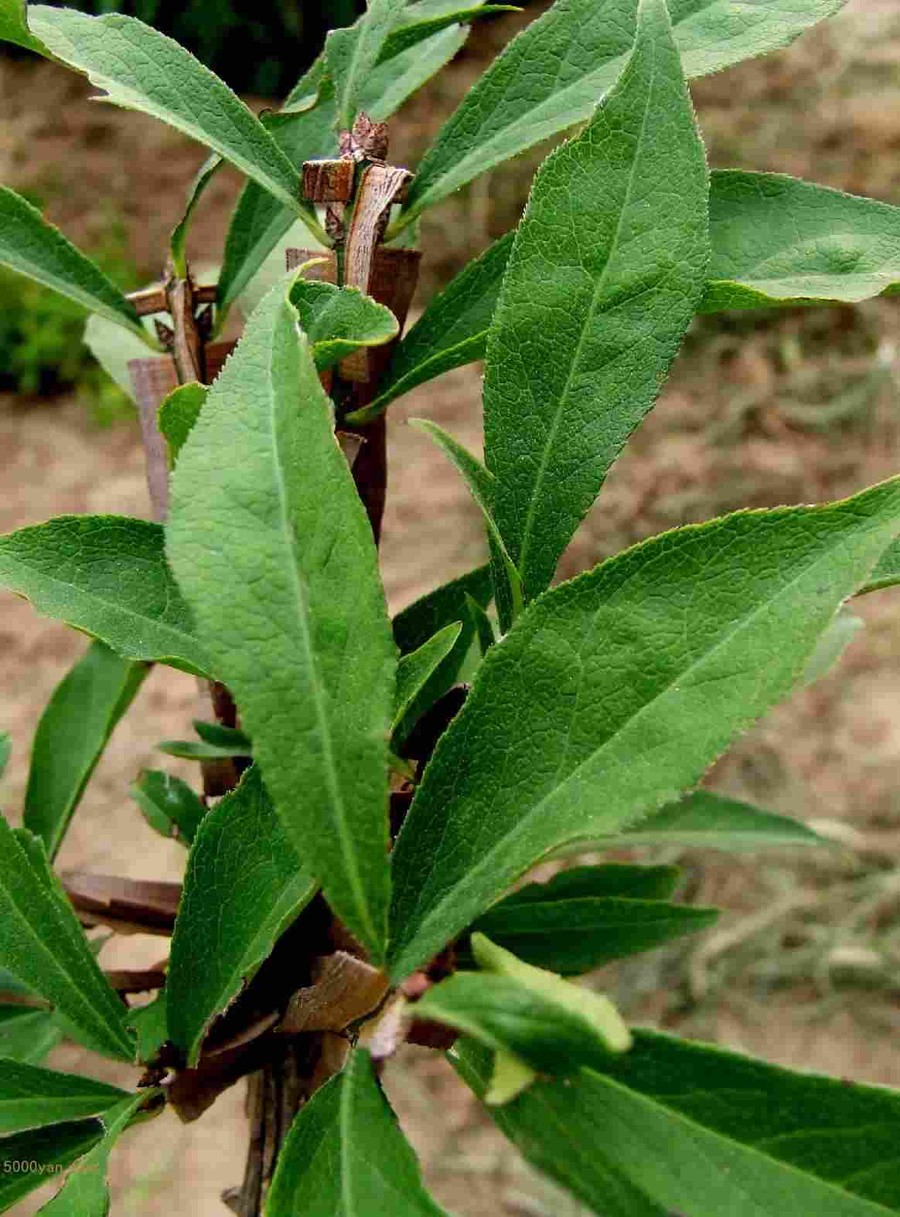
Deciduous shrub, glabrous (hairless), 2-3 m tall, much branched. Branchlets usually quadrangular, often with corky flattened wing-like ridges on the angles, wings about 1 cm wide or wider. Leaves simple, opposite; petiole very short; leaf blade thin, somewhat membranous, obovate, elliptic to broadly lanceolate, 2-6 cm long, 1.5-3.5 cm wide, apex shortly acuminate or acuminate, margin finely serrate, base cuneate to broadly cuneate, upper surface dark green, lower surface pale green. Cymes axillary, with 3-9 flowers; flowers small, bisexual, pale yellow-green, about 3 mm in diameter; calyx 4-lobed, lobes semiorbicular, margin with irregular hairy teeth; petals 4, suborbicular, margin sometimes slightly undulate; stamens 4, filaments short, inserted on a thick, quadrangular disc, disc adnate to the ovary. Capsule ellipsoid, green or purple, 1-3-locular, separating. Seeds ellipsoid or ovoid, pale brown, surrounded by an orange-red aril. Flowering period May to June, fruiting period September to October.
Habitat and Distribution
Born in the wild. Distributed in Northeast China and Hebei, Shaanxi, Gansu, Shandong, Jiangsu, Anhui, Zhejiang, Hubei, Hunan, Sichuan, Guizhou, Yunnan, and other regions.
Harvesting and Processing
Harvested year-round; after cutting the branches, the tender branches are collected and dried in the sun, or the winged parts are collected and dried in the sun.
Medicinal Properties
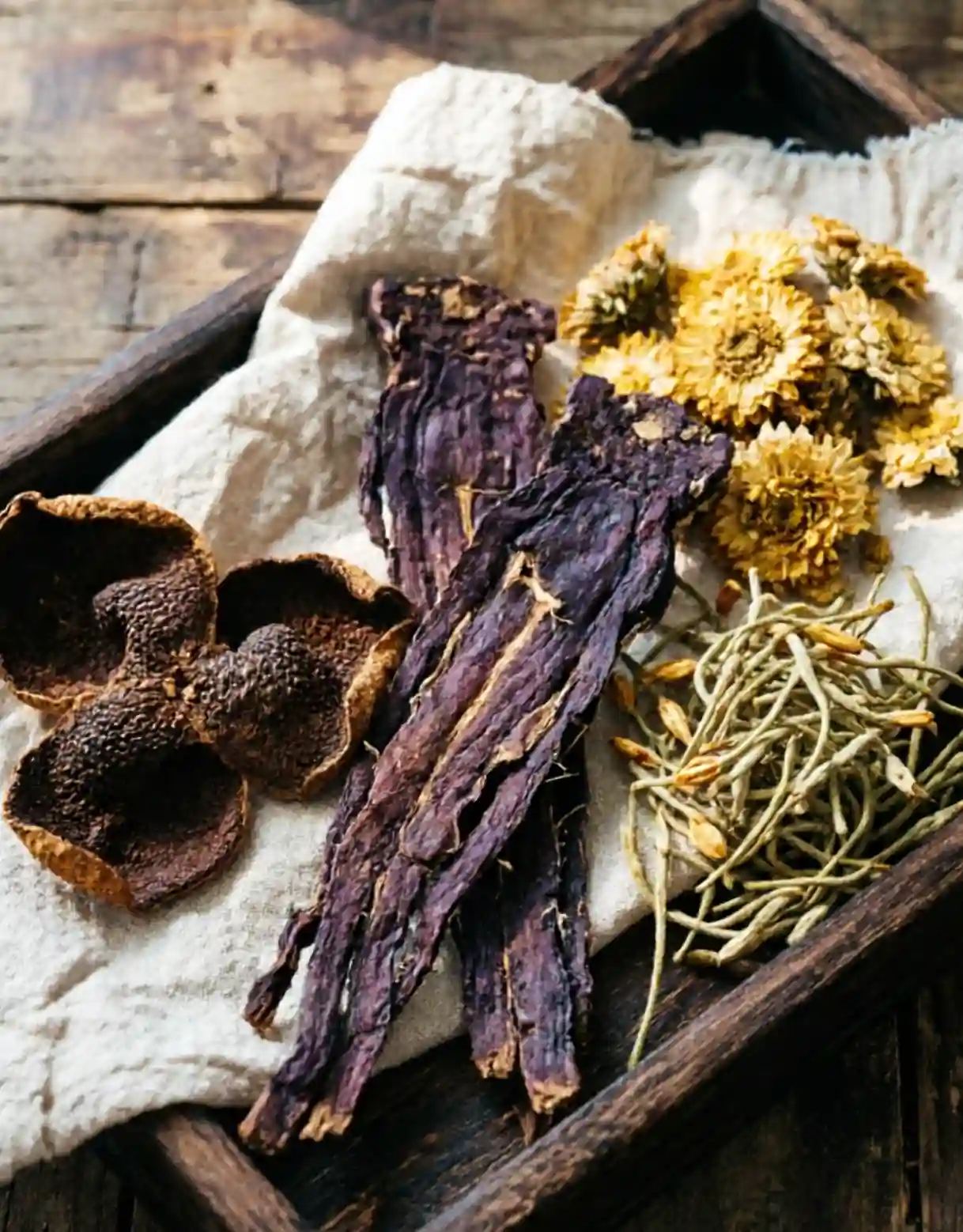
This product consists of cylindrical branches with wing-like structures, branching at the top, approximately 40-60 cm long, with branch diameters of 2-6 mm. The surface is relatively rough, dark grayish-green to grayish-yellow-green, with longitudinal striations and lenticels that are longitudinal, grayish-white, slightly raised and slightly rolled outward. The wing-like structures are flat, slightly thicker near the base, gradually thinning outward, 4-10 mm wide, about 2 mm thick, with a surface of deep grayish-brown to dark brownish-red, featuring fine, long, straight or slightly wavy longitudinal striations. The wings are easily peeled off, and broken marks are often seen on the branches. The branches are hard and tough, difficult to break, with a pale yellowish-white, coarse fibrous cross-section. Odor: faint; Taste: slightly bitter.
Chemical Constituents
This product mainly contains epifriedelanol, friedelin, quercetin, dulcitol, euonymine, wilfordine, oleic acid, linoleic acid, linolenic acid, caproic acid, acetic acid, and benzoic acid, among other components.
Pharmacology
Has the effect of regulating blood lipids and lowering blood sugar.
Properties and Channel Entry
Bitter, acrid, and cold. Enters the Liver and Spleen channels.
Functions and Indications
Breaks Blood and unblocks the menses, resolves toxicity and reduces swelling, kills parasites. Indicated for abdominal masses and nodules, heart and abdominal pain, amenorrhea, dysmenorrhea, metrorrhagia and metrostaxis, postpartum stasis and abdominal pain, lochiorrhea, hernia, migratory arthralgia and painful obstruction, sores and swelling, traumatic injury and pain, abdominal pain due to parasitic infestation, scalds and burns, and venomous snake bites.
Dosage and Administration
Oral: decoct 4-9 g in water; or steep in wine, or prepare as pills or powder. External use: appropriate amount, crush and apply, or wash with decoction; or grind into powder and mix for application.
Precautions and Contraindications
Pregnant women and those with Qi deficiency and uterine bleeding should not take this.
Prescriptions
1. For irregular menstruation: Guijianyu (Euonymus alatus) stem and branch 15 g, decoct in water, mix with brown sugar and take orally. (Hunan Materia Medica) 2. For metrorrhagia (heavy uterine bleeding): Guijianyu 10 g, Danggui (Angelica sinensis) 10 g, Gancao (Glycyrrhiza uralensis) 10 g, decoct in water, take 2 times daily. (Northeast Medicinal Plants) 3. For nephritis: Guijianyu stem bark 60 g, decoct in water, use the decoction to prepare egg tea and drink. (Henan Chinese Herbal Medicine Manual) 4. For common cold: Weimao (Euonymus alatus) stem and branch 30 g, decoct in water and take orally. (Fujian Materia Medica) 5. For dry cough: Guijianyu and Hongzao (jujube) each 30 g, decoct and take orally. (Zhejiang Folk Herbal Medicine)