Pinyin: Xiaotongcao
Aliases
Jingjiehua, Xiaotonghua, Shantongcao, Tongtiaoshu.
Source
1. For pneumonia: Renshen 6 g, decoct in water and take orally.Stachyurus chinensisDried stem pith of *Tetrapanax papyrifer* (Hook.) K. Koch.
Plant
Botanical Description
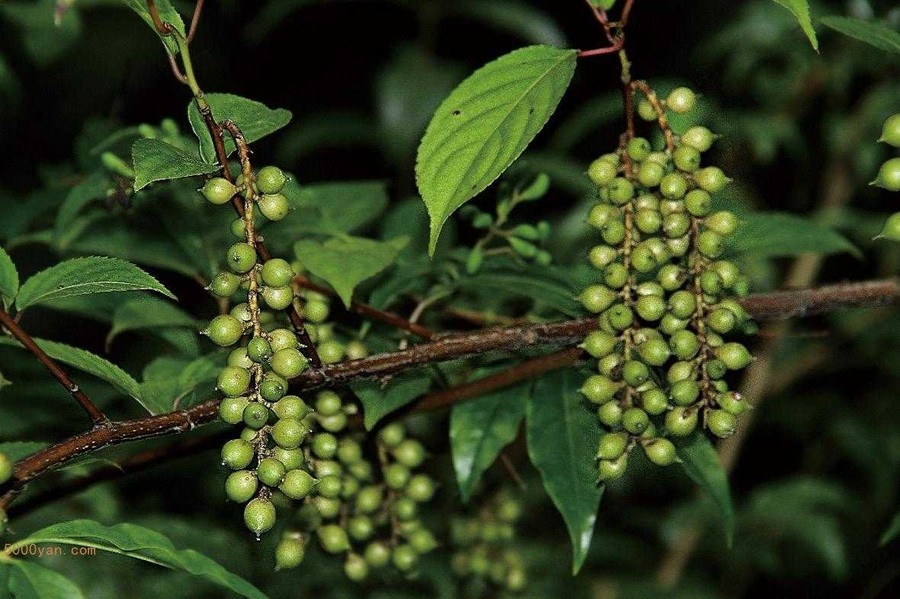
Deciduous shrub, 1.5-5 m tall. Leaves alternate; petiole 1-2.5 cm long; leaf blade papery, ovate or ovate-oblong, 6-15 cm long, apex abruptly acuminate or caudate, base broadly cuneate or rounded, margin sparsely serrate; lateral veins 5-6 pairs. Spike 3-10 cm long, with 15-20 flowers. Fruit 6 mm in diameter, fruit stalk about 2 mm long. Flowering period March to April, fruiting period June to July.
Habitat and Distribution
This is not a prescription or formula. It is a description of habitat and distribution. The correct translation is: Grows in valleys, streamsides, mixed forests, and thickets at elevations of 500-2500 m, distributed in the southwestern region and Shaanxi, Gansu, Anhui, Zhejiang, Jiangxi, Fujian, Hubei, Hunan, Guangdong, Guangxi, and other areas.
Harvesting and Processing
In autumn, cut the stems, cut into sections, remove the pith while fresh, straighten, and sun-dry.
Medicinal Properties
Cylindrical in shape, 30-50 cm long, 0.5-1 cm in diameter. The surface is white or pale yellow, without striations. The texture is light, soft, and pliable, deforming when squeezed, elastic, and easily broken. The fracture surface is flat, non-hollow, with a silvery-white luster. It feels sticky and slippery when soaked in water. Odor: faint; Taste: bland.
Chemical Constituents
The stem pith contains ash, fat, protein, crude fiber, pentosan, and uronic acid.αGalactose, glucose, xylose, galacturonic acid, various amino acids, and 18 trace elements including calcium, barium, magnesium, and iron.
Properties and Channel Entry
Sweet and bland, cold. Enters the Lung and Stomach channels.
Functions and Indications
Clears Heat, promotes urination, and promotes lactation. Used for difficulty in urination, strangury syndrome, and insufficient lactation.
Dosage and Administration
Oral: decoction, 3-6 g.
Precautions and Contraindications
Patients with Qi deficiency without Damp-Heat and pregnant women should use with caution.
Prescriptions
1. For yellow and red urine: Stachyurus praecox 6 g, Akebia quinata 4.5 g, Plantago asiatica 9 g (wrapped in cloth). Decoct and take. ("Anhui Chinese Materia Medica Annals") 2. For febrile agitation and dysuria: Stachyurus praecox 6 g, Gardenia jasminoides, Rehmannia glutinosa, Lophatherum gracile, Anemarrhena asphodeloides, Scutellaria baicalensis 9 g each. Decoct and take. ("Anhui Chinese Materia Medica Annals") 3. For acute urethritis: Stachyurus praecox 6 g, Kochia scoparia, Plantago asiatica (wrapped in cloth) 15 g each. Decoct and take. ("Anhui Chinese Materia Medica Annals") 4. For dysuria: Stachyurus praecox 15 g, Plantago asiatica 15 g, Acorus calamus 15 g, Juncus effusus 3 g, Gypsum Fibrosum 3 g. Decoct and take. ("Hunan Materia Medica") 5. For gonorrhea and dysuria: Talcum 30 g, Glycyrrhiza uralensis 6 g, Stachyurus praecox 9 g. Decoct in water and take. ("Gansu Chinese Herbal Medicine Manual") 6. For postpartum galactostasis: Stachyurus praecox 6 g, Vaccaria segetalis 9 g, Abelmoschus manihot root 12 g. Decoct in water and drink as tea. If due to blood deficiency with insufficient milk, add one pair of pig's trotters, stew until tender, remove the medicinal residue, and eat the meat and drink the broth. ("Anhui Chinese Herbal Medicine") 7. For insufficient lactation: Astragalus membranaceus 30 g, Angelica sinensis 15 g, Stachyurus praecox 9 g. Decoct in water. ("Gansu Chinese Herbal Medicine Manual") 8. For amenorrhea: Stachyurus praecox, Cyathula officinalis 9-15 g each. Decoct in water and take. ("Zhejiang Medicinal Flora")