Pinyin: Tongcao
Aliases
Kou Tuo, Bai Tong Cao, Da Tong Cao, Wu Jia Feng.
Source
Araliaceae plant Tetrapanax papyrifer.Tetrapanax papyriferDried stem pith of (Hook.) K.Koch.
Botanical Description
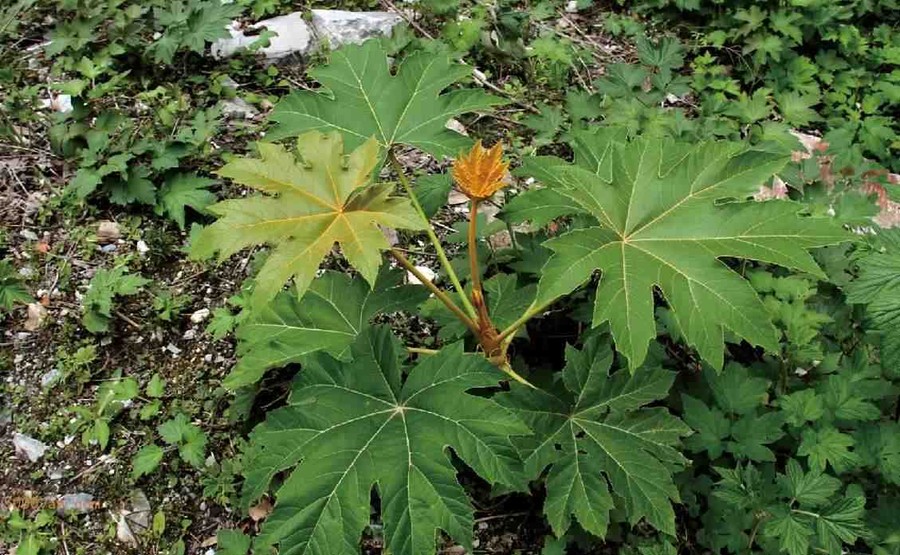
Evergreen shrub or small tree, 1-3.5 m tall. Stem thick, unbranched, densely covered with yellow stellate hairs or occasionally with deciduous gray-yellow soft hairs when young. Pith large, white, papery; bark dark brown, slightly fissured; new branches pale brown or pale yellow-brown, with distinct leaf scars and large lenticels. Leaves large, alternate, clustered at stem apex; petiole thick, cylindrical, 30-50 cm long; stipules membranous, conical, base adnate to petiole, with stellate thick tomentum; leaf blade papery or thinly leathery, palmately 5-11-lobed, lobes usually 1/3-1/2 of leaf length, rarely to 2/3, obovate-oblong or ovate-oblong, each lobe often with 2-3 small lobules, entire or with coarse teeth, dark green and glabrous above, densely white stellate-tomentose beneath. Umbels aggregated into terminal or subterminal large compound panicles, up to 50 cm long or more; calyx densely stellate-tomentose, entire or nearly entire; petals 4, rarely 5, triangular-ovate, 2 mm long, densely stellate-tomentose outside; stamens 5, same number as petals; ovary inferior, 2-loculed, styles 2, free, apex recurved. Fruit spherical, about 4 mm in diameter, purple-black when ripe. Flowering October to December, fruiting January to February of the following year.
Habitat and Distribution
It grows in sunny, fertile soil or is cultivated in gardens. It is distributed in the Southwest, Shaanxi, Jiangsu, Anhui, Zhejiang, Jiangxi, Fujian, Taiwan, Hubei, Hunan, Guangdong, Guangxi, and other regions.
Harvesting and Processing
In autumn, cut the stems, cut into sections, remove the pith while fresh, straighten, and sun-dry.
Medicinal Properties
This product is cylindrical in shape, 20-40 cm long and 1-2.5 cm in diameter. The surface is white or pale yellow with shallow longitudinal grooves. The body is light, soft and loose, slightly elastic, and easily broken; the fracture surface is flat. It exhibits a silvery-white luster, with a hollow or semi-transparent membrane in the center measuring 0.3-1.5 cm in diameter, arranged in a ladder-like pattern on the longitudinal section; solid specimens are rare. Odor: faint; Taste: bland.
Chemical Constituents
This product mainly contains ash, fat, pentosan, and uronic acid, among other components. It also contains 13 amino acids including aspartic acid, threonine, glutamic acid, and phenylalanine, as well as 18 trace elements such as calcium, barium, magnesium, and iron, along with lignin.
Pharmacology
Has a diuretic effect that promotes potassium excretion.
Properties and Channel Entry
Sweet and bland, slightly cold. Enters the Lung and Stomach channels.
Functions and Indications
Clears Heat, promotes urination, unblocks Qi, and promotes lactation. Used for Damp-Heat strangury syndrome, edema with reduced urination, and lactation failure.
Dosage and Administration
2-5 g, decocted for oral administration.
Precautions and Contraindications
Patients with Qi-Yin deficiency, without internal Damp-Heat, and pregnant women should use with caution.
Prescriptions
1. For Qi-Heat strangury with frequent, urgent, and painful urination, and lower abdominal distension and fullness: decoct Tetrapanax medulla in water and consume with scallions. (From Pu Ji Fang) 2. For edema, dysuria, and turbid urine: Tetrapanax medulla 9 g, Poria peel 9 g, Talcum 9 g, Alisma 9 g, and Atractylodes macrocephala 9 g. Decoct in water and take orally. (From Chang Yong Zhong Cao Yao Tu Pu) 3. For bladder heat accumulation causing urinary retention: Tetrapanax medulla 9 g, Plantago asiatica 9 g, Gentiana scabra 9 g, and Dianthus superbus 9 g. Decoct in water and take orally. (From Qu Jing Zhuan Qu Zhong Cao Yao) 4. For acute nephritis: Tetrapanax medulla 6 g, Poria peel 12 g, and Areca peel 9 g. Decoct in water and take orally. (From Zhe Jiang Yao Yong Zhi Wu Zhi) 5. For lingering Damp-Heat with dysuria: Tetrapanax medulla 3 g, Amomum cardamomum 3 g, Lonicera japonica 9 g, Coix seed 9 g, Talcum 12 g, and Prunus armeniaca 6 g. Decoct and take orally. (From An Hui Zhong Cao Yao) 6. For postpartum insufficient lactation: Tetrapanax medulla 9 g, stewed with pig trotters and consumed as soup; or Tetrapanax medulla 9 g and Vaccaria segetalis 4.5 g, decocted in water and taken orally. For those with weak constitution, add honey-fried Astragalus membranaceus 12 g and decoct together. (From Qing Dao Zhong Cao Yao Shou Ce) 7. For irregular menstruation: Tetrapanax medulla 6 g, Angelica sinensis tail 3 g, Prunus persica kernel 12 g, and Carthamus tinctorius 6 g. Decoct and take orally. (From Yun Nan Zhong Cao Yao Xuan) 8. For leukorrhea: Tetrapanax medulla stem pith 30-60 g. Stew with meat and consume. (From En Shi Zhong Cao Yao Shou Ce)