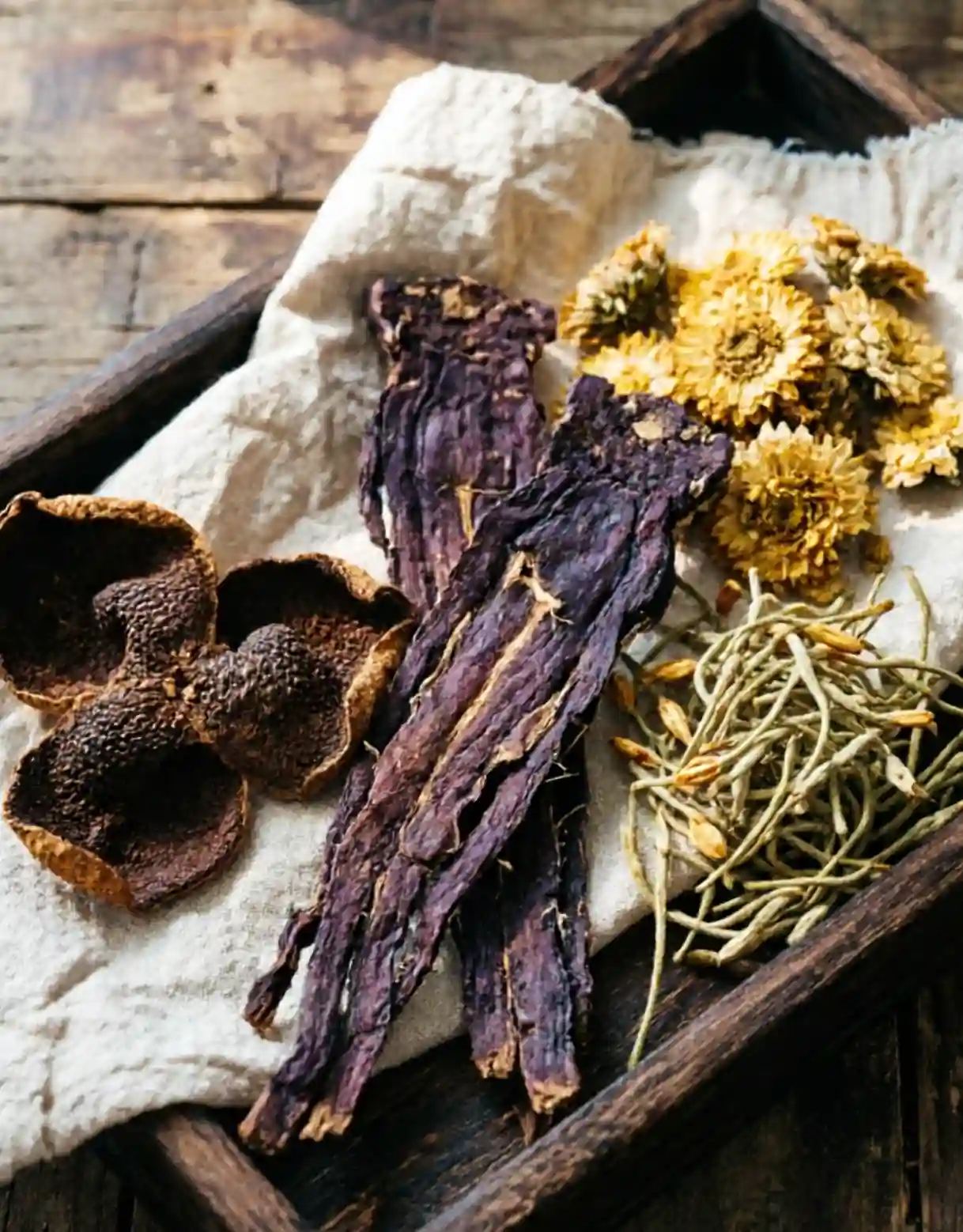
Pinyin: Shihu
Aliases
Linlan, Dulan, Qiannianzhu.
Source
Orchidaceae plant *Dendrobium nobile*.Dendrobium nobileLindl., Dendrobium chrysotoxumDendrobium chrysotoxumThe fresh or dried stems of cultivated varieties of Lindl. and its approximate species within the same genus.
Botanical Description
1. Dendrobium nobile (Jinchai Shihu): A perennial epiphytic herb. Stems clustered, erect, 30-50 cm tall, 1-1.3 cm in diameter. Yellow-green, multi-noded, internodes 2.5-3.5 cm long. Leaves nearly leathery, usually 3-5 at the stem apex; leaf blade oblong or oblong-lanceolate, 6-12 cm long, 1.5-2.5 cm wide, apex 2-round lobed, veins parallel, usually 9; leaf sheath tightly clasping the internode, 1.5-2.7 cm long; petiole absent. Raceme arising from stem nodes, usually with 2-3 flowers; bracts ovate, small, membranous; flowers large, pendulous, 6-8 cm in diameter; sepals and petals white, apex pale red; sepals 3, median sepal free, lateral sepals obliquely attached to the column foot, oblong, 3.5-4.5 cm long, 1.2-1.5 cm wide; petals ovate-oblong or elliptic, nearly as long as sepals, 2.1-2.5 cm wide; lip nearly round-ovate, born in front of the column foot, 4-4.5 cm long, 3-3.5 cm wide, apex rounded, base with a short claw, lower half reflexed surrounding the column, both surfaces pubescent, with a deep purple spot near the base center; column 6-7 mm long, including foot about 12 mm; stamens conical, anther 2-celled, pollinia 4, waxy. Capsule. Flowering period: May-June. 2. Dendrobium chrysotoxum (Guchui Shihu): A perennial epiphytic herb. Stem cylindrical, 50-200 cm tall, 5-15 mm thick. Upper part slightly curved, internodes 3-4 cm long. Leaves thin papery, lanceolate or oblong-lanceolate, apex acuminate; leaf sheath membranous, sheath mouth open cup-shaped. Leafless at flowering; umbel nearly without peduncle, with 2-6 flowers; flower bracts small, membranous; flowers yellow, slightly fleshy; median sepal oblong, 1.5-1.8 cm long, about 1 cm wide, apex obtuse; lateral sepals nearly falcate, slightly longer than median sepal; sepals sac short conical; petals obovate-oblong, distinctly wider than sepals, margin often toothed near apex; lip transversely oblong, both surfaces densely pubescent, disc with 2 blood-purple round spots on upper surface, 2 lamellae from base to near middle, margin with short fimbriae. Flowering period: May-September.
Habitat and Distribution
This text describes the habitat and distribution of two Dendrobium species, not a prescription or formula. It is not possible to translate it as a prescription. *Jinchai Shihu* (Dendrobium nobile) grows epiphytically on high mountain rocks or tree trunks in forests, distributed in Taiwan, Hubei, Guangdong, Guangxi, Sichuan, Guizhou, and Yunnan. *Guchui Shihu* (Dendrobium chrysotoxum) grows epiphytically on trees and rocks, distributed in Guangxi, Guizhou, Yunnan, and Xizang.
Harvesting and Processing
Harvested year-round. For fresh use: remove roots and sediment. For dry use: after harvesting, remove impurities, briefly blanch in boiling water or soften by baking, then alternately rub and sun-dry until the leaf sheaths are fully removed, then dry thoroughly.
Medicinal Properties
1. Fresh Dendrobium (Xian Shihu): Cylindrical or flat-cylindrical, approximately 30 cm long, 0.4-1.2 cm in diameter. Surface yellow-green, smooth or with longitudinal striations, nodes distinct and darker in color, with membranous leaf sheaths at nodes. Fleshy and juicy, easily broken. Odor: faint; Taste: slightly bitter with a sweet aftertaste, sticky when chewed. 2. Gold Dendrobium (Jinchai Shihu): Flat-cylindrical, 20-40 cm long, 0.4-0.6 cm in diameter, internodes 2.5-3 cm long. Surface golden yellow or yellow with greenish tint, with deep longitudinal grooves. Texture hard and brittle, fracture relatively flat and loose. Odor: faint; Taste: bitter. 3. Drumstick Dendrobium (Guchui Shihu): Thick spindle-shaped, central part 1-3 cm in diameter. With 3-7 nodes. Surface smooth, golden yellow, with distinctly raised ridges. Texture light and brittle, fracture spongy. Odor: faint; Taste: bland, sticky when chewed.
Chemical Constituents
This product contains crepidamine and dendrobine.N1. For pneumonia: Renshen 6 g, decoct in water and take orally. Internal use: decoct 3-10 g, large dose 10-30 g.
Pharmacology
It has a regulatory effect on smooth muscle; it inhibits the heart, and in large doses can reduce myocardial contractility, lower blood pressure, and inhibit respiration; it can enhance the body's immune function and delay aging. It not only delays the progression of cataracts but also has a certain therapeutic effect; it inhibits or corrects abnormal changes in enzyme activity; it moderately elevates blood sugar and also has mild analgesic and antipyretic effects.
Properties and Channel Entry
Sweet, slightly cold. Enters the Stomach and Kidney channels.
Functions and Indications
Benefits the Stomach, generates body fluids, nourishes Yin, and clears Heat. Used for fluid damage from febrile disease, dry mouth and vexing thirst, Stomach Yin insufficiency, reduced appetite and dry heaving, lingering deficiency fever after illness, Yin deficiency with blazing Fire, bone-steaming and consumptive fever, dim vision, and weak and limp sinews and bones.
Dosage and Administration
Oral: decoct in water, 6-15 g, double for fresh product; or prepare as pills or powder; or make into paste. Fresh Dendrobium has a stronger effect in clearing Heat and generating fluids, suitable for febrile diseases with fluid damage; dry Dendrobium is suitable for those with Stomach deficiency complicated by Heat damaging Yin.
Precautions and Contraindications
Contraindicated in the early stage of warm-heat diseases with undamaged Yin, in damp-warm diseases without dryness transformation, and in those with Spleen-Stomach deficiency-cold.
Prescriptions
1. For warm-heat with sweating, wind-heat transforming into fire, heat damaging body fluids, and warm malaria with black tongue coating: fresh Shihu (Dendrobium) 9 g, Lianqiao (Forsythia, heart removed) 9 g, Tianhuafen (Trichosanthes root) 6 g, fresh Shengdihuang (Rehmannia) 12 g, Maidong (Ophiopogon, heart removed) 12 g, Shenye (Panax ginseng leaf) 2.4 g. Decoct in water and take orally. (From "Treatise on Seasonal Diseases" Qingre Baojin Method) 2. For stomach fire ascending, causing chest vexation, palpitations, prolonged cases leading to atrophy with weakness of both legs and inability to walk: Shihu (Dendrobium) 30 g, Xuanshen (Scrophularia) 6 g. Decoct in water and take orally. (From "Records of Pattern Differentiation" Shihu Xuanshen Tang) 3. For lung-heat dry cough: Shihu (Dendrobium), Pipaye (Loquat leaf), and Gualoupi (Trichosanthes peel) each 9 g, Sheng Gancao (licorice) and Jiegeng (Platycodon) each 3 g. Decoct in water and take orally. (From "Zhejiang Medicinal Flora")

