Pinyin: Dengxincao
Aliases
Huxu cao, Deng cao, Tie deng xin
Source
1. For pneumonia: Renshen 6 g, decoct in water and take orally.Juncus effusesL. of the dried stem pith.
Botanical Description
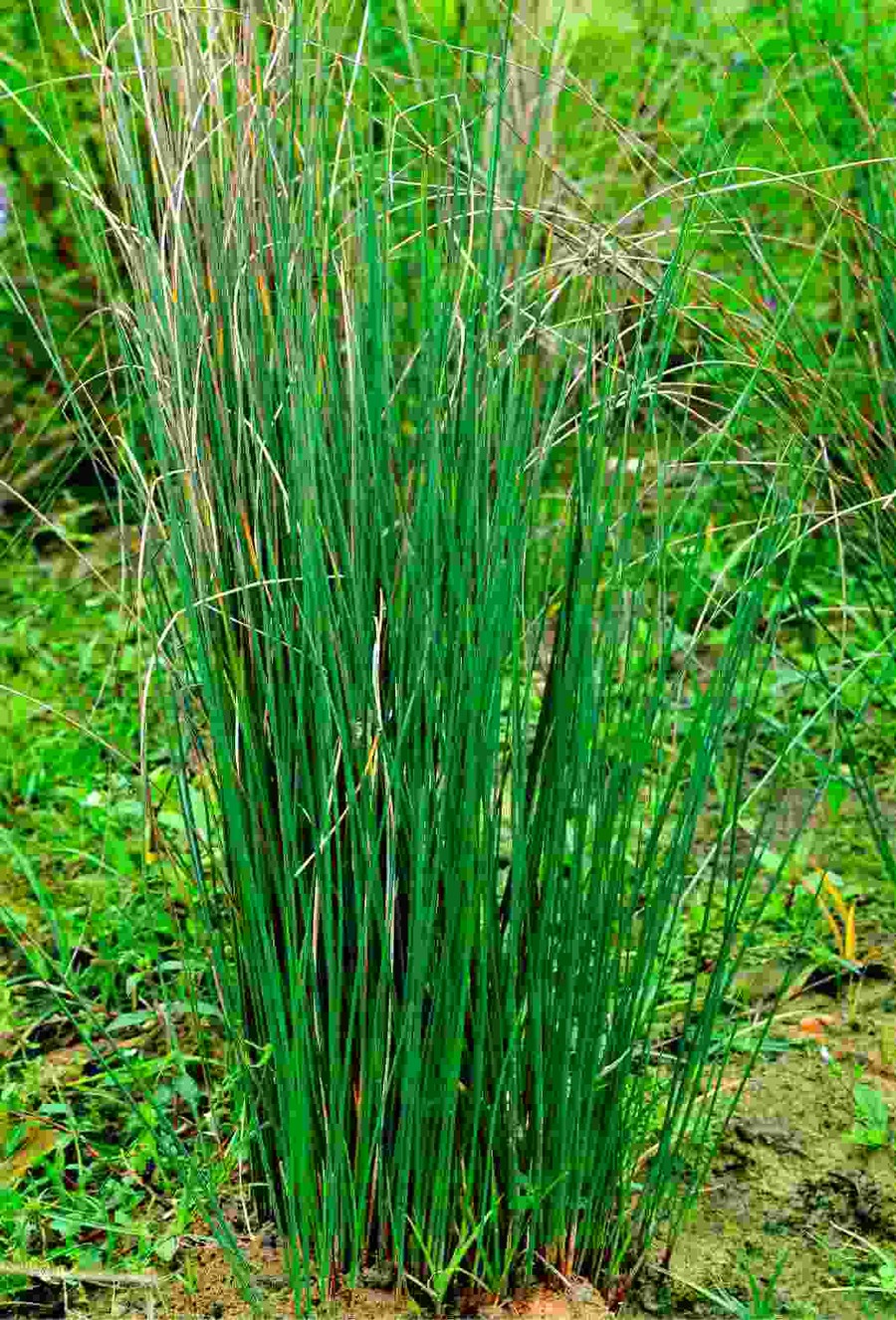
Perennial herb, 40-100 cm tall. Rhizomes creeping, densely covered with fibrous roots. Stems clustered, erect, slender columnar, 1.5-4 mm in diameter, filled with milky white pith occupying most of the stem. Leaf sheaths reddish-brown or pale yellow, up to 15 cm long; leaf blades reduced to awn-like structures. Inflorescences pseudolateral, cymose, many-flowered, dense or lax; bracts connected to the stem 5-20 cm long; flowers pale green, short-pedicelled, 2-2.5 mm long; perianth segments 6, linear-lanceolate, arranged in 2 whorls, outer whorl slightly longer, margins membranous, abaxially pubescent; stamens 3 or rarely 6, about 2/3 the length of the perianth, anthers slightly shorter than filaments; pistil 1, ovary superior, 3-locular, style very short, stigma 3. Capsule oblong, apex obtuse or slightly emarginate. Seeds numerous, ovoid-oblong, brown, about 0.4 mm long. Flowering June-July, fruiting July-October.
Habitat and Distribution
Grows in moist areas by water edges and field sides
Harvesting and Processing
Harvest the stem from late summer to autumn, dry in the sun, remove the stem pith, straighten, and bundle into small handfuls.
Medicinal Properties
This product is slender and cylindrical, up to 90 cm long, with a diameter of 0.1-0.3 cm. The surface is white or pale yellow-white with fine longitudinal wrinkles. It is light in weight, soft in texture, slightly elastic, easily broken, and the fracture surface is white. Odor: faint; Taste: bland.
Chemical Constituents
Contains juncusol, 6-methyljuncusol, juncunol, eugenol, and juncusone among other constituents.
Pharmacology
Has antioxidant and antimicrobial effects.
Properties and Channel Entry
Sweet and bland, slightly cold. Enters the Heart, Lung, and Small Intestine channels.
Functions and Indications
Clears Heart Fire, promotes urination. Used for vexation and insomnia, scanty urine with painful urination, and mouth and tongue sores.
Dosage and Administration
Oral: decoct in water, 1-3 g, fresh product 15-30 g; or made into pills or powder. For treating restlessness and insomnia, use mixed with cinnabar. External: appropriate amount, calcined and ground for sprinkling; or mash fresh product for application, bundle and rub externally.
Precautions and Contraindications
Contraindicated in patients with lower Jiao deficiency-cold and urinary incontinence.
Prescriptions
1. For heat stranguria: 15 g each of *Juncus effusus*, *Pteris multifida*, *Achyranthes bidentata* root, and *Lophatherum gracile*. Decoct in rice-washed water for oral administration. (Jiangxi Herbal Medicine) 2. For insomnia and vexation: 18 g of *Juncus effusus*. Decoct as tea for regular consumption. (Modern Practical Chinese Medicine) 3. For infantile night crying: Burn *Juncus effusus* to ash, mix with breast milk, and apply to the nipple for feeding. (Baoging Bencao Zhezhi) 4. For febrile convulsions in children: 120 g of *Juncus effusus* and 120 g of fresh bitter peach tree secondary bark. Pound together into a paste and apply to the forehead, palms, and soles. (Mindong Bencao) 5. For mastitis: 30 g of *Juncus effusus*. Decoct in meat broth, take warm, and induce sweating while resting. (Jiangxi Herbal Medicine) 6. For cystitis, urethritis, and nephritis edema: 30-60 g of fresh *Juncus effusus*, 60 g of fresh *Plantago asiatica*, 30 g of *Coix lacryma-jobi*, and 30 g of fresh *Lygodium japonicum* spores. Decoct in water for oral administration. (Henan Chinese Herbal Medicine Manual) 7. For jaundice: 15 g of fresh *Juncus effusus*, 30 g of *Lycium chinense* root, and 15 g of *Artemisia anomala*. Decoct in water, add sugar as needed, and take orally. (Henan Chinese Herbal Medicine Manual) 8. For diabetes: 60 g of *Juncus effusus* and 1 block of tofu. Stew in water for oral administration. (Fujian Materia Medica Records)